




TI Museum
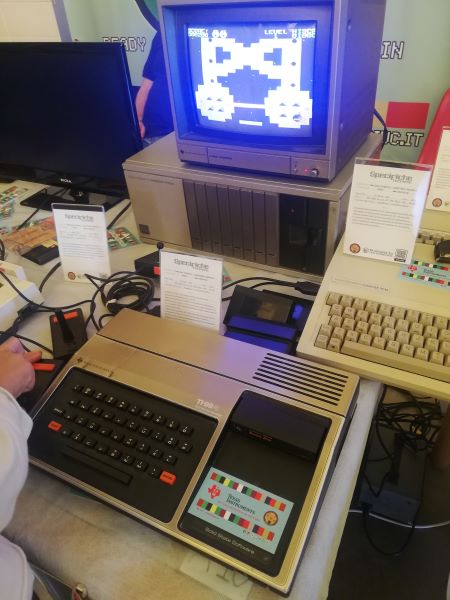 The commercial life of the TI-99/4 was however short with the announcement of its replacement with the 99 / 4A which would then be presented at the "Consumer Electronics Show", on June 30, 1981.
In order not to disappoint its customers, Texas Instruments offered to replace the old computer / 4 with the new Texas Instruments TI-99 / 4A totally free of charge but on the condition that the purchase of the / 4 had been at least 6 months before. of the release of the new model, only the shipping costs were charged to the customer.
The company T.I. tried to market the Texas Instruments TI-99/4 also in Italy and France, but due to delays, its distribution was immediately interrupted to make way for the / 4A already present in the US market. In any case, in Europe the 99/4 found no interest in the market also precisely because of the monitor alley which had a US NTSC standard and therefore problematic for European standards. Texas Instruments, strangely, never officially announced the discontinuation of the TI-99/4. In total, around 25,000 units were produced.
 TI-99/4 with inernal Speaker. In the end we also managed to get a nice TI-99/4 with internal speaker and volume control. In this photo a 32Kbyte memory expansion and an RS232 interface complete the set.
Here are the original manuals and the masks to use for playing or teaching.


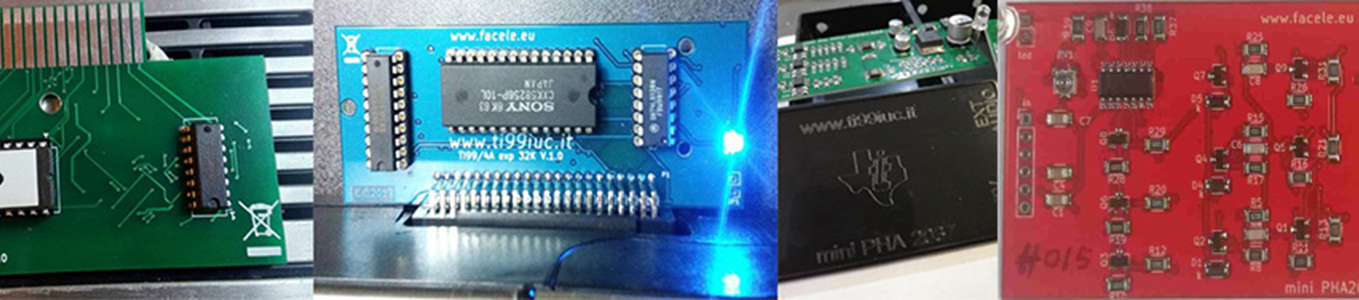
 A detail from the inside, the PCB with an operational amplifier, used to drive the internal speaker via the volume slider potentiometer, which is located on the bottom of the TI-99/4.


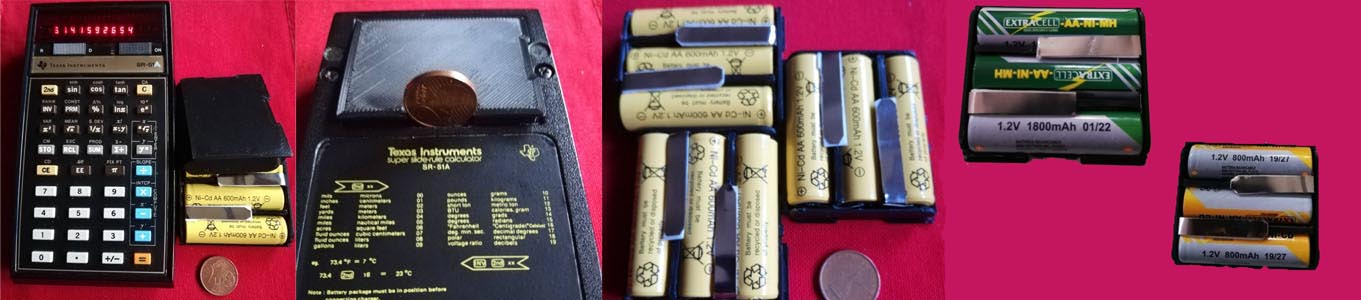
Compared to all the others, this version has a very important peculiarity to keep in mind: the power supply that provides the three voltages (+12vdc, +5vdc and -5vdc) is not located inside the computer but outside in a plastic box as shown in the photo.

It is important to note that the 4-pin connector has a different sized pin than the other 3 pins.
Home Computer TI-99/4A
Audio Guide

|
|

|
|
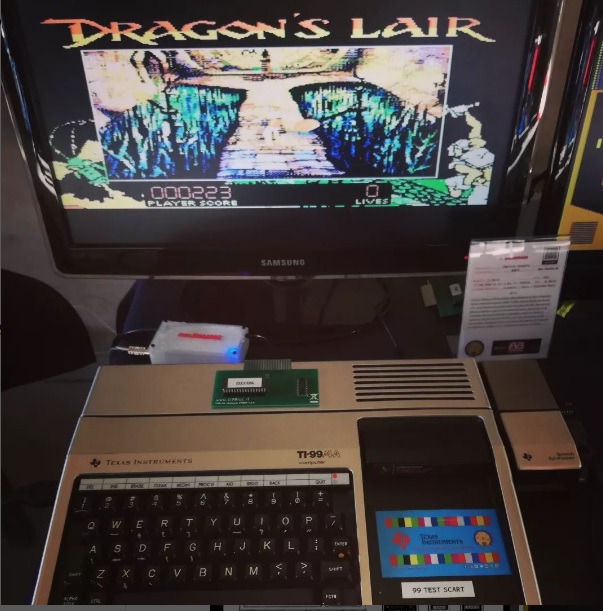 Home Computer TI-99/4A Enhanced version of the TI-99/4 model marketed at the end of 1979, it was placed on the market starting from June 1981, had a certain diffusion especially in the USA but due to the commercial war with Commodore International it was unable to achieve a significant number of sales, especially due to the success of the Commodore 64, and production ceased just two years after launch. It supports lowercase writing, unlike some machines of the time which required specific expansion, and a full-travel keyboard, and is based on the TMS-9900, a 16-bit CPU clocked at 3 MHz. The graphics are 16 colors with a video resolution of 256 x 192 pixels, organized in 32 columns x 24 rows, with characters (ASCII or user definable) based on 8 x 8 pixels.
Built around a single block, which contains the CPU, the motherboard and the cartridge slot (SSC Solid State Cartridge), it also had a 5.25" floppy disk drive, a serial card, among other options. RS-232 equipped with two serial ports and one parallel, a P-Code card for supporting the Pascal programming language, a thermal printer, an acoustic coupler, tape drives for saving and loading data (on normal cassettes), a pair of joysticks and a 32 kB memory expansion. The peculiarity of the machine was that it was sold already equipped with a monitor (a modified version of a 13" Zenith Color TV), as the RF adapter for connection to a normal TV it never obtained certification from the Federal Communications Commission. In Italy it was sold without a monitor and the video output was fully compatible with normal televisions. Another peculiarity for the time was the presence of an optional speech synthesizer, exactly like the one present in the Atari 2600, which allowed the software or games to be equipped with speech synthesis. The synthesizer was provided free of charge to customers after the purchase of a certain number of cartridges, and was widely used in several video games written by TI itself.
TI99-4A Main BOARD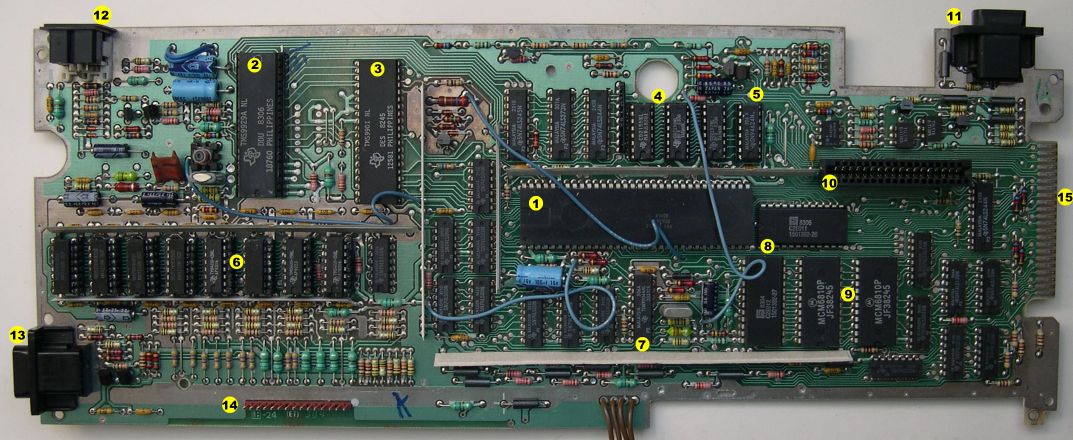 Released:June 1981 Price: US$525 (without monitor) How many:2.8 Million
CPU:TI TMS9900, 3MHz Memory:16K RAM, 26K ROM Sound: 3: channels + effect Joystick: 2
Display:Video via an RF modulator 32 characters by 24 lines text 192 X 256, 16 color graphics
Ports:ROM cartridge (on front) Data storage cassette Audio/Video output Joystick input CPU bus expansion
Peripherals:Speech Synthesizer Peripheral Expansion Box Data storage cassette 300 baud modem
OS:ROM BASIC
| 1 | TMS9900 CPU central process unit |
| 2 | TMS9918A VDP video display processor |
| 3 | TMS9901 HW Interface |
| 4 | Grom Chips CD2155/CD2156/CD2157 |
| 5 | TMS9919/SN94624 Sound Chips |
| 6 | 8 x TMS4116 RAM Chips |
| 7 | TMS9904 Clock Generator |
| 8 | 2 x 4k ROM chips (1501392-26) |
| 9 | 2 x 128 byte MCM6810P Scratch-pad RAM |
| 10 | Command Module Connector ( cartridges ) |
| 11 | Cassette Port |
| 12 | Video Port |
| 13 | Joystick Port |
| 14 | Keyboard Connector |
| 15 | Expansion Port |
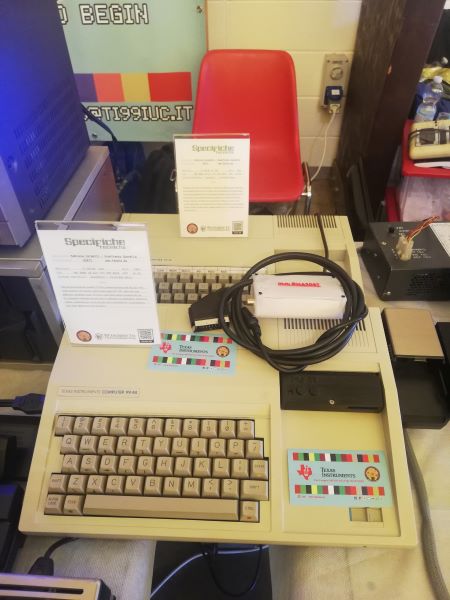 In August of 1983 TI released the TI-99/4A QI. Though this name was not official for the console, it was what the motherboard was designated. QI stood for Quality Improved. No visual changes were made to the exterior of the console, and in fact they are very hard to distinguish from the beige models. On the other hand, major changes were made to the internal components of the QI. We will take a look at these changes a little later.
One change that was made that created major grumbling was TI's decision to change the internal workings to lockout unlicensed ROM cartridges. This was done to keep other 3rd party companies from producing cartridges for the TI-99/4A. Not all QI consoles had this "feature", and even non QI, later beige consoles may have. It is easy to determine if you have the lockout or not. Look at the first screen (the one with the color bars) when you turn on the console, if you show a copyright date of 1981 you do not have the lockout, but if it shows a copyright date of 1983 then you do.

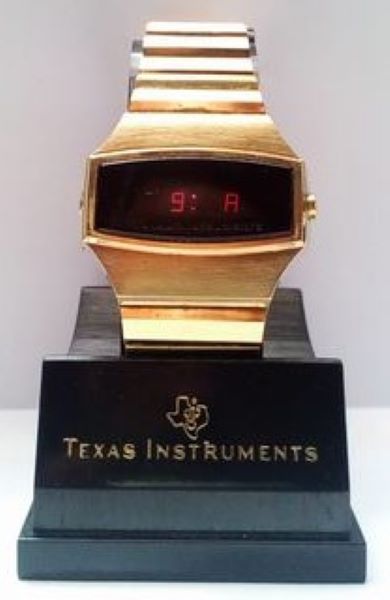
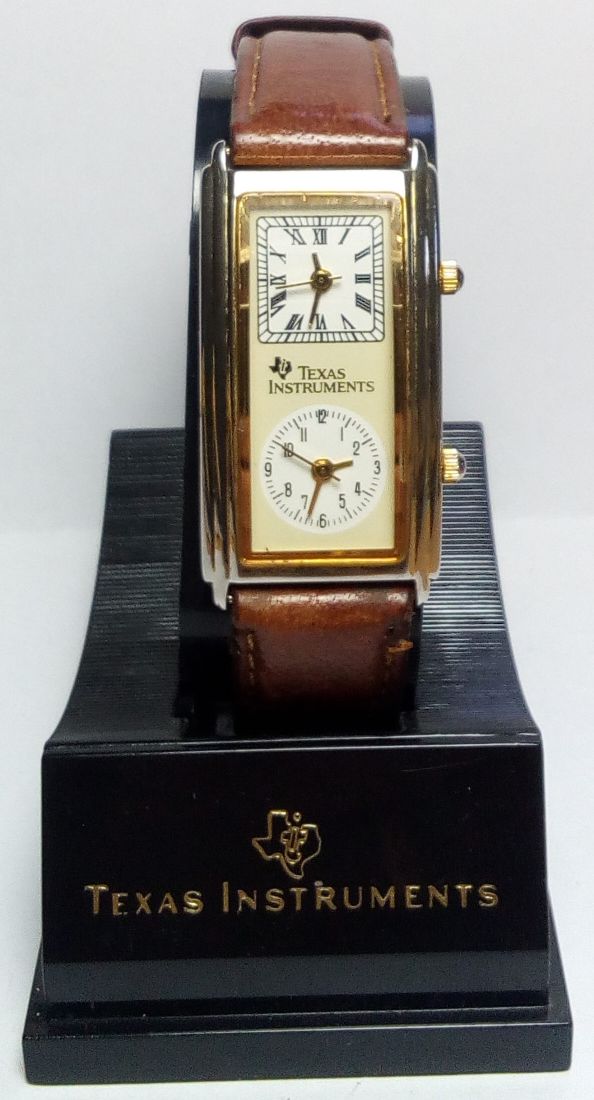
.jpg "Core Module Watch")

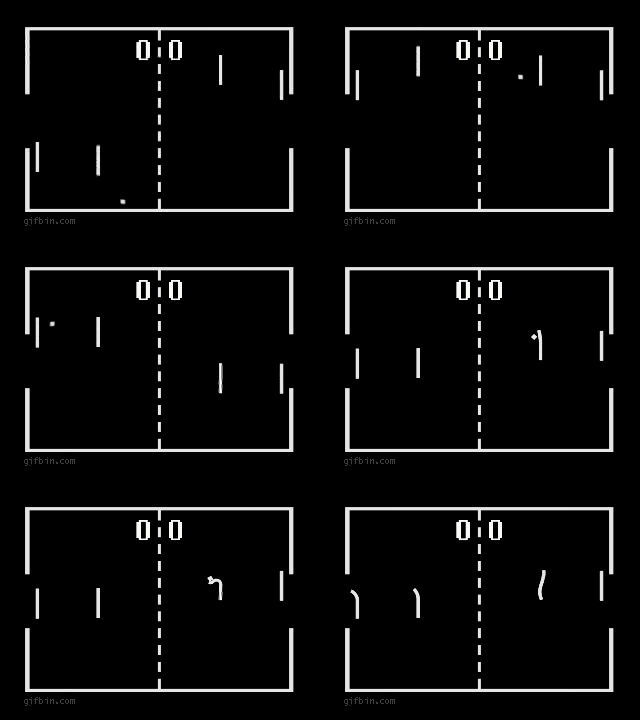
.jpg "Calculator Fuller")

.jpg "Olivetti Valentine")
.jpg "Console / Games")
.jpg "Battle Star Galactica")
.jpg "APPLE")


.png)