
TI Museum

 Model: Robot Logo
Battery: 4 x 1,5 C+ 2 x 9 volt
AC adapter:
Year: 1982
Chip: TMS5100 / MP3468 / CM62191
Info: Talking radio-controlled, 6 minutes of speech with more than 40 sentences, led lights and backward movement by pressing the remote control
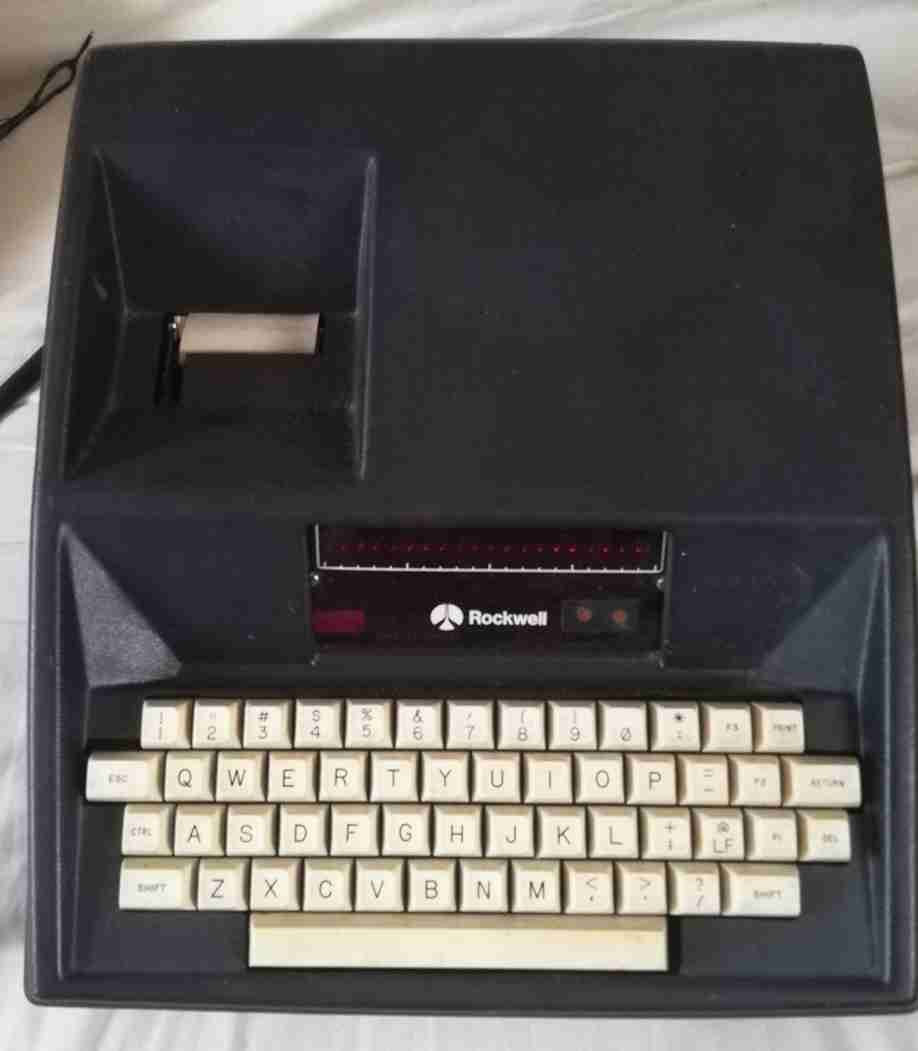
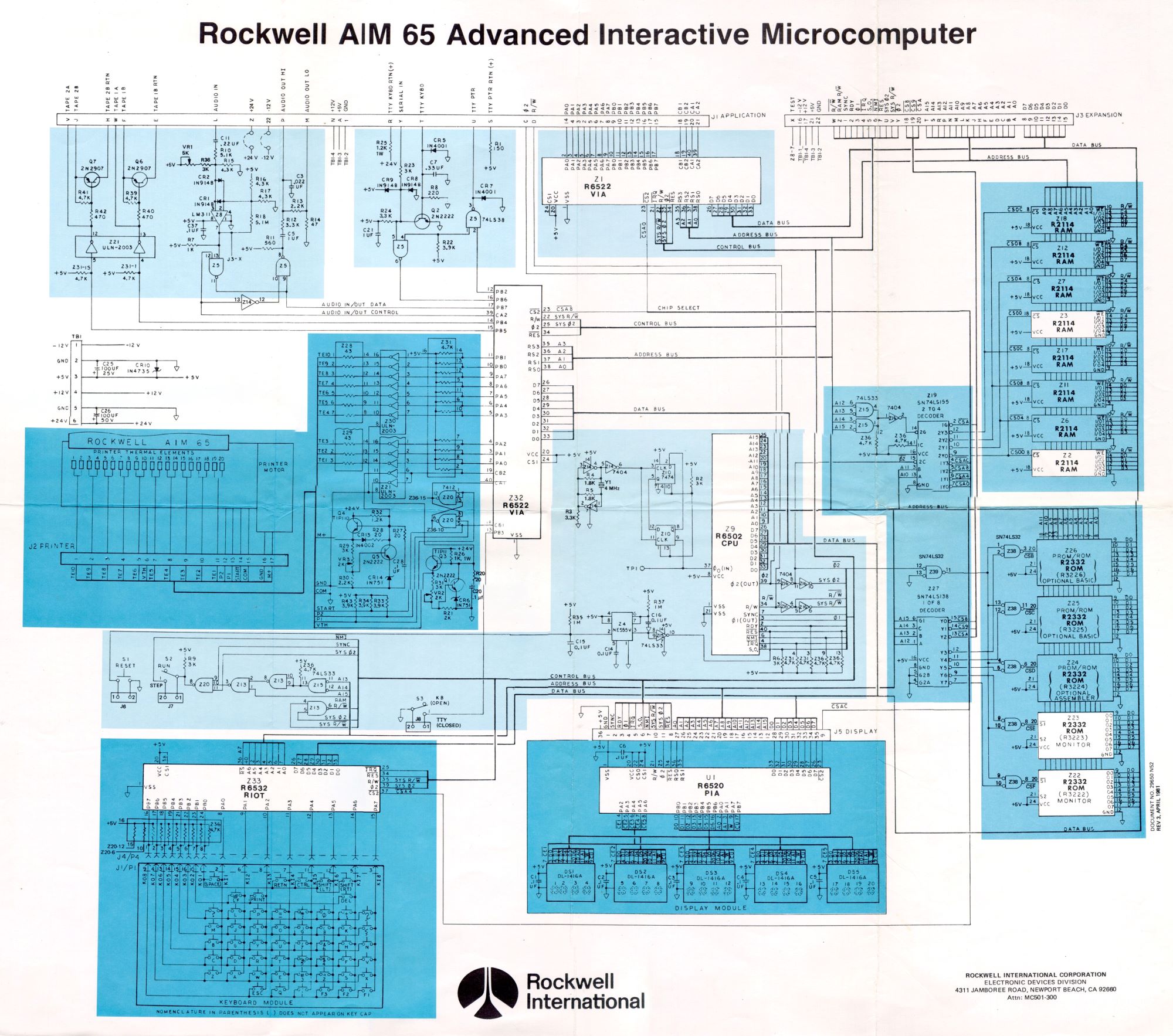
Rockwell The Rockwell AIM-65 computer is a development computer introduced in 1978 based on the MOS Technology 6502 microprocessor. The AIM-65 is essentially an expanded KIM-1 computer. Available software included a line-oriented machine code monitor, BASIC interpreter, assembler, Pascal, PL/65, and FORTH development system. Available hardware included a floppy disk controller and a backplane for expansion.
.jpg)
.jpg) The Rockwell AIM 65 (R6500 based Advanced Interactive Microcomputer) is a microcomputer based on the MOS Technology 6502 microprocessor manufactured by Rockwell International since 1976. It differed from the MOS KIM-1, the first of the microcomputers based on the MOS 6502, to be a system more advanced, also including a full keyboard and a small thermal paper printer. It was conceived as an educational development system, but it was in fact a versatile and economic tool.
The Rockwell AIM 65 (R6500 based Advanced Interactive Microcomputer) is a microcomputer based on the MOS Technology 6502 microprocessor manufactured by Rockwell International since 1976. It differed from the MOS KIM-1, the first of the microcomputers based on the MOS 6502, to be a system more advanced, also including a full keyboard and a small thermal paper printer. It was conceived as an educational development system, but it was in fact a versatile and economic tool.
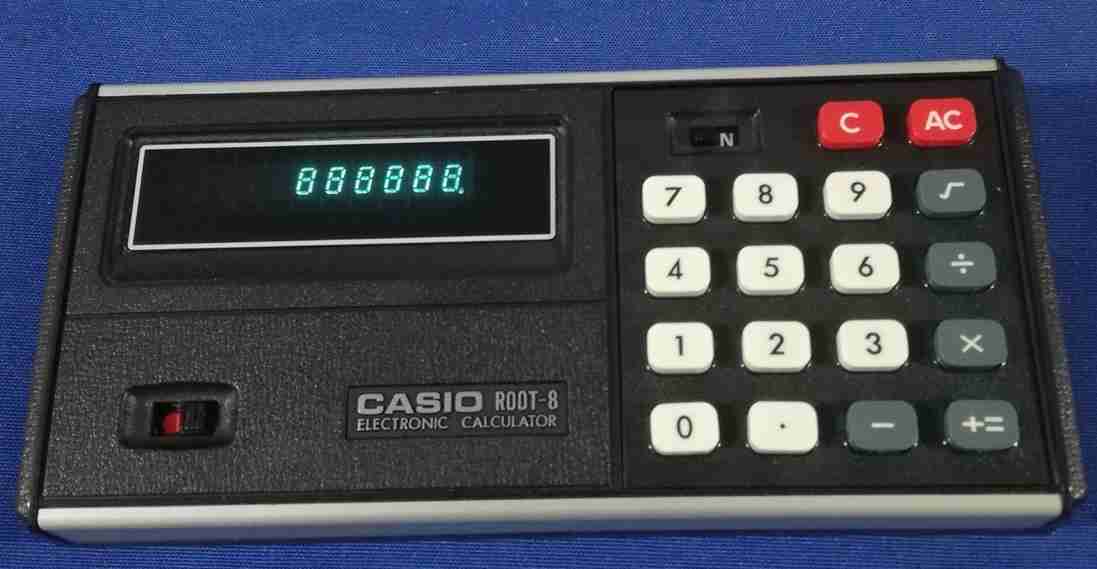
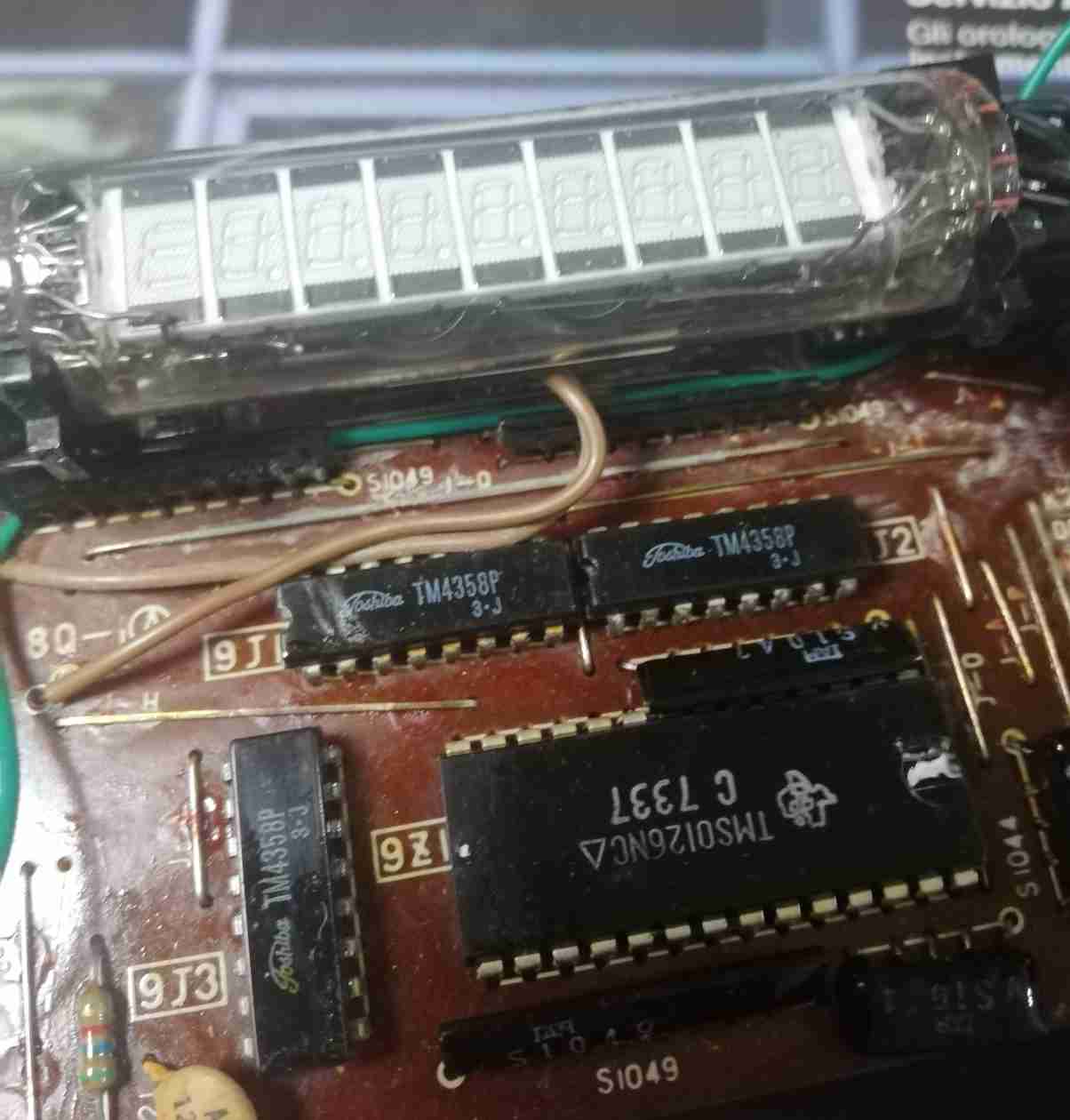 Model: ROOT-8
Battery: 4 x AA
AC adapter:
Year: 1973
Chip: TMS0126NC
Info: made in Japan
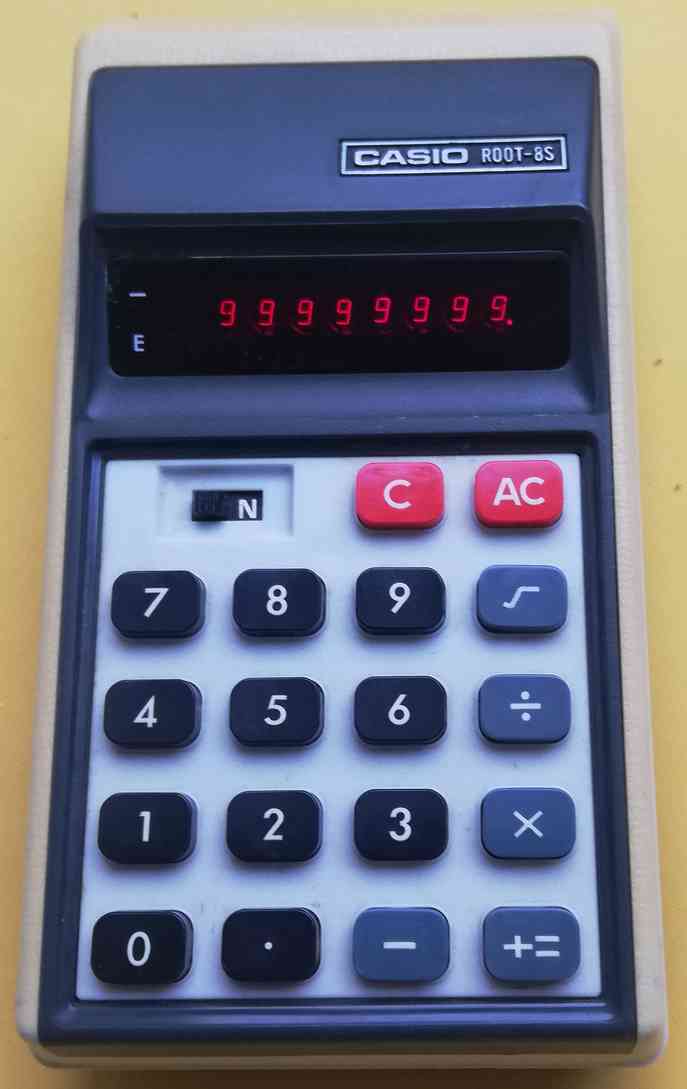 Model: ROOT-8S
Battery: 4 x AA
AC adapter: AD4145
Year: 1974
Chip: TMS0126NC
Info: made in Japan
RPN
Reverse Polish notation (RPN), also known as Polish postfix notation or simply postfix notation, is a mathematical notation in which operators follow their operands, in contrast to Polish notation (PN), in which operators precede their operands. It does not need any parentheses as long as each operator has a fixed number of operands. The description "Polish" refers to the nationality of logician Jan Łukasiewicz, who invented Polish notation in 1924.
The reverse Polish scheme was proposed in 1954 by Arthur Burks, Don Warren, and Jesse Wright and was independently reinvented by Friedrich L. Bauer and Edsger W. Dijkstra in the early 1960s to reduce computer memory access and use the stack to evaluate expressions. The algorithms and notation for this scheme were extended by the Australian philosopher and computer scientist Charles L. Hamblin in the mid-1950s.
During the 1970s and 1980s, Hewlett-Packard used RPN in all of their desktop and hand-held calculators, and continued to use it in some models into the 2020s. In computer science, reverse Polish notation is used in stack-oriented programming languages such as Forth, STOIC, PostScript, RPL and Joy.
Explanation
In reverse Polish notation, the operators follow their operands; for instance, to add 3 and 4 together, one would write 3 4 + rather than 3 + 4. If there are multiple operations, operators are given immediately after their second operands; so the expression written 3 − 4 + 5 in conventional notation would be written 3 4 − 5 + in reverse Polish notation: 4 is first subtracted from 3, then 5 is added to it. An advantage of reverse Polish notation is that it removes the need for parentheses that are required by infix notation. While 3 − 4 × 5 can also be written 3 − (4 × 5), that means something quite different from (3 − 4) × 5. In reverse Polish notation, the former could be written 3 4 5 × −, which unambiguously means 3 (4 5 ×) − which reduces to 3 20 − (which can further be reduced to -17); the latter could be written 3 4 − 5 × (or 5 3 4 − ×, if keeping similar formatting), which unambiguously means (3 4 −) 5 ×.
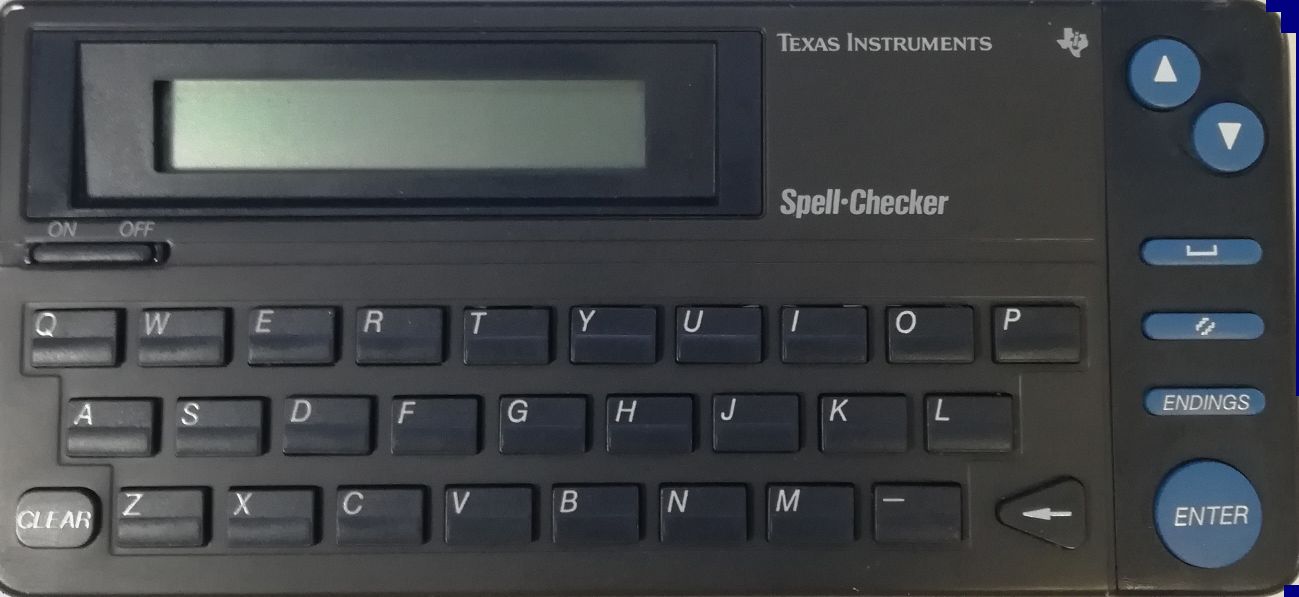 Model: RR-1 spell checker
Battery: 4 x AAA
AC adapter:
Year: 1981
Chip:
Info:
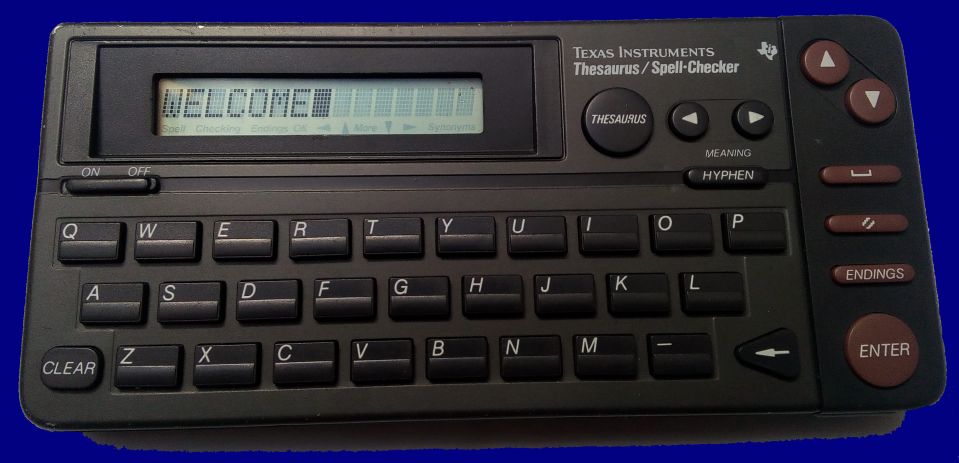 Model: RR-2 spell checker
Battery: 4 x AAA
AC adapter:
Year: 1989
Chip:
Info:
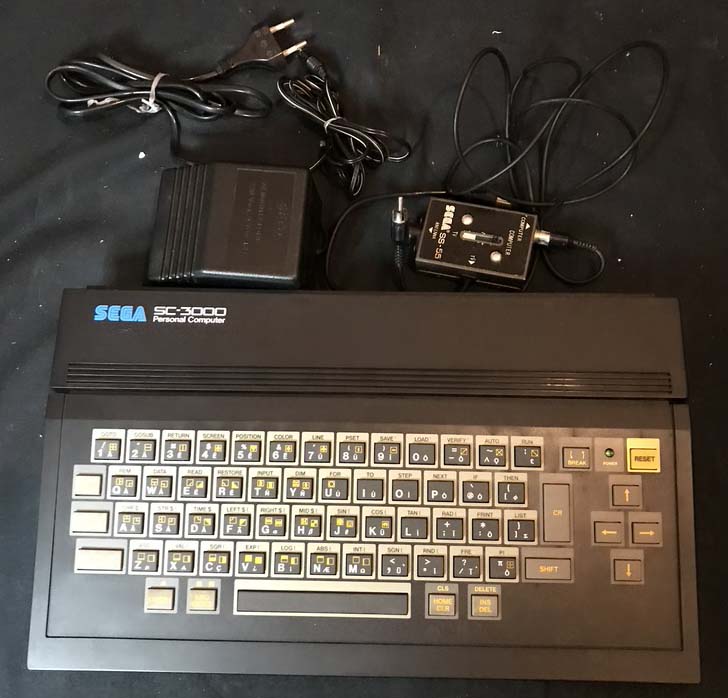 The SG-1000, also known as the Sega Game 1000 or Sega Mark I, is a home video game console manufactured by
 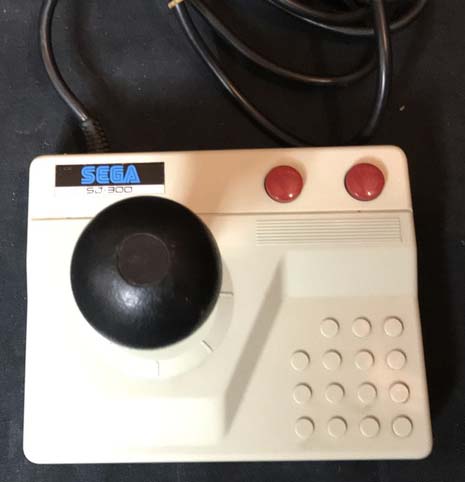 Sega and released in Japan, Australia, New Zealand, and other regions. It was Sega's first entry into the home video game hardware business. Introduced in 1983, the SG-1000 was released on the same day that Nintendo released the Family Computer in Japan. The SG-1000 was released in several forms, including the SC-3000 computer and the redesigned SG-1000 II released in 1984. A third iteration of the console, the Sega Mark III, was released in 1985. It provided a custom video display processor over previous iterations and served as the basis for the Master System in 1986,
 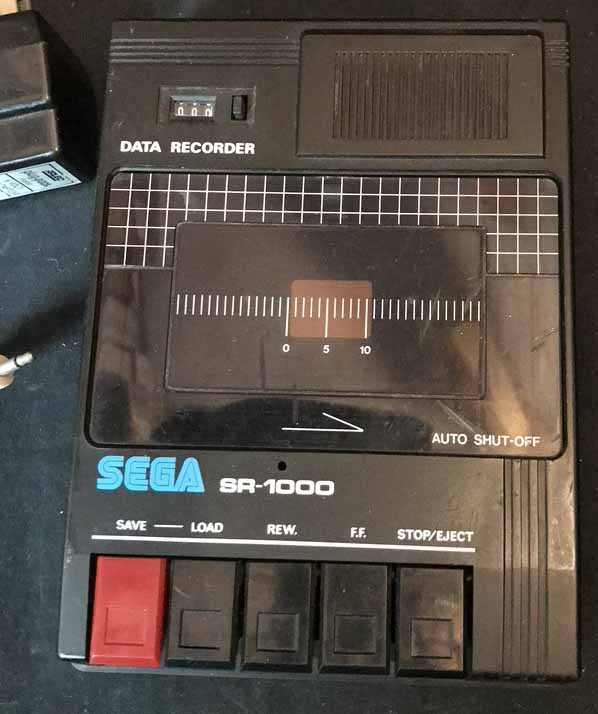 Sega's first internationally released console.
Developed in response to a downturn in arcades in 1982, the SG-1000 was created on the advice of Hayao Nakayama, president of Sega Enterprises, Ltd. Shortly after the release, Sega Enterprises was sold to CSK Corporation, which was followed by the release of the SG-1000 II. The SC-3000 and the SG-1000 line both support a library of 76 ROM cartridge games and 29 Sega My Card games, all of which are fully compatible with the Mark III and the Japanese version of the Master System.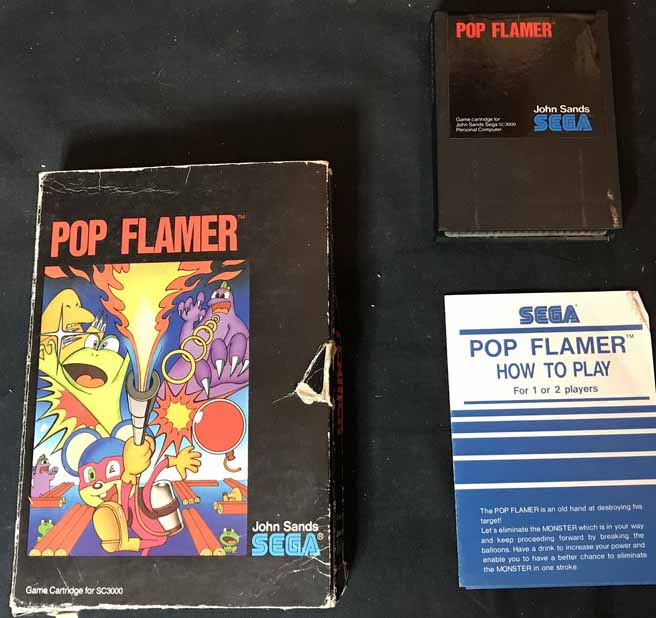
 SCART (also known as Péritel or Péritélévision, especially in France, 21-pin EuroSCART in marketing by Sharp in Asia, Euroconector in Spain, EuroAV or EXT, or EIA Multiport in the United States, as an EIA interface) is a French-originated standard and associated 21-pin connector for connecting audio-visual (AV) equipment. The name SCART comes from Syndicat des Constructeurs d'Appareils Radiorécepteurs et Téléviseurs, "Radio and Television Receiver Manufacturers' Association", the French organisation that created the connector in the mid-1970s. The related European standard EN 50049 has then been refined and published in 1978 by CENELEC, calling it péritelevision, but it is commonly called by the abbreviation péritel in French.
Schoenherr Gmbh
Schoenherr GmbH, Horb (Germany) was founded in 1974 by Mr. Schoenherr. He invented in 1975 the world’s first Braille element that could display and erase Braille characters. This patented invention was the prerequisite for developing Braille displays which enabled access to the world of computers for the blind. In 1980 Mr. Schoenherr was awarded with the Louis-Braille-Prize and Schoenherr GmbH introduced with the Braillotron TI-30, the first electronic calculator using a refreshable Braille cell for output. In 1981 he was killed in an accident and two years later the company was taken over by the "Deutsche Blindenstudienanstalt", a non-profit-organization in Marburg as EHG GmbH and was the production site for Braille displays. Since 1994 the company re-firmed as EHG Handy Tech Elektronik GmbH.
with permission of the author www.datamath.org
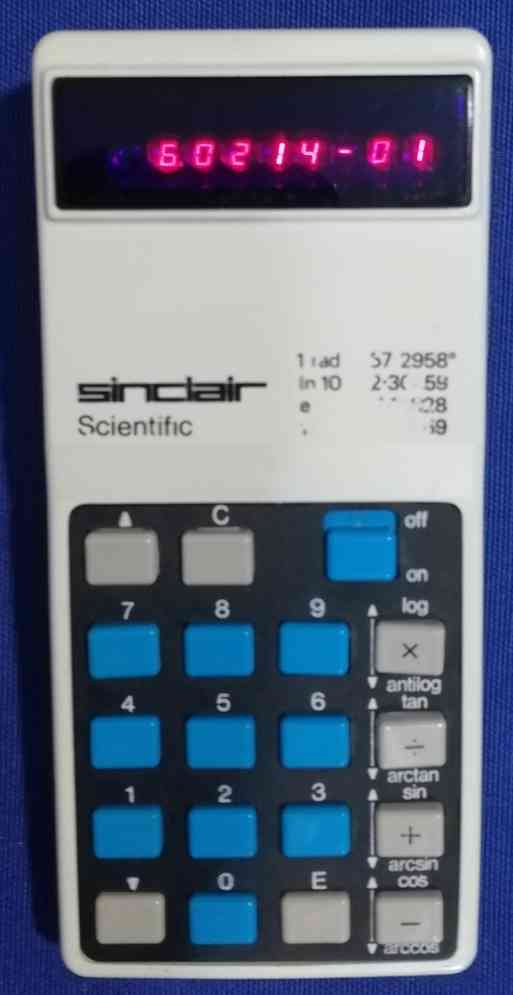
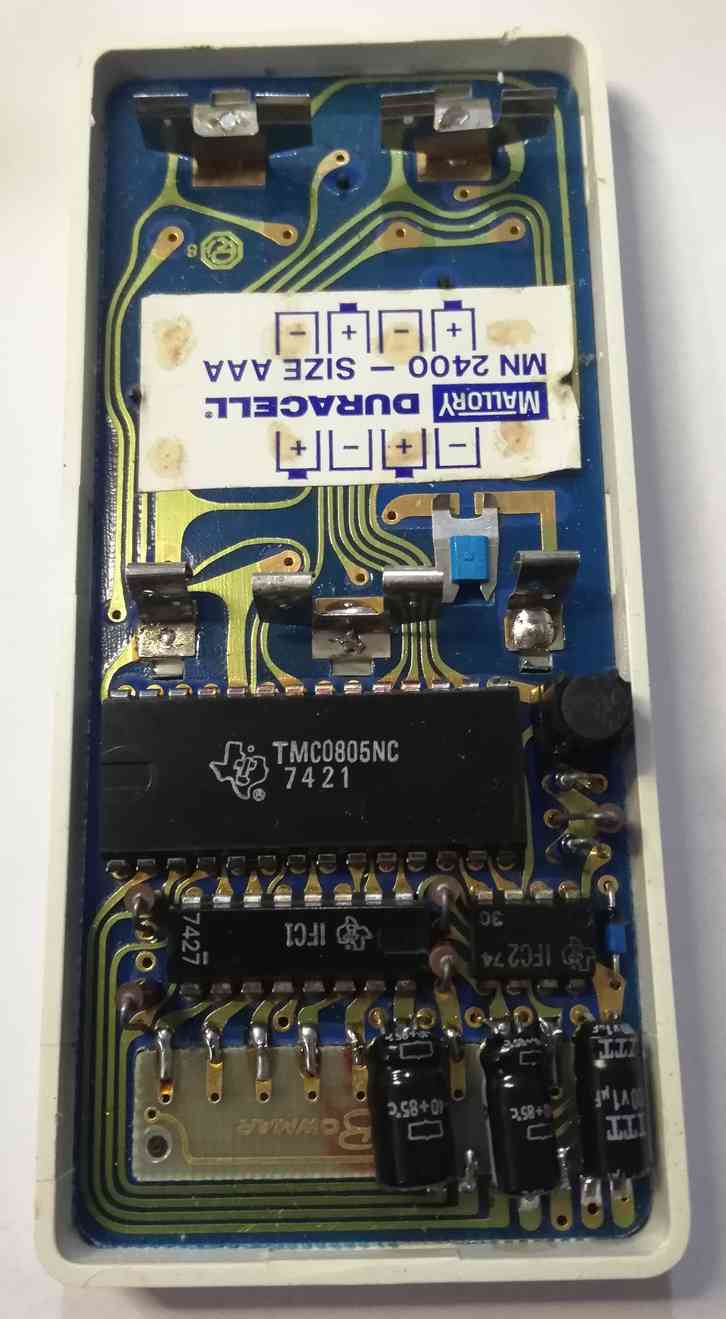 Model: Scientific
Battery: 4 x AAA cells
AC adapter:
Year: 1974
Chip: TMS0805NC
Info: made in England
How to use this unusual calculator
The Sinclair Scientific calculator uses reverse Polish notation (RPN) and scientific notation, so the key sequences are totally different from regular calculators. Numbers automatically have a decimal point inserted; use E to set the exponent. Operations are entered after the number and there is no equals key. Use the up and down arrows to select scientific functions. A display such as 1.2300 01 indicates 1.23*10^1, i.e. 12.3. A few examples:
To divide 17 by 3, enter 1 7 E 1 + 3 ÷
To take the sin of 0.01 radians, enter 0 0 1 ▲ +
To take antilog of .5 (to compute 10^.5), enter 5 E - 1 ▼ ×
Reverse Engineering from Ken Shirriff's blog
Bowmar soon became one of the world's largest producers of electronic calculators, mainly pocket models, for sale by themselves and by other companies such as Sears, Radio Shack, etc. (under their own nameplates). Early Bowmar calculators were made in the USA. In later years some were also made or assembled in Mexico.
Sega Corporation is a Japanese multinational video game developer and publisher headquartered in Shinagawa, Tokyo. Its international branches, Sega of America and Sega Europe, are headquartered in Irvine, California, and London. Sega's arcade division existed as Sega Interactive Co., Ltd. from 2015 to 2020 before it merged with Sega Games to create Sega Corporation with Sega Games as the surviving entity. Sega is a subsidiary of Sega Group Corporation, a part of Sega Sammy Holdings. From 1983 until 2001, Sega also developed video game consoles.
Sega was founded by American businessmen Martin Bromley and Richard Stewart as Nihon Goraku Bussan on June 3, 1960; shortly after, the company acquired the assets of its predecessor, Service Games of Japan. Five years later, the company became known as Sega Enterprises, Ltd., after acquiring Rosen Enterprises, an importer of coin-operated games. Sega developed its first coin-operated game, Periscope, in 1966. Sega was sold to Gulf and Western Industries in 1969. Following a downturn in the arcade business in the early 1980s, Sega began to develop video game consoles, starting with the SG-1000 and Master System but struggled against competitors such as the Nintendo Entertainment System. In 1984, Sega executives David Rosen and Hayao Nakayama led a management buyout of the company with backing from CSK Corporation.
🏪 SHOP
🛍️ On this page, the volunteer organization objects for sale are displayed.
💰 The proceeds will be used to support the activities of the volunteer organization.
❤️🔥 Public fundraising is increasingly recognized today as a fundamental tool to support the initiatives of associations.
📢 Here are the ads! 📦 For shipping, contact me ✉️ sending your address 🏠 for a quote 💬💶!!!
🎨 Paintings

In this section you will find reproductions in ink and acrylic on 40x60 cardboard ,
donated by the artist Lia Jonescu
|
Electric Heart of Texas Instruments 80 Eur each + ask for shipping |
The Birth of Digital Dreams 80 Eur each + ask for shipping |
|
Orbit of Digital Time 80 Eur each + ask for shipping |
The Talking Chip 80 Eur each + ask for shipping |

Explosion of Digital Logic 80 Eur each + ask for shipping |
Math in Color 80 Eur each + ask for shipping |

Calculator Dreams 80 Eur each + ask for shipping |


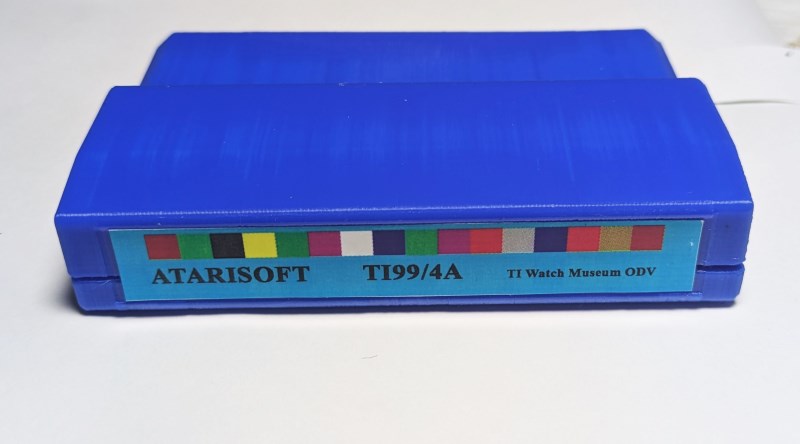
🎮 Cartridges TI-99/4A
🖥️ Home Computer TI-99/4A
|
25 Eur + ask for shipping |
25 Eur + ask for shipping |
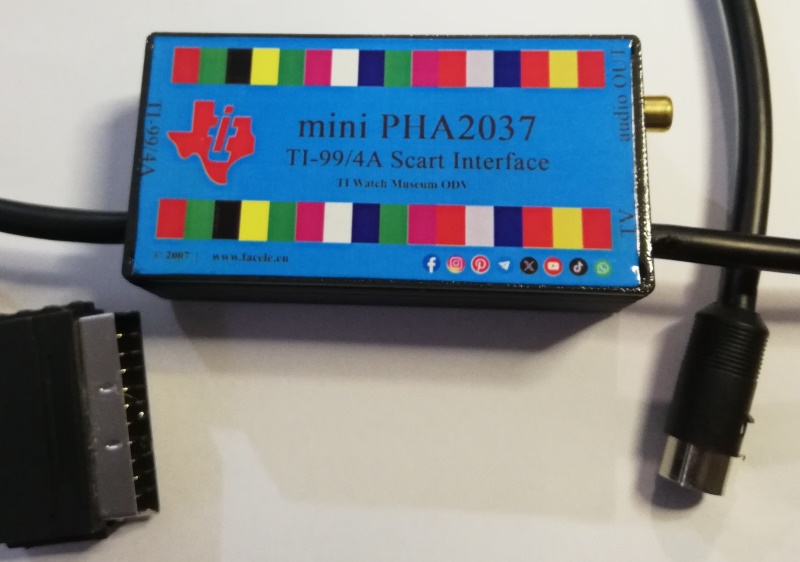
Mini PHA 2037 V.2.0 ( Pal Scart Interface ) 90 Eur + ask for shipping |
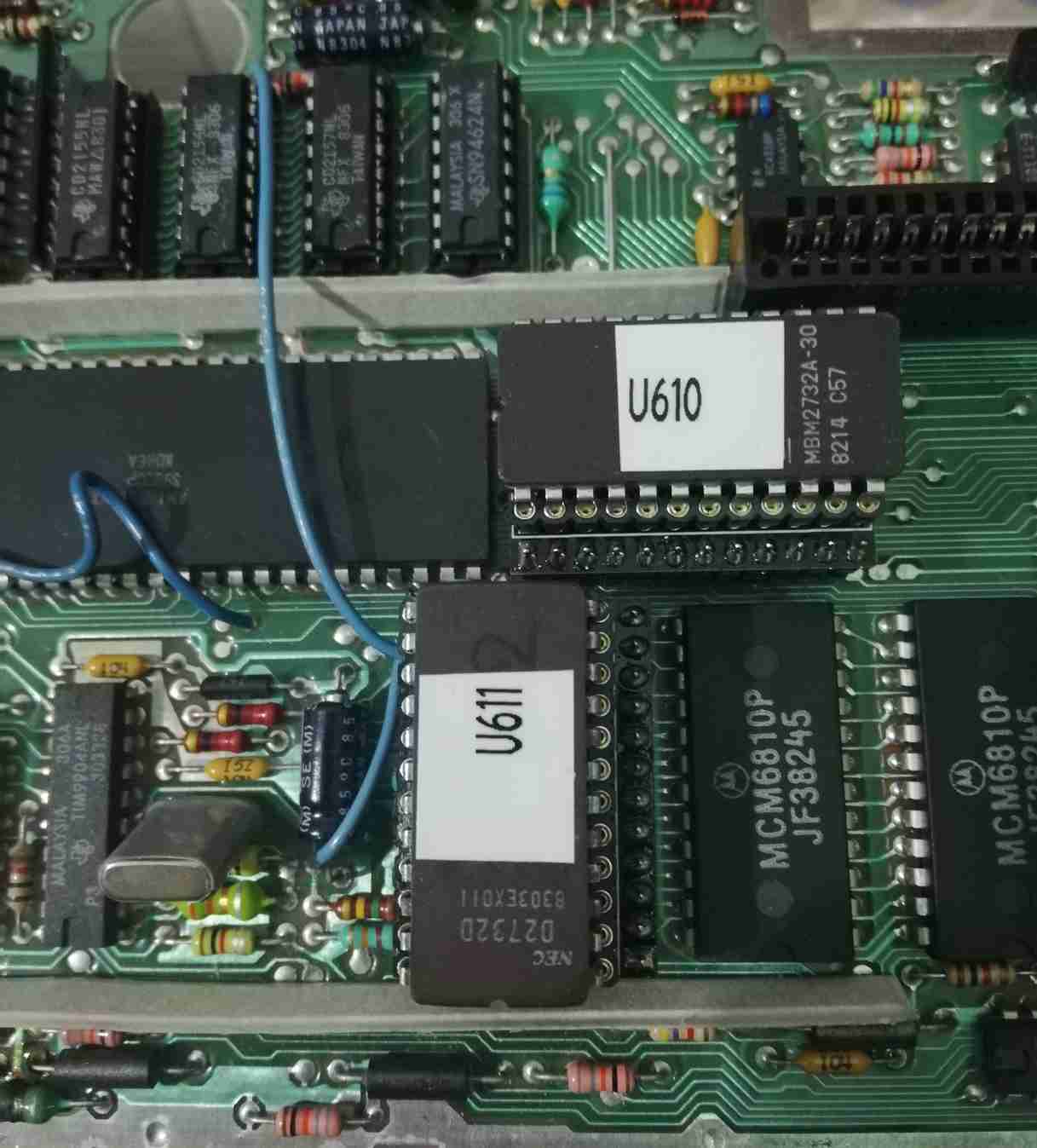
EPROM adpater 2532 to 2732 for TI-99/4A 25 Eur + ask for shipping
|
|
25 Eur + ask for shipping |
35 Eur + ask for shipping + 3d printed shell 40 Eur + ask for shipping
|
|
Ram Expansion 32 Kbyte with 3D printed shell 50 Eur + ask for shipping |
Final Grom 99 with 3d printed shell 90 Eur + ask for shipping
|
|
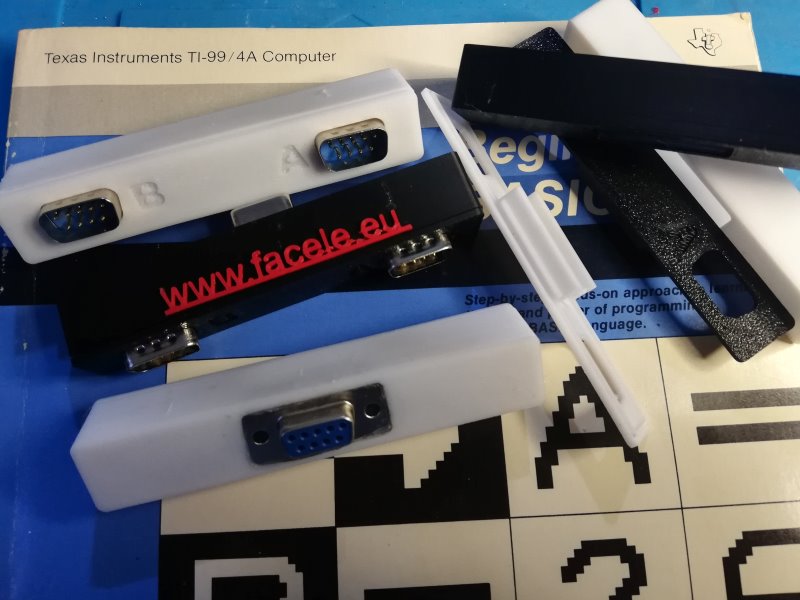
3D printed slider to turn on the TI-99/4A 2 pcs 10 Eur + ask for shipping
|


.jpg)


🧮 Texas Instruments Calculators
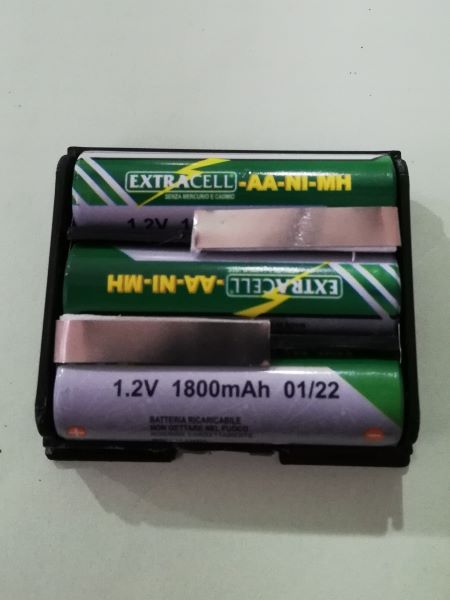 NEW BATTERY PACK BP1 ( SR-50, SR-51, SR-50A, SR51A, SR52, SR56, TI-58, TI-58C, TI-59 ) NEW BATTERY PACK BP1 ( SR-50, SR-51, SR-50A, SR51A, SR52, SR56, TI-58, TI-58C, TI-59 )
NI-MH 1800 mA 30 Eur + ask for shipping |
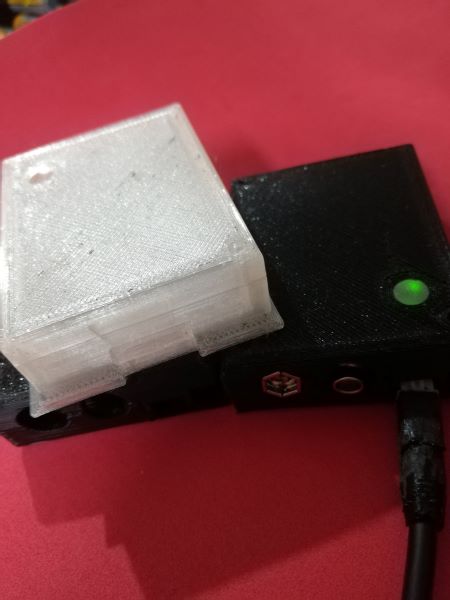
NEW BATTERY PACK BP7 ( TI-51-III, TI-55, TI-57, TI-42 MBA, MBA) BP8 ( SR-40, TI-15, TI-30, TI-31, TI-33, TI-41, TI-45, BA, BA1, Money Manager, Programmer BP9 ( TI-45 ) 40 Eur + ask for shipping |
.jpg)
NEW COVER ( TI-51-III, TI-55, TI-57, TI-42 MBA, MBA ) ( SR-40, TI-15, TI-30, TI-31, TI-33, TI-41, TI-45, BA, BA1, Money Manager, Programmer ) ( TI-45 ) 5 Eur + ask for shipping |
.jpg)
Stickers Grillo Parlante N. 2 stickers 10 Eur + ask for shipping |
🧮 # Texas Instruments
|
20 Eur + ask for shipping |
   
Game Handheld A very simple, handheld game with a super-vintage LED display, but with modern components.
|


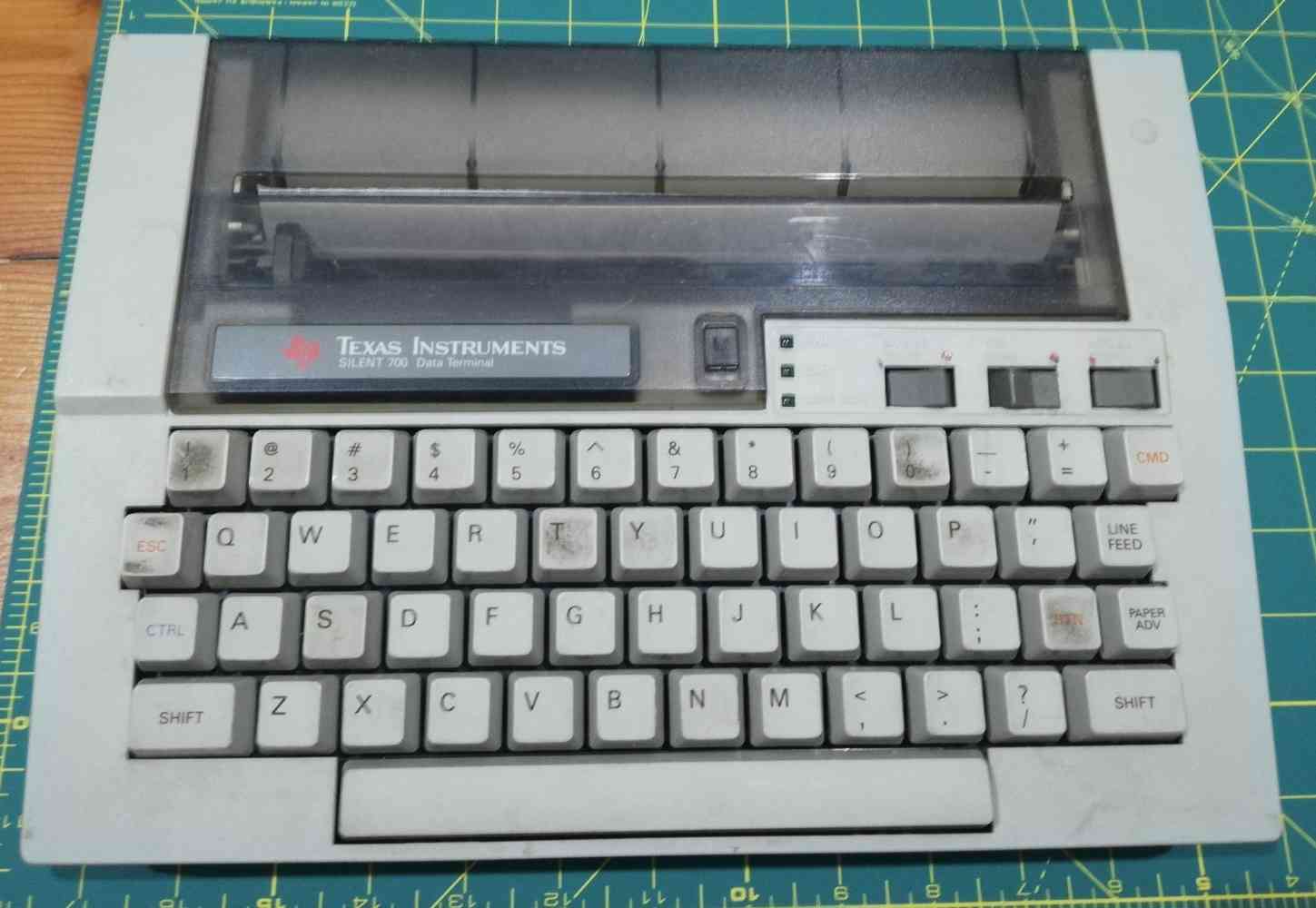 Model: 703
Adapter: 20 vac
Year: 1975
Info:The Silent 700, introduced in 1971, was a line of portable computer terminals manufactured by Texas Instruments in the 1970s and 1980s. Silent 700s printed with a 5 x 7 dot-matrix heating element onto a roll of heat-sensitive paper. Some models were equipped with an integrated acoustic coupler and modem that could receive data at 30 characters per second. Other models could be directly connected to computers at 300 bits/second (bps), and were sometimes used as the System console where a hard copy record of the activities would be retained for a period of time.
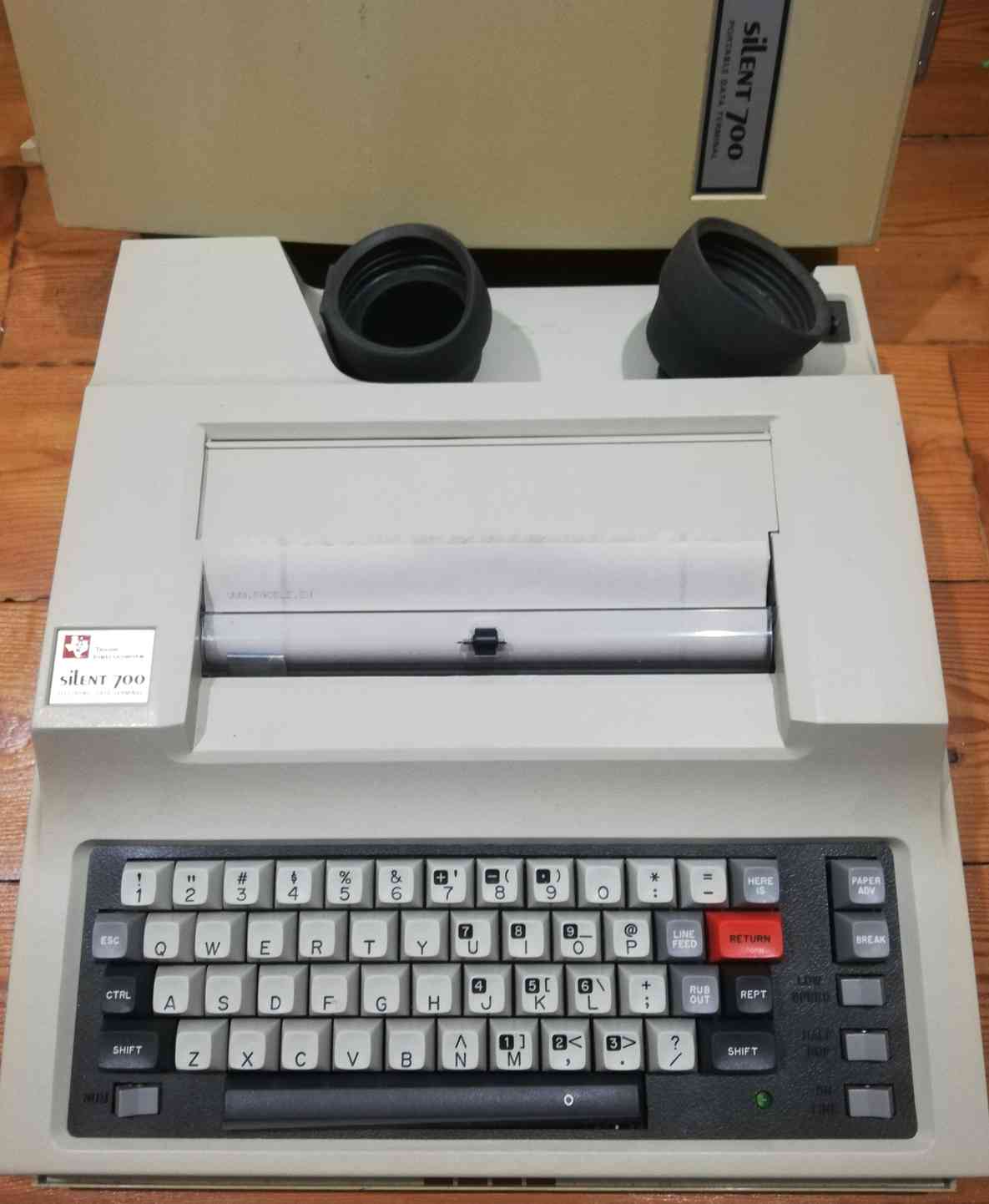 Model: 745
Adapter: 220 vac
Year: 1971
Info: The Silent 700, introduced in 1971, was a line of portable computer terminals manufactured by Texas Instruments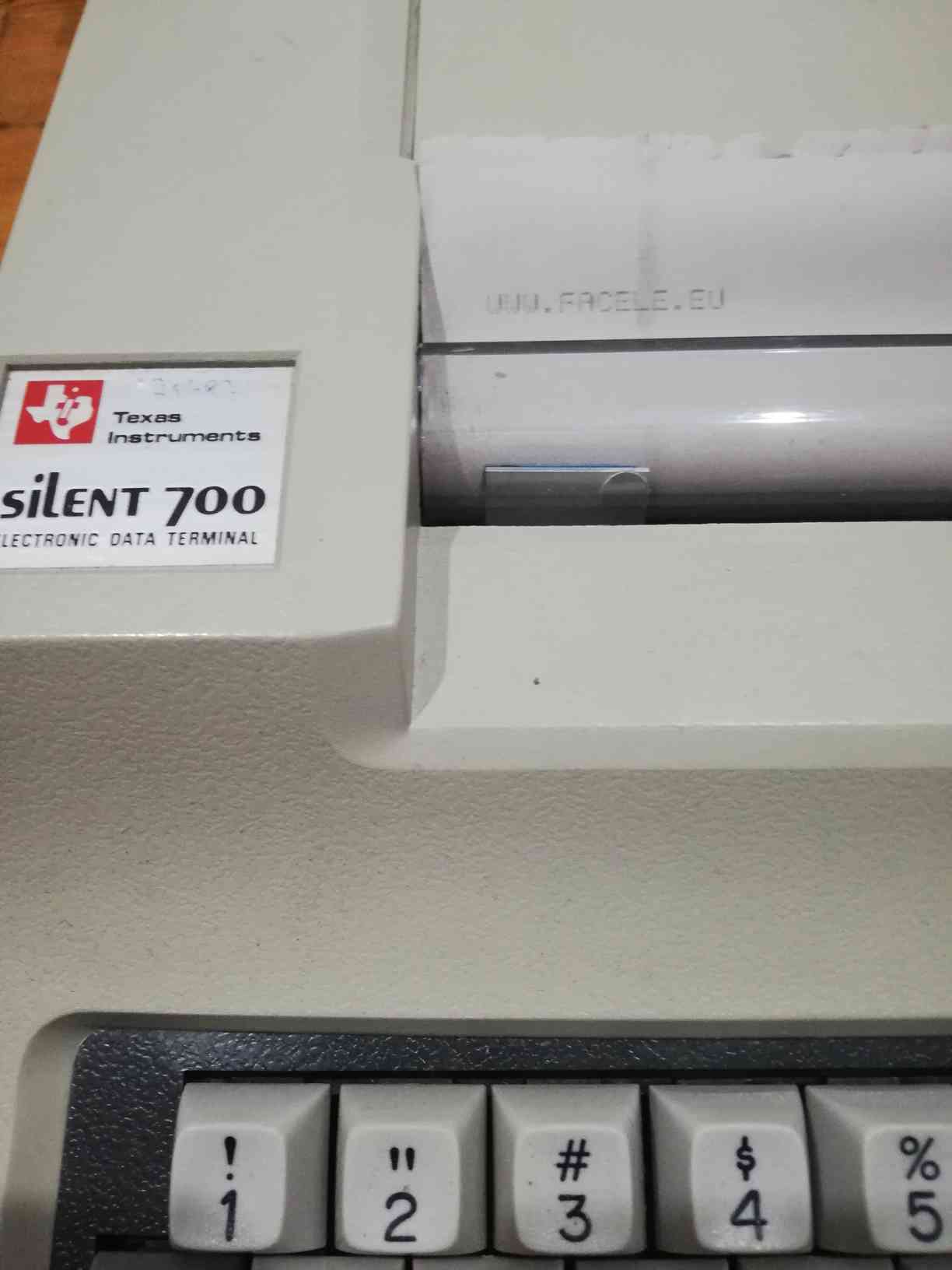 in the 1970s and 1980s.
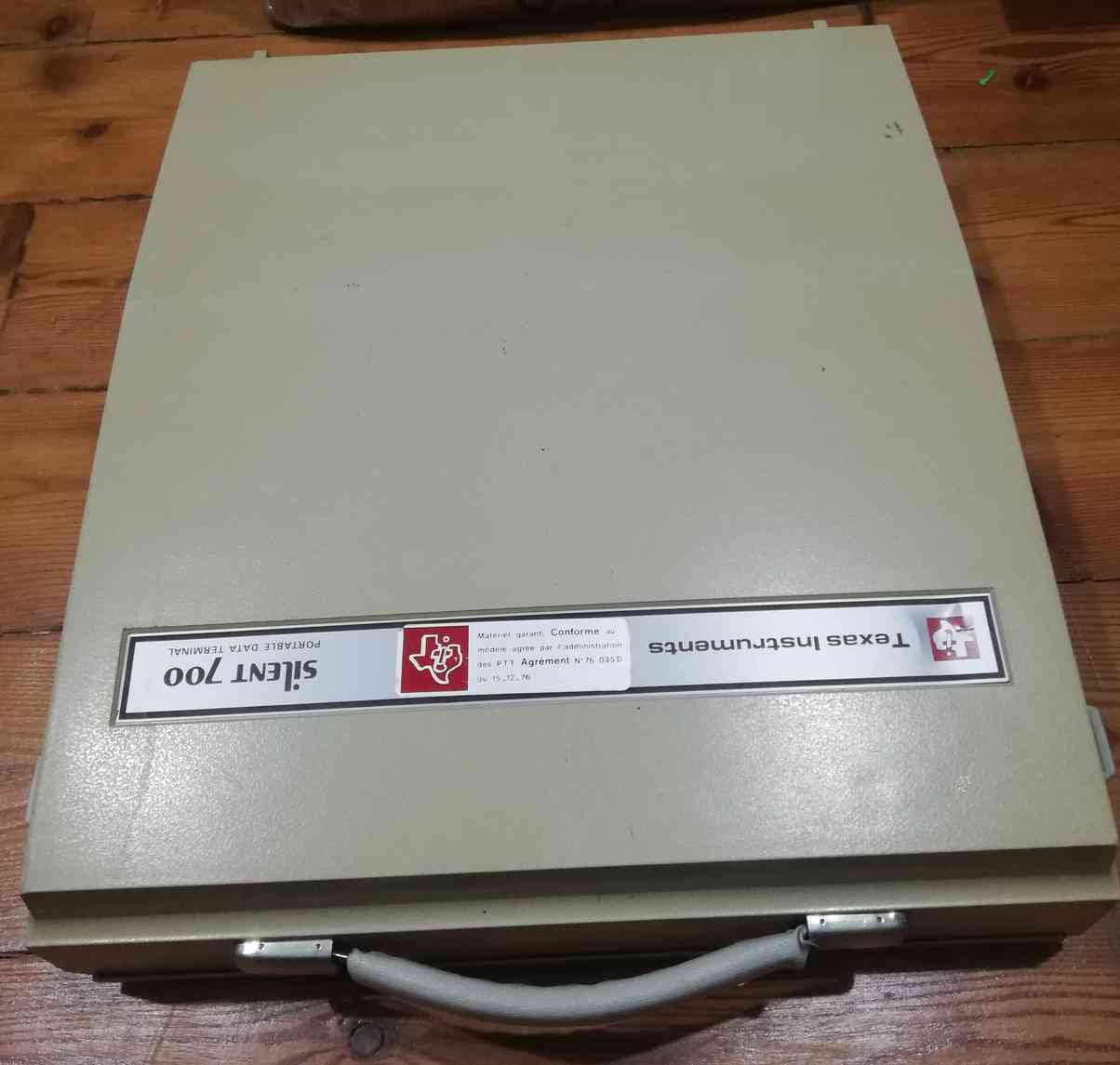 Silent 700s printed with a 5 x 7 dot-matrix heating element onto a roll of heat-sensitive paper. Some models were equipped with an integrated acoustic coupler and modem that could receive data at 30 characters per second. Other models could be directly connected to computers at 300 bits/second (bps), and were sometimes used as the System console where a hard copy record of the activities would be retained for a period of time. The Silent 700s were marketed as being extremely portable and reliable, “designed to use a minimum of moving parts, eliminating wear elements” (Texas Instruments). They included features like a built-in acoustic coupler that allowed the user to call into a remote computer system from any telephone and a built-in thermal printer which would quietly (user reports from the 70’s indicate that “silent” was a stretch) (Hannigan 4) print with a dot-matrix heating element onto thermal paper. Thermal paper was thin paper that was specially coated in heat sensitive material that would change color when exposed to heat, thus giving physical form to the data being transmitted. The Silent 700 models printed data at a speed of 30 characters per second. The 735 model weighed 25 pounds and cost $2,595 (approximately $12,400 in 2019), while the streamlined 745 model weighed only 13 pounds and cost $1995 (approximately $9,500 in 2019) (Texas Instruments).
Silicon Wafer
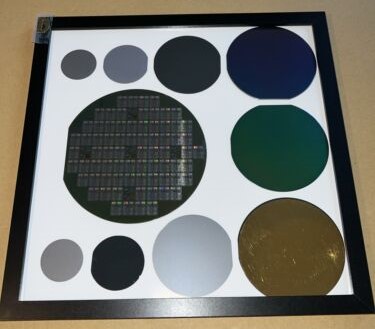 Silicon Wafer In electronics, a wafer (also called a slice or substrate) is a thin slice of semiconductor, such as a crystalline silicon (c-Si, silicium), used for the fabrication of integrated circuits and, in photovoltaics, to manufacture solar cells.
The wafer serves as the substrate for microelectronic devices built in and upon the wafer. It undergoes many microfabrication processes, such as doping, ion implantation, etching, thin-film deposition of various materials, and photolithographic patterning. Finally, the individual microcircuits are separated by wafer dicing and packaged as an integrated circuit.
.jpg)
.jpg)
.jpg)
.jpg)
.jpg)
Here you can see some production scraps. The first photo (left) shows the component ready to be assembled, the second shows the various chips ready to be removed from the tray and placed in the ceramic chip. The three remaining photos show the various chips ready to be cut. I have to thank Francesco for giving me the opportunity to show these pieces!
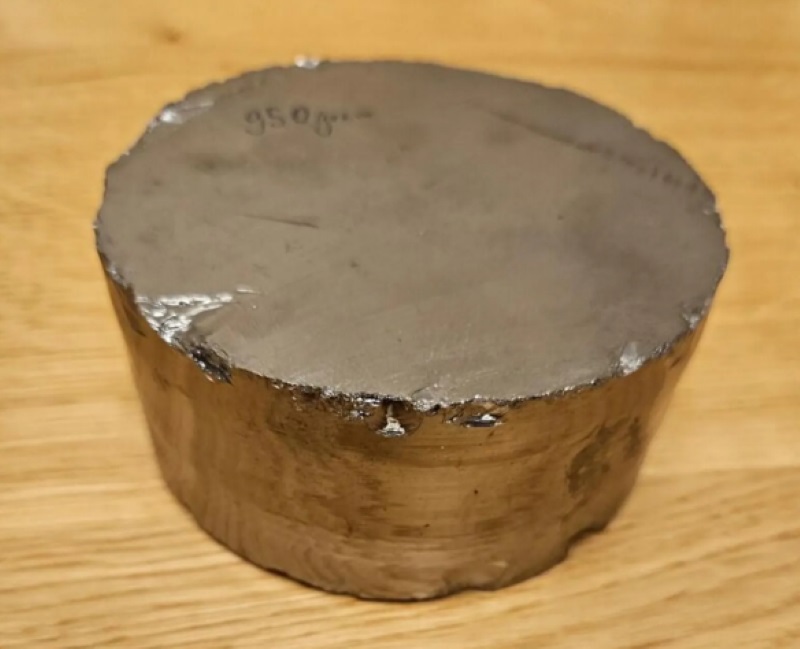
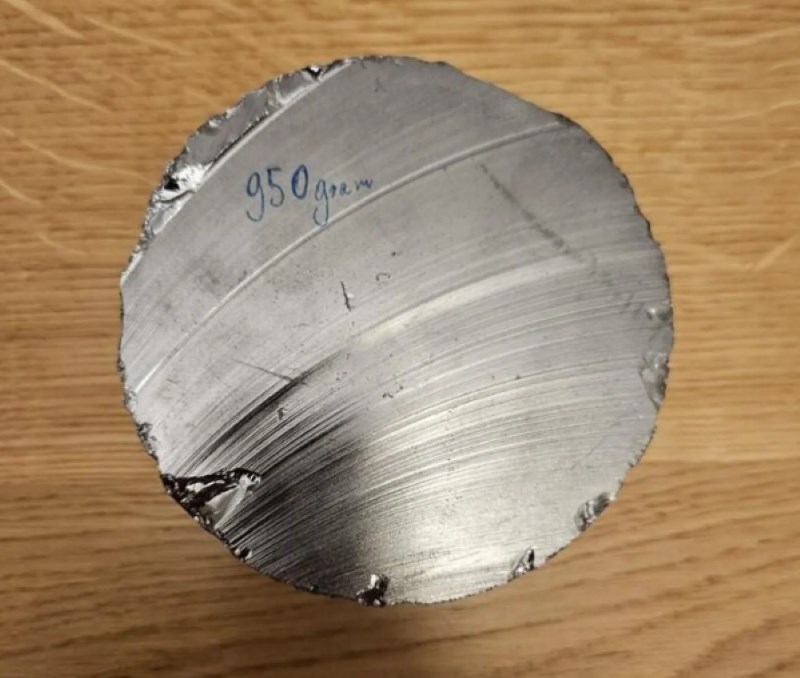
This 950g crystalline (105 x 50 mm) silicon ingot is a high-purity, technical-grade sample produced using the "Czochralski method" a technique commonly employed in the manufacture of semiconductors and microchips. It originates from Silicon Valley (USA), with final processing carried out in Poland. Silicon fragments in this form are rarely available outside of industrial manufacturing settings, making this item an exceptional collector's or display piece. Its metallic luster and regular crystalline structure make it ideal for scientific demonstrations, educational activities, and materials research.
 Model: Silly Sound Stage
Battery: 4 x AA
AC adapter:
Year: 1994
Chip:
Info: made in China
.jpg)
.jpg)
Model: Simon
Battery: 1 x 9 volt
AC adapter:
Year: 1978
Chip: TMS1000 / MP3226
Info:The Simon is an electronic game of short-term memory skill invented by Ralph H. Baer and Howard J. Morrison, working for toy design firm Marvin Glass and Associates, with software programming by Lenny Cope. The device creates a series of tones and lights and requires a user to repeat the sequence. If the user succeeds, the series becomes progressively longer and more complex. Once the user fails or the time limit runs out, the game is over. The original version was manufactured and distributed by Milton Bradley and later by Hasbro after it took over Milton Bradley. Much of the assembly language code was written by Charles Kapps, who taught computer science at Temple University and also wrote one of the first books on the theory of computer programming. Simon was launched in 1978 at Studio 54 in New York City and was an immediate success, becoming a pop culture symbol of the 1970s and 1980s.
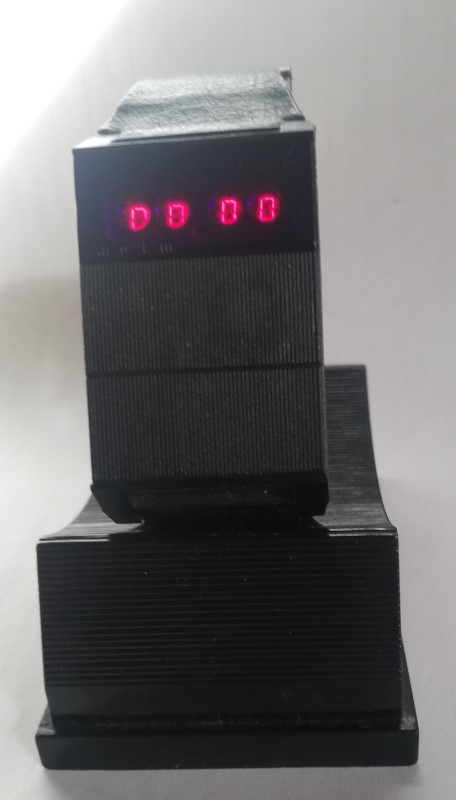 The Black Watch is an electronic wristwatch launched in September 1975 by Sinclair Radionics. It cost £24.95 ready-built, but was also available for £17.95
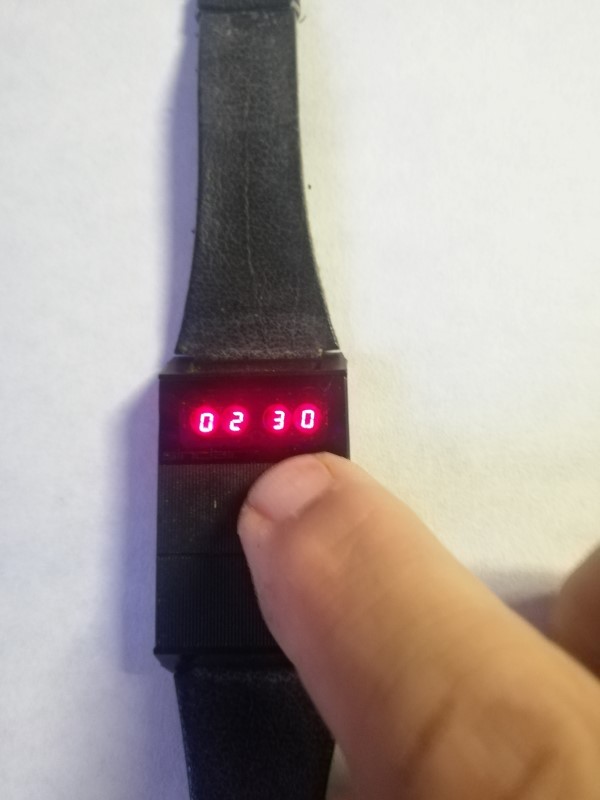 , as a kit.[These prices are equivalent to around £190 and £140 respectively in 2021, when adjusted for inflation.
The Black Watch was supplied with a plastic band as standard, with a black stainless steel bracelet available as an extra at £2.00.
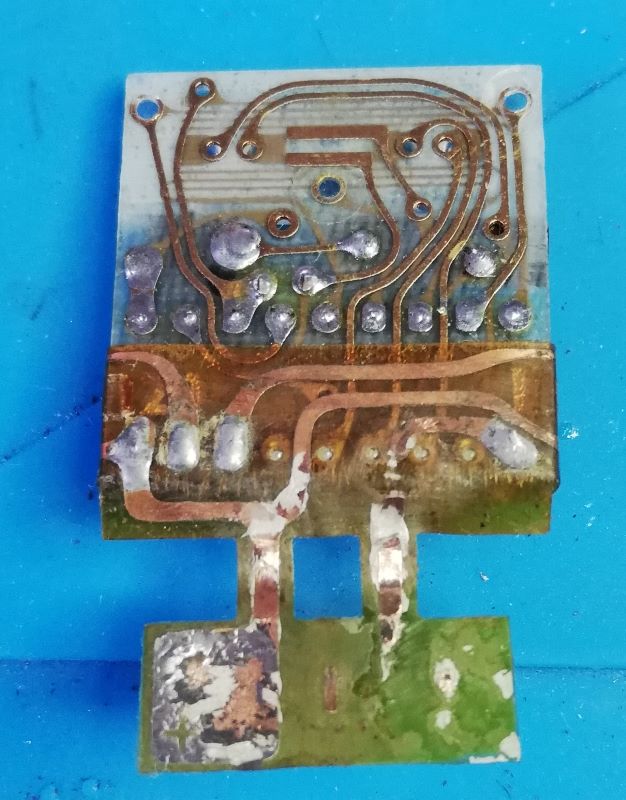 I'm a fan of watches especially Texas Instruments, but when I come across watches like this 1975 Sinclair black watch I don't let it get away. Unfortunately he had problems with corrosion from the usual button cell batteries.
I solved, as often happens with objects with corroded pcb, to use 0.03 mm copper sheets. You have to clean up the damaged part and copy the part of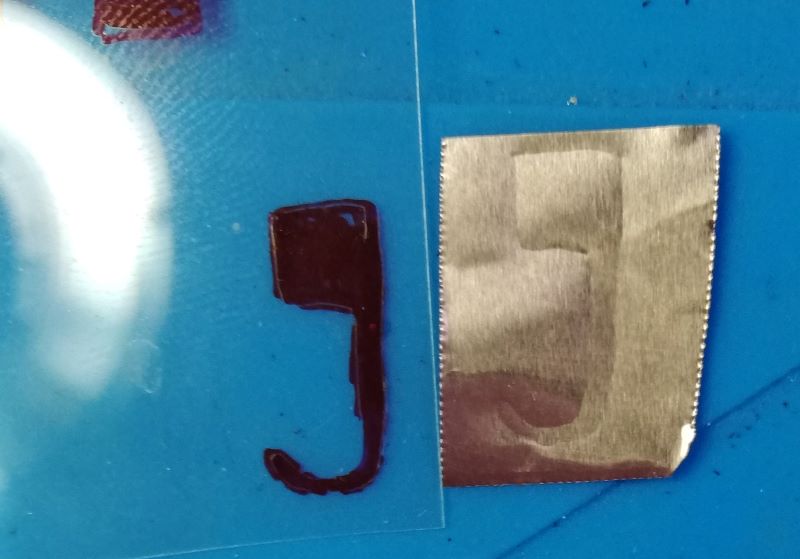 the PCB to be reproduced on a transparent sheet, copy it on the copper sheet and cut it.
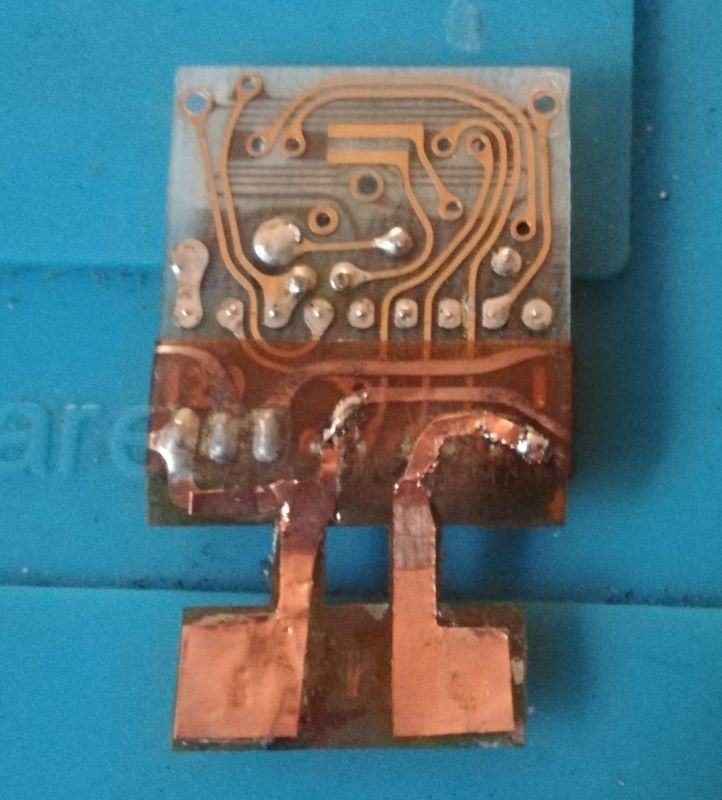 Then glue the pcb reproduced with silicone or with glue for gold leaf, I prefer the latter. Put it all together and you're done.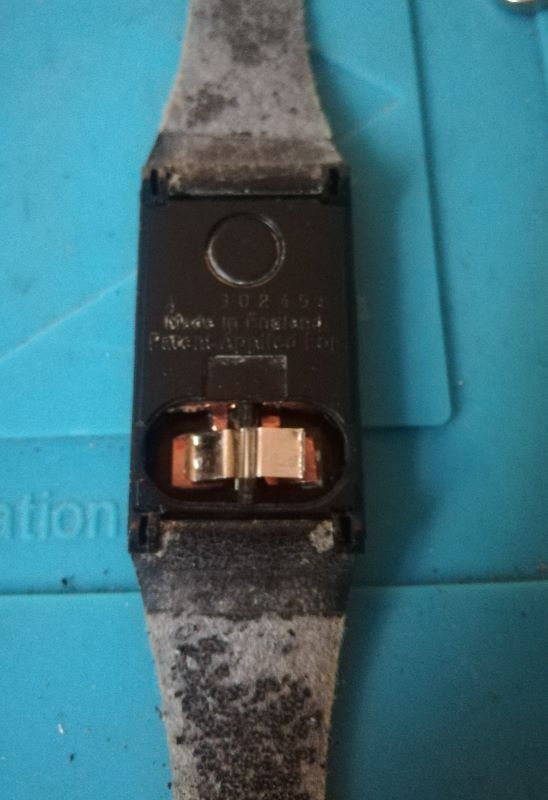
Wikipedia Sinclair Black Watch
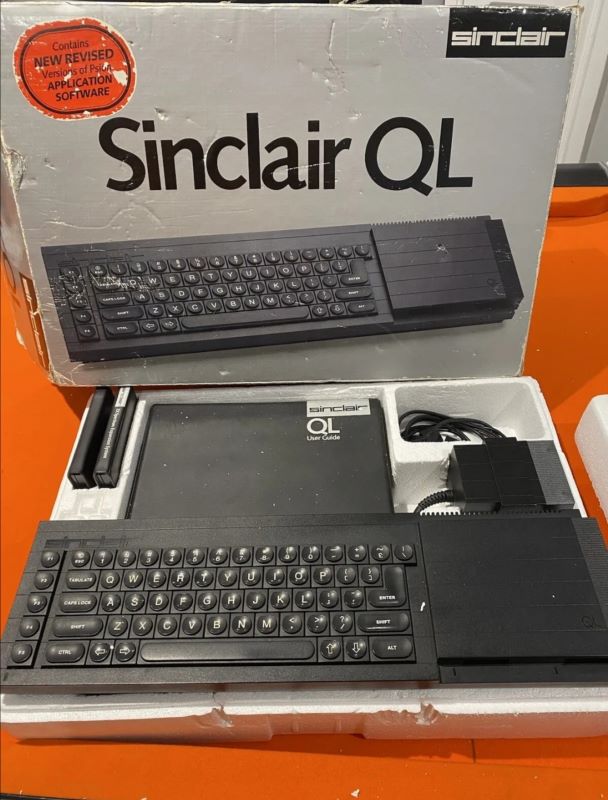
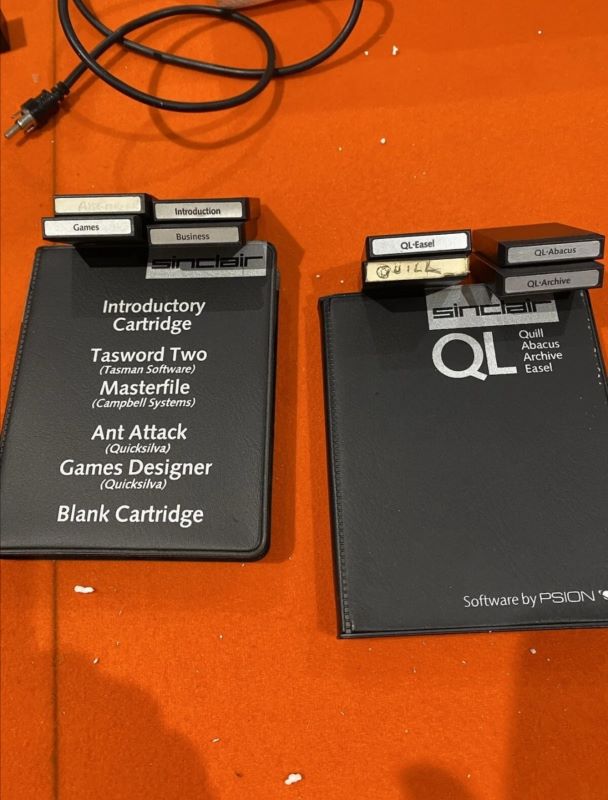
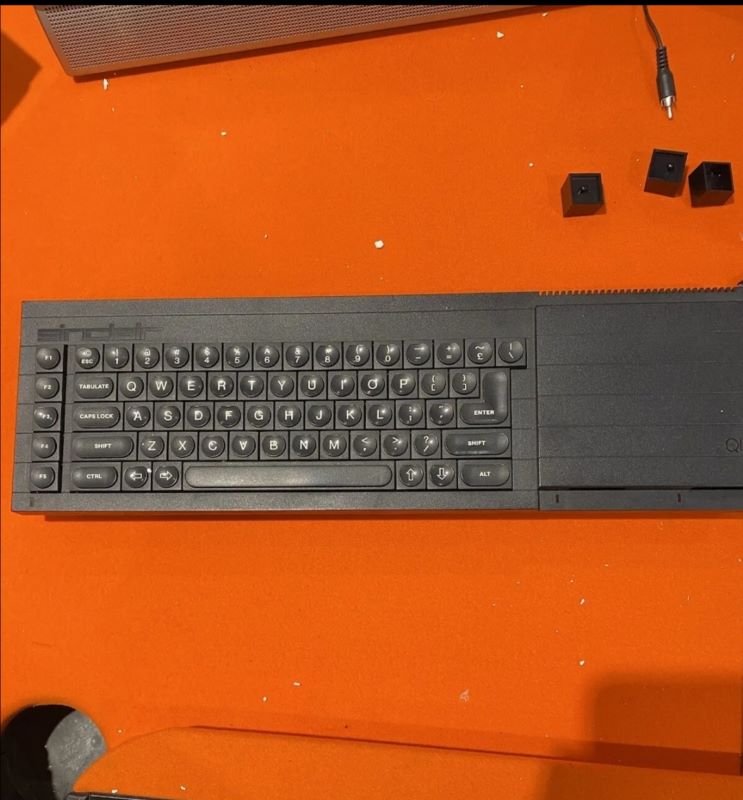 The Sinclair QL (for Quantum Leap) is a personal computer launched by Sinclair Research in 1984, as an upper-end counterpart to the ZX Spectrum.
The QL was aimed at the serious home user and professional and executive users markets from small to medium-sized businesses and higher educational establishments, but failed to achieve commercial success.
While the ZX Spectrum has an 8-bit Zilog Z80 as the CPU, the QL uses a Motorola 68008. The 68008 is a member of the Motorola 68000 family with 32-bit internal data registers, but an 8-bit external data bus.
TroubleShooting
Power-on problem: White screen, possible faulty RAM memory.
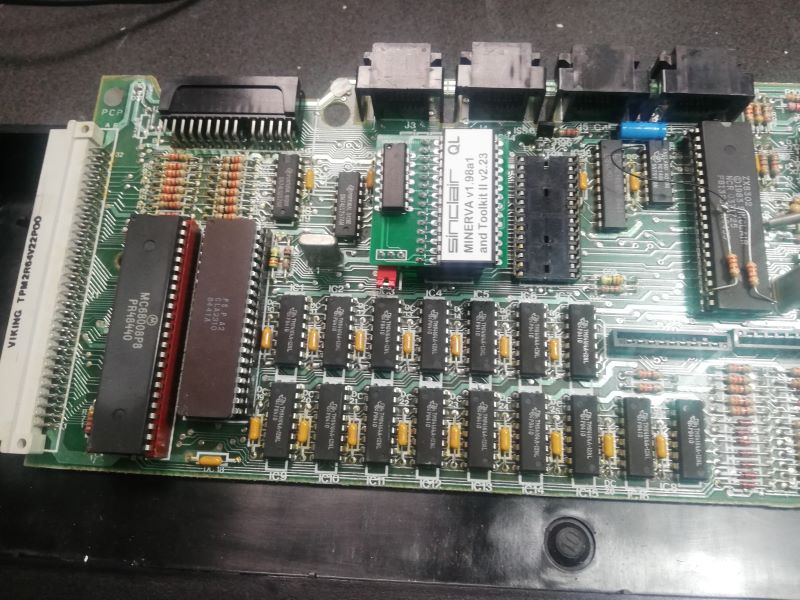
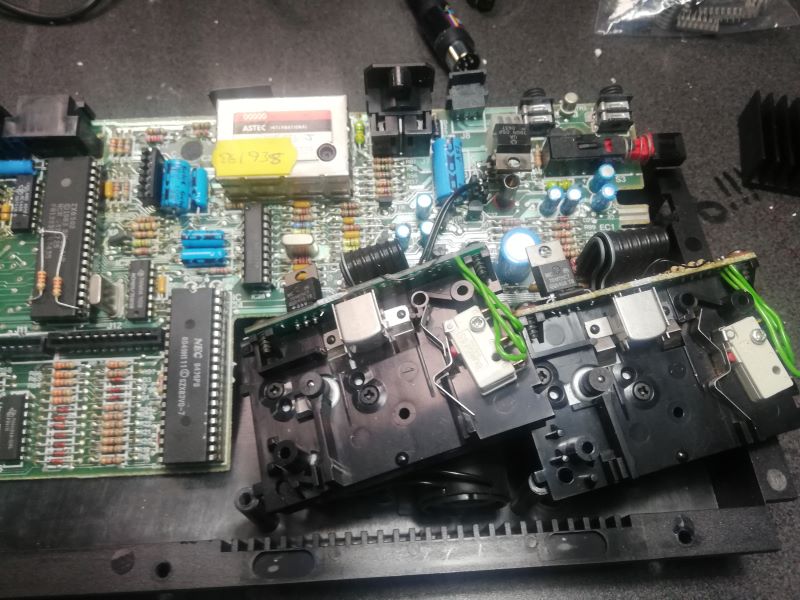 I recommend installing the "Minerva" eprom, FW developed to give a new basic, but above all to help turn on the QL. Remove the two original EPROMs and insert the socket with the new EPROM.
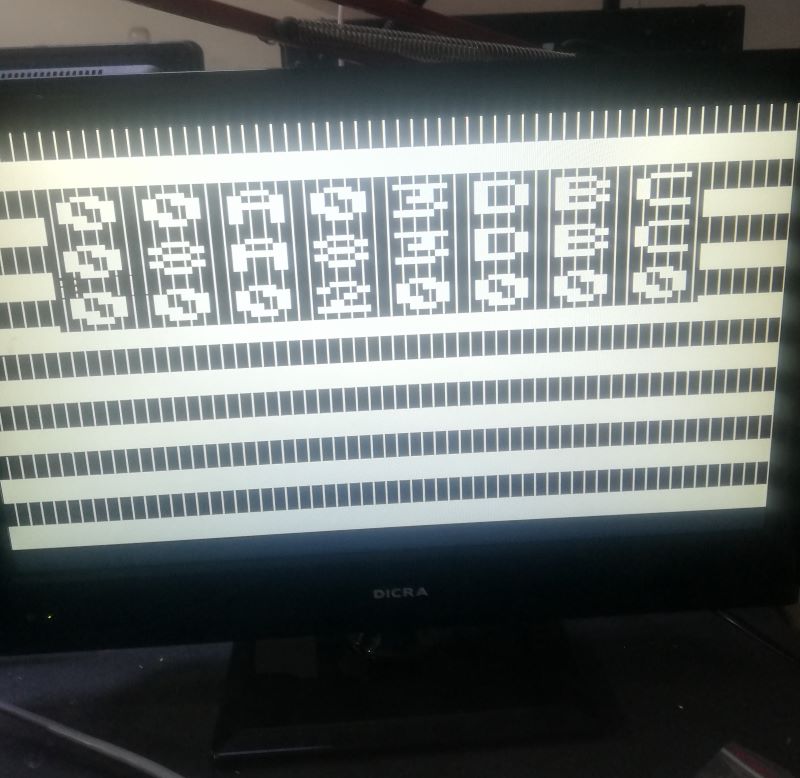 in case of error a screen like this will appear. This window tells us that the first line is the value that is written to RAM, the second line is the read value, the third is the memory address.
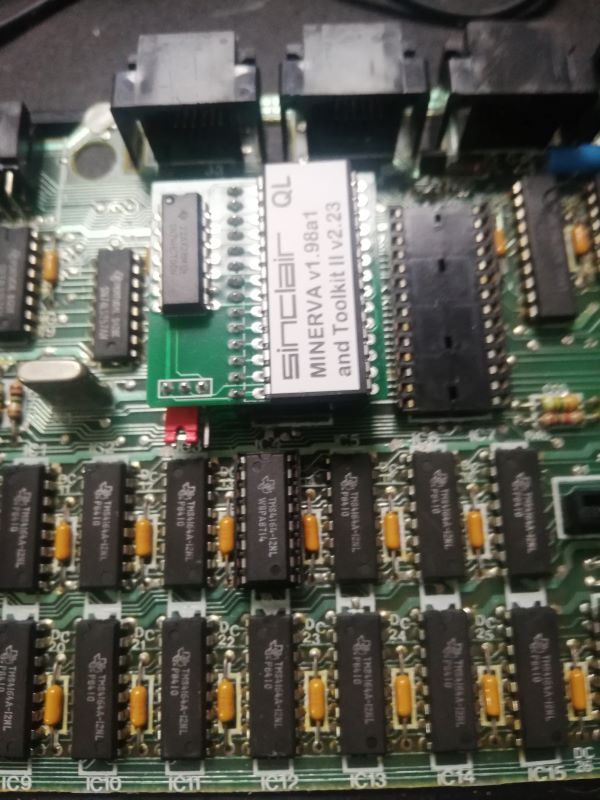
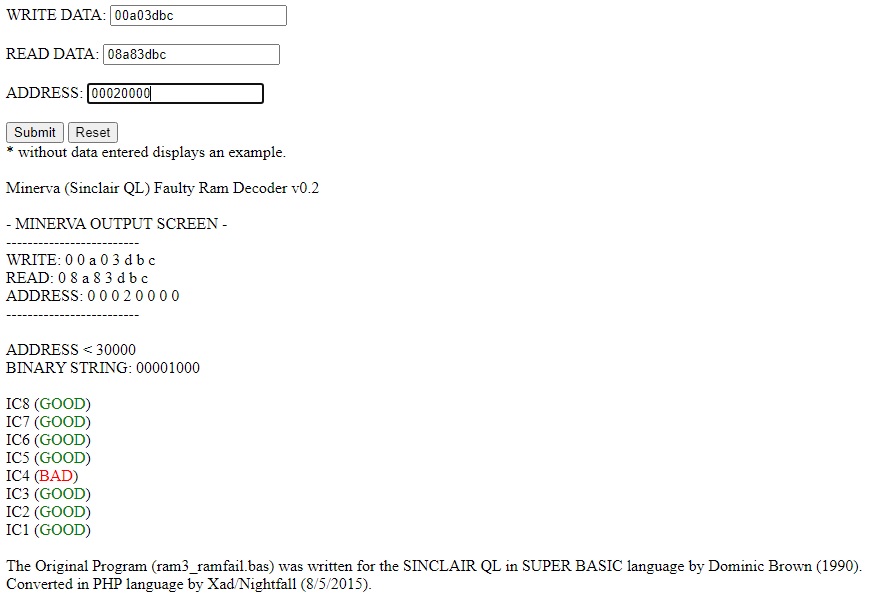
In this case, a little program developed by XAD at this address comes to our aid: https://www.nightfallcrew.com/minervaram/index.php
We enter the data and we will have an indication of the faulty RAM. In our case the U4.
IF < $30000 (ADDRESS) = IC8 ,IC7 ,IC6 ,IC5 ,IC4 ,IC3 ,IC2 ,IC1
IF > $30000 (ADDRESS) = IC16 ,IC15 ,IC14 ,IC13 ,IC12 ,IC11 ,IC10 ,IC9
IF > $40000 Faulty ram is in expansion memory.
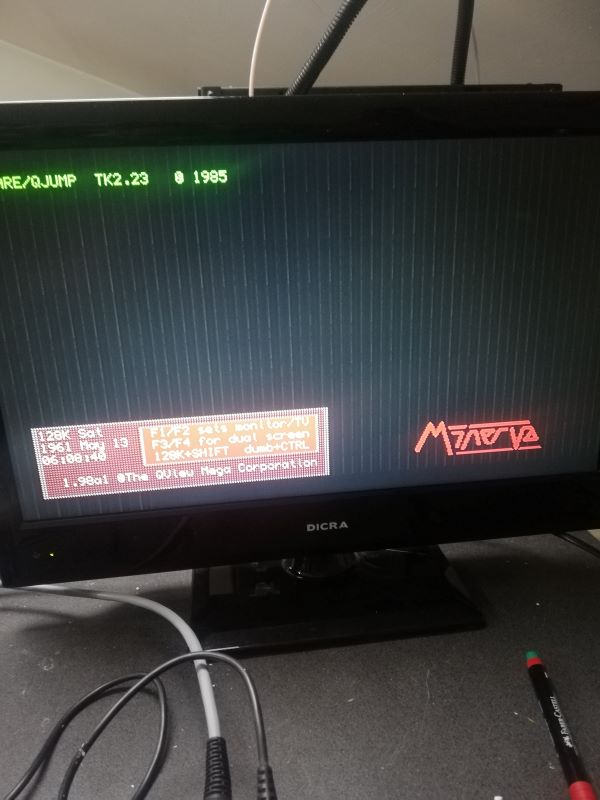
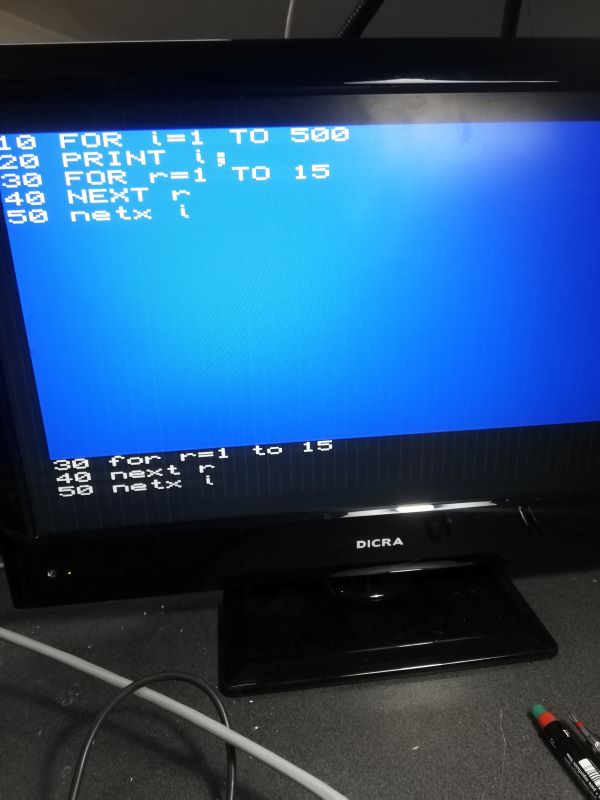
Here we can see the operation after the repair.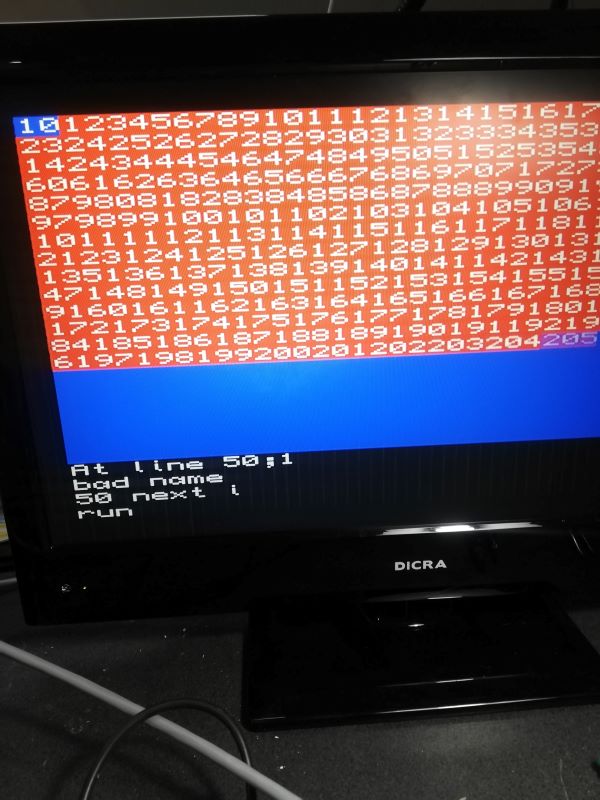
Sinclair Radionics
In 1972, Radionics launched its first electronic calculator, the Executive, which was considerably smaller than its competitors' by the use of hearing-aid-sized batteries. What had made this possible was it had been discovered that there was considerable latency in the display and memory and that, with the addition of a timer, power could be withheld from these battery-draining components for much of the time, thus greatly extending battery life.
During the majority of the 1970s, Sinclair focused on building the most affordable pocket calculators with the best design. In 1972 Sinclair released the world's first slim-line pocket calculator, the Sinclair Executive, for £79.95. The calculator only included basic maths functions, and the LED display required much power. It is often credited as being the world's first attractively styled calculator that did not require mains power to be used like prior calculators. The Executive was a phenomenal success, earning Sinclair £1.8m in profit. In 1973 the slightly larger Sinclair Cambridge was introduced at a far cheaper price of £29.95 + VAT. A cheaper Executive was also launched shortly after. In addition to expanding the Cambridge range, the Sinclair Scientific was launched in 1975. It was a scientific pocket calculator for the very competitive price of £49.95. In 1977 a revised model, the "Scientific Programmable", was released at £29.95. The Scientific Programmable Mark 2 was later released, reducing the price to £17.22.
In 1975, Sinclair Radionics launched the Oxford range of briefcase calculators. Sinclair also attempted to capture the top-end calculator market with the Sinclair Sovereign, available in plated gold or silver. The calculator was critically acclaimed for its excellent engineering and design and enjoyed short success. Final attempts at the mass-market for calculators, the Sinclair Enterprise and the President, did not sell well.
In 1974, Radionics launched the DM1 digital multimeter. Such scientific instruments were to form a quiet backbone of Radionics business for the rest of its existence. In marked contrast to the rest of the Sinclair range, the instruments gained a reputation for reliable conventionality rather than often unreliable idiosyncrasy.
Slide Rule Decline
Texas Instruments (TI) invented the first integrated circuit in 1958, courtesy of TI inventor Jack Kilby, and the handheld calculator, a prototype called the "Cal Tech," invented by TI's Jerry Merryman in 1967. However, the first handheld scientific calculator or "slide rule" offered to the public was Hewlett-Packard's. The HP-35 was named by Bill Hewlett for the number of keys on the calculator, and in 1972, the year the slide rule as we know it began to decline, Hewlett-Packard announced the HP-35 as a fast, highly accurate electronic slide rule with solid-state memory similar to a computer. Even though they had a launch price of $395.00, engineers and engineering students flocked to stores to buy them (much like the iPod craze today). Some students even sold their cars to afford one. However, because the exorbitant cost of producing HP calculators made them unaffordable to 90% of the general population, the slide rule remained popular and useful for another four years. According to the ISRM, the official death date of the slide rule was June 13, 1976, when Texas Instruments introduced the TI-30 single-chip slide rule scientific calculator for $24.95, which was below the cost of a comparable slide rule. There was no longer any cost advantage for new students, technicians, and engineers to purchase a slide rule, since everyone could afford the TI-30. Coincidentally, just one month later, on July 11, 1976, Kueffel & Esser, the oldest and largest slide rule manufacturer in the United States, produced its last slide rule. In the following month of August 1976, Pickett Industries followed suit, discontinuing all production of its slide rules.
Texas Instruments SN7400
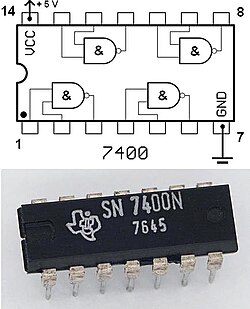
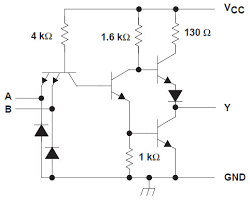 The 7400 series is a popular family of transistor-transistor logic (TTL) integrated circuits (ICs).
In 1964, Texas Instruments introduced the SN5400 series of logic chips in a ceramic semiconductor package. In 1966, the SN7400 series (composed of four NAND logic gates with 40 transistors) in a low-cost plastic package was introduced, quickly capturing over 50% of the logic chip market and becoming a de facto standard electronic component. Since the introduction of the original bipolar transistor TTL components, pin-compatible components have been introduced with features such as low-power CMOS technology and lower supply voltages. Surface-mount packages exist for several functions of this popular logic family.
In the photo an example of an integrated circuit produced by Texas instruments, the first line indicates the type of integrated circuit SN7400N, the second line indicates the date of construction, the first two numbers indicate the year, the second two numbers indicate the week, therefore, 45th week of 1976. In the nearby photo there is a drawing of how a logic gate of the SN7400N is made
Texas Instruments SN76477
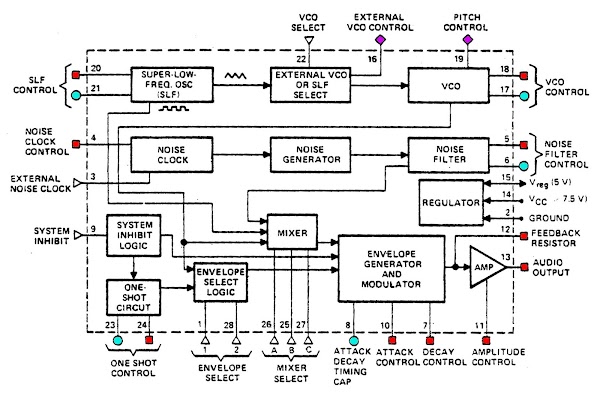 "complex sound generator" is a sound chip produced by Texas Instruments (TI). Th
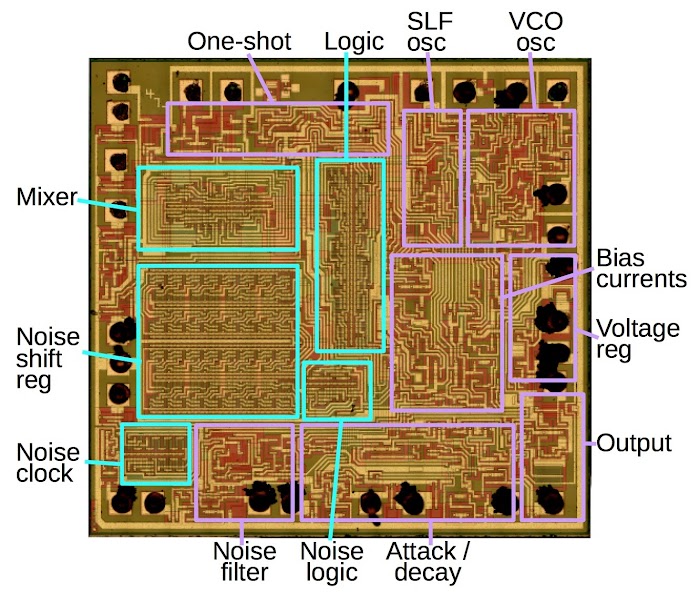 e chip came to market in 1978, and TI ceased production of the part. A compatible version is identified as ICS76477. The chip is typically used as a sound effects generator in arcade games and toys and for hobby projects. The use of the SN76477 in a musical context is limited by the fact that it was difficult to electronically control the pitch of the produced sound.
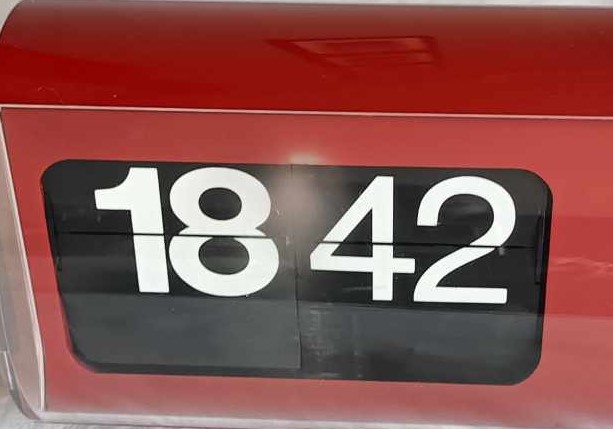 Solari Cifra 3
Solari Cifra 3 is the smallest direct reading electromechanical watch, designed by Gino Valle and produced by the Solari company of Udine in the late 1960s. The clock was added to the permanent collection of the Museum of Modern Art in New York (MoMA) in 1967.
«I don't make objects, I establish relationships. I build relationships and define environmental flows in terms of time, such as before, during and after. It is not so much the plots that count as the succession of spaces, the relationships, the transformations, the transition rituals.» (Gino Valle)
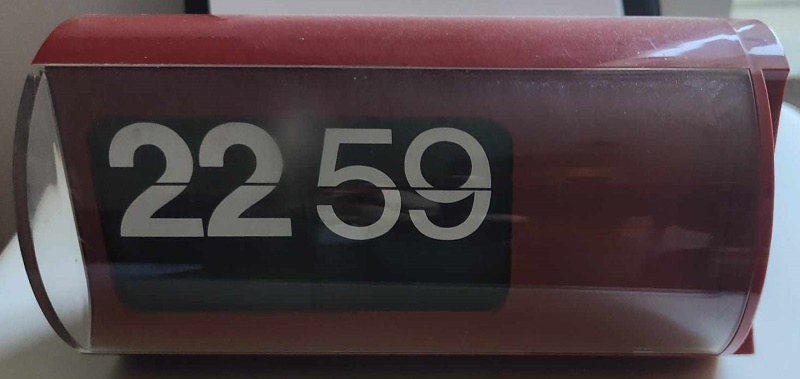
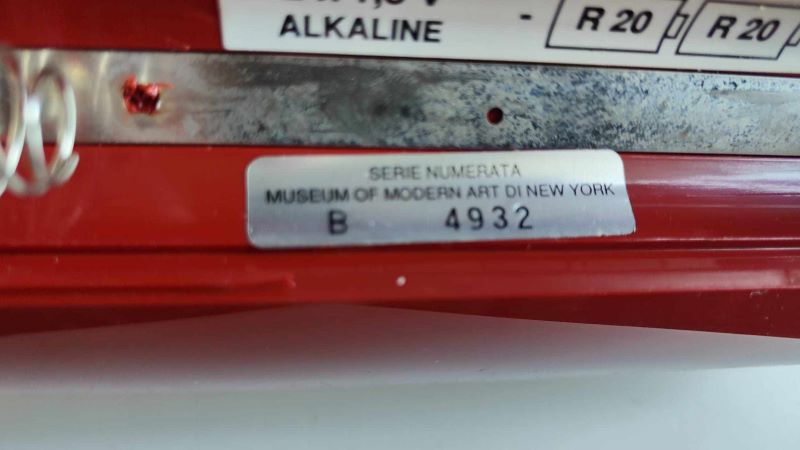
Inc. Solari di Udine S.p.A. è una società che opera prevalentemente nel settore dei sistemi a orologeria d'informazione al pubblico, storicamente legatasi al settore dell'orologeria industriale e resasi famosa per l'invenzione dell'orologio a palette e, in generale, dello schermo a palette.
Il 1725 è l'anno ufficiale di fondazione del primo stabilimento produttivo che era collocato a Pesariis, un piccolo paese montano della Carnia; la ditta Fratelli Solari era conosciuta come “Antica e premiata fabbrica di orologi da torre”: infatti, per oltre due secoli, l'impresa produsse orologi da torre e orologi ornamentali da parete.
Nel corso del XIX secolo, l'azienda s'ingrandì costantemente sviluppando la produzione e assumendo molte persone: da attività puramente artigianale diventò gradualmente una realtà industriale; da ditta individuale si trasformò in società: Fratelli Solari & Co. La produzione subì una battuta d'arresto nel 1917 quando i contraccolpi della prima guerra mondiale comportarono la perdita d'importanti strumenti produttivi.
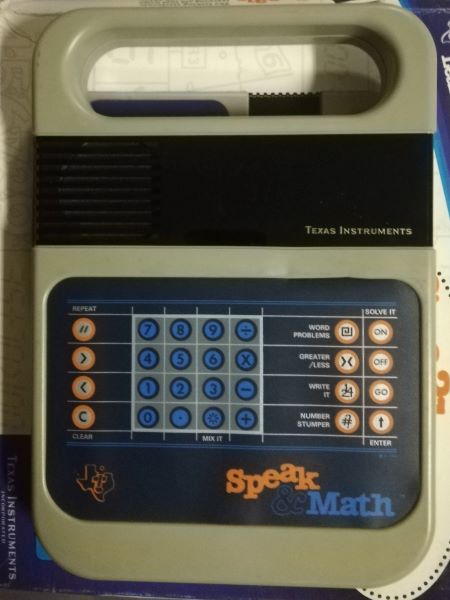 Model: Speak and Math 1v
Battery: 4 x 1,5 C
AC adapter: AC9199
Year: 1981
Chip: TMC0270/CD2704, CD2801, CD2392, CD2393
Info:1 series red logo on the left
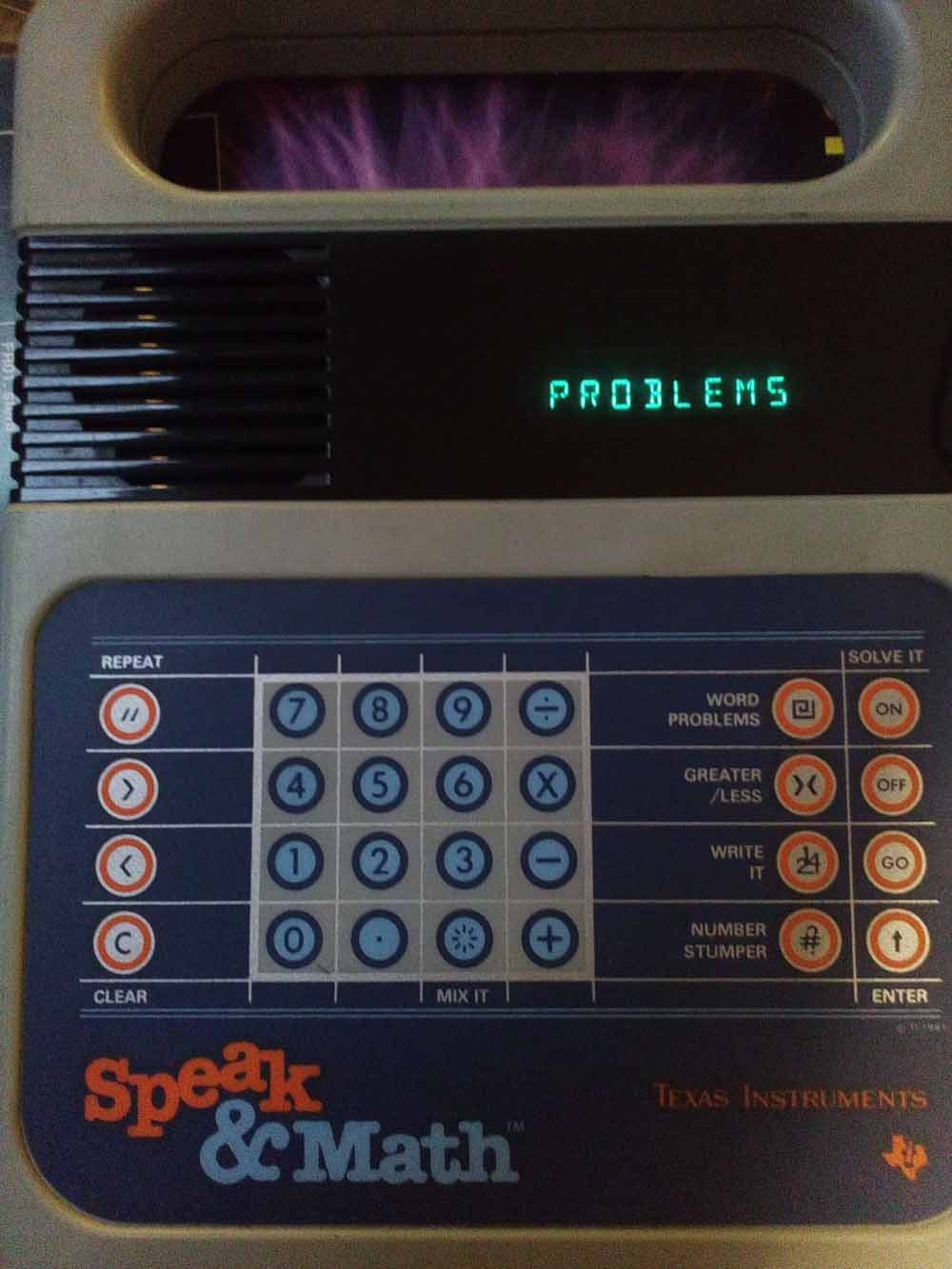 Model: Speak & Math 2v
Battery: 4 x 1,5 C
AC adapter: AC9199
Year: 1986
Chip:
Info: 2 series red logo on the right
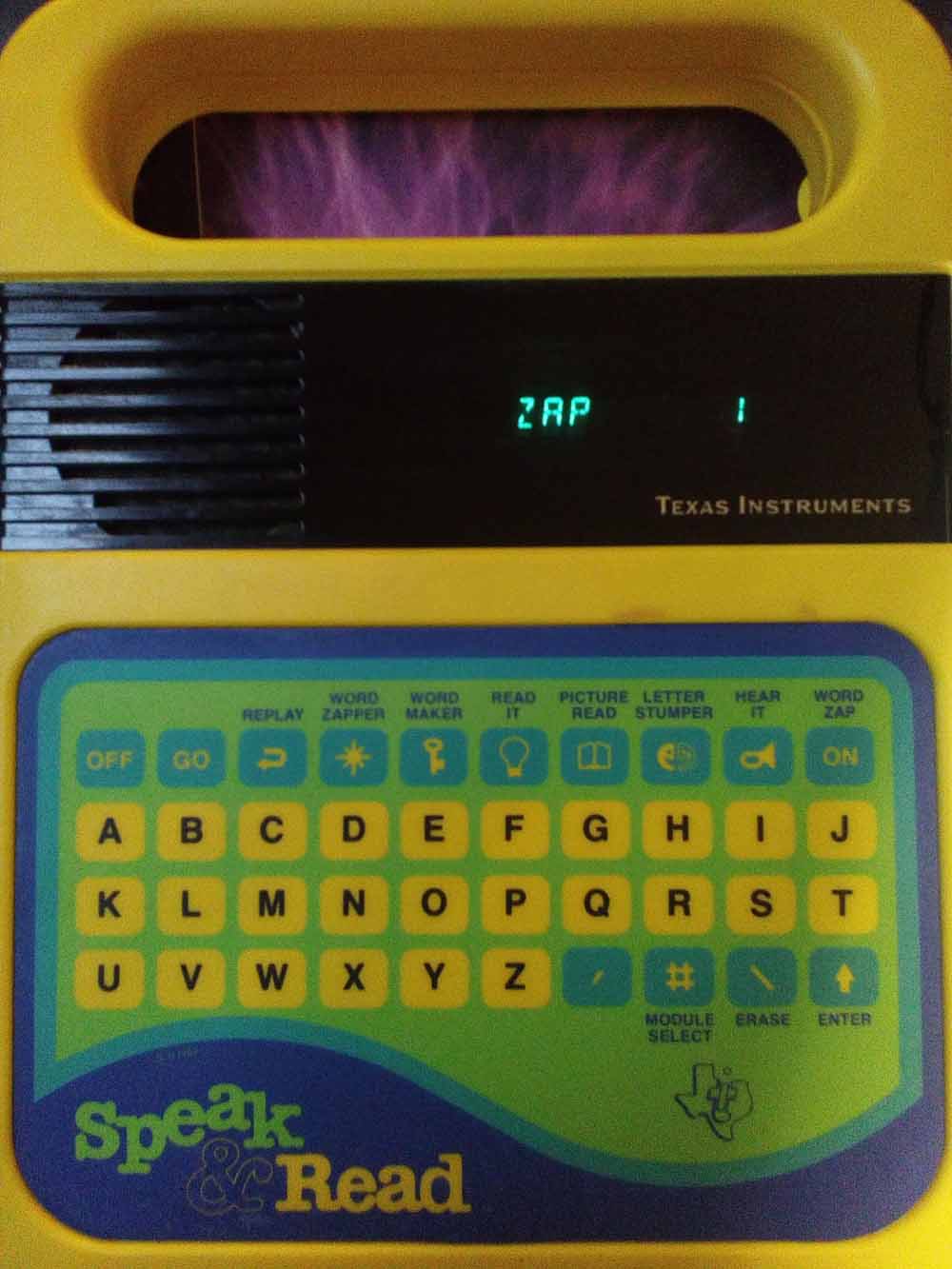 Model: Spell & Read 1 V
Battery: 4 x 1,5 C
AC adapter: AC9199
Year: 1980
Chip:
Info: 1 series blue logo on the center with wave
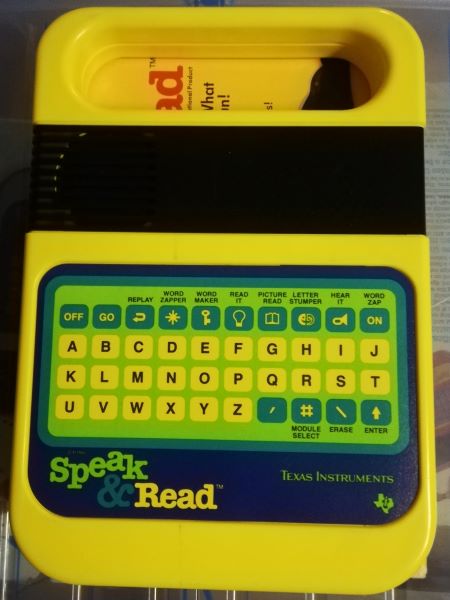 Model: Speak & Read 2 v
Battery: 4 x 1,5 C
AC adapter: AC9199
Year: 1986
Chip: TMC0270/CD2705, TMC0280/CD2801, 2*TMC0350 (CD2394, 2395)
Info:2 series blue logo without wave
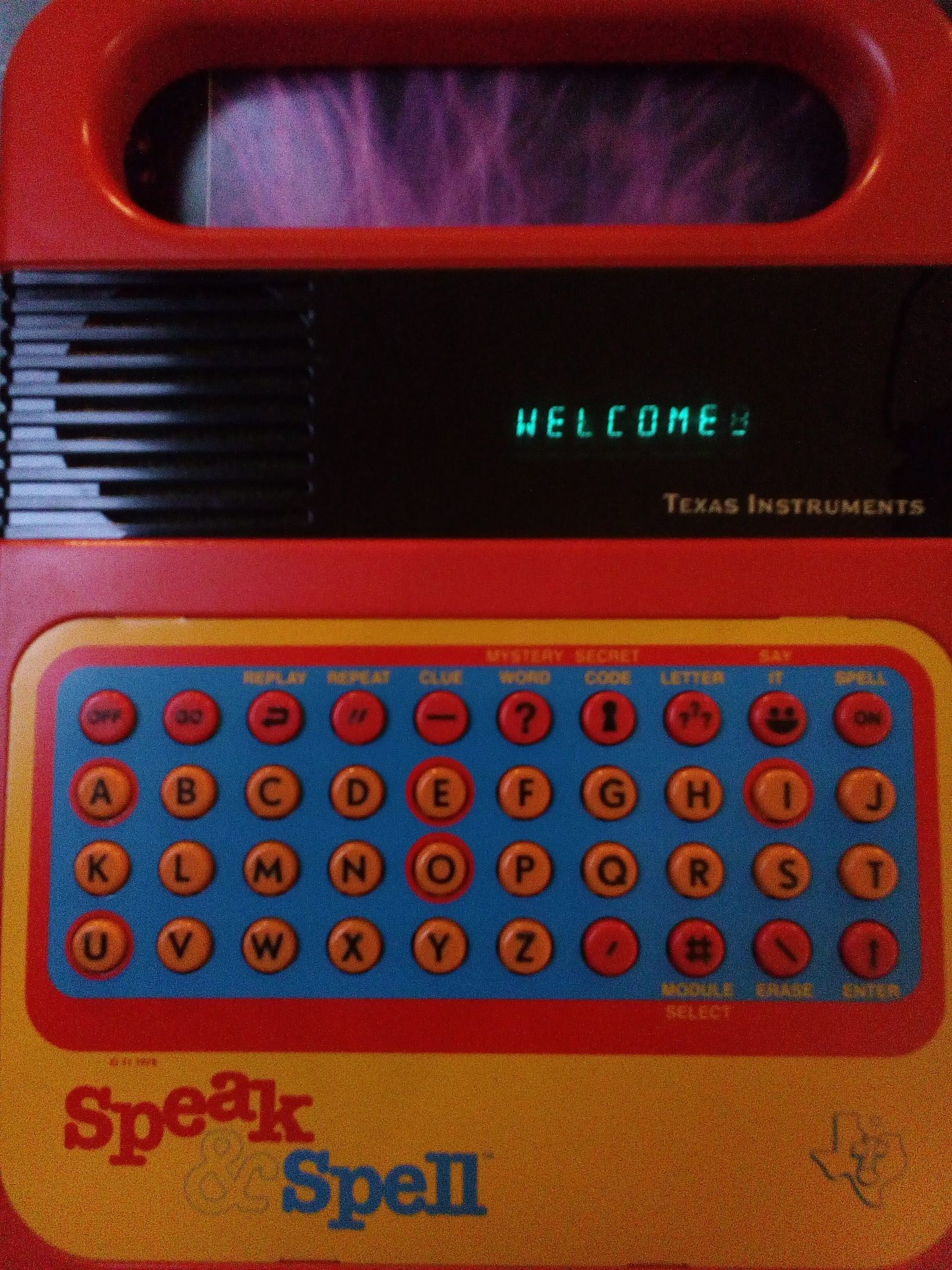 Model: Speak & Spell 1v
Battery: 4 x 1,5 C
AC adapter:
Year: 1978
Chip:
Info: 1 series blue logo on the right. The Speak & Spell series uses the first single chip LPC speech synthesizer with the TMC0280. Subsequent refinements to the Speak & Spell chips led to the TMS5100, 5200 and 5220 speech synthesis processors for commercial products. This Jiminy Cricket uses a CD2801 which it interprets as TMC0280, Version 1.
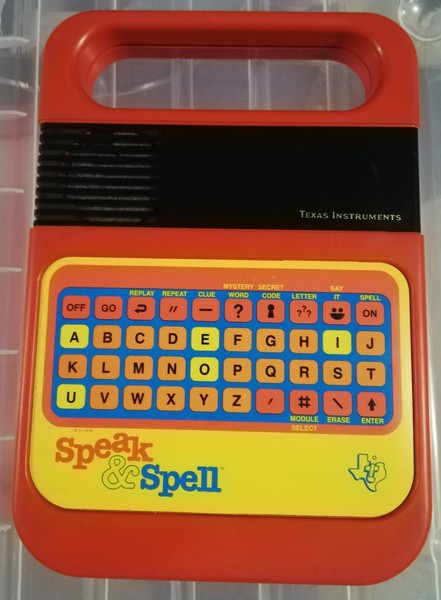 Model: Speak & Spell 1v 1981
Battery: 4 x 1,5 C
AC adapter: AC9199
Year: 1981
Chip: TMC0271, TMC0281, TMC0351 and TMC0352
Info:1 series blue logo on the right
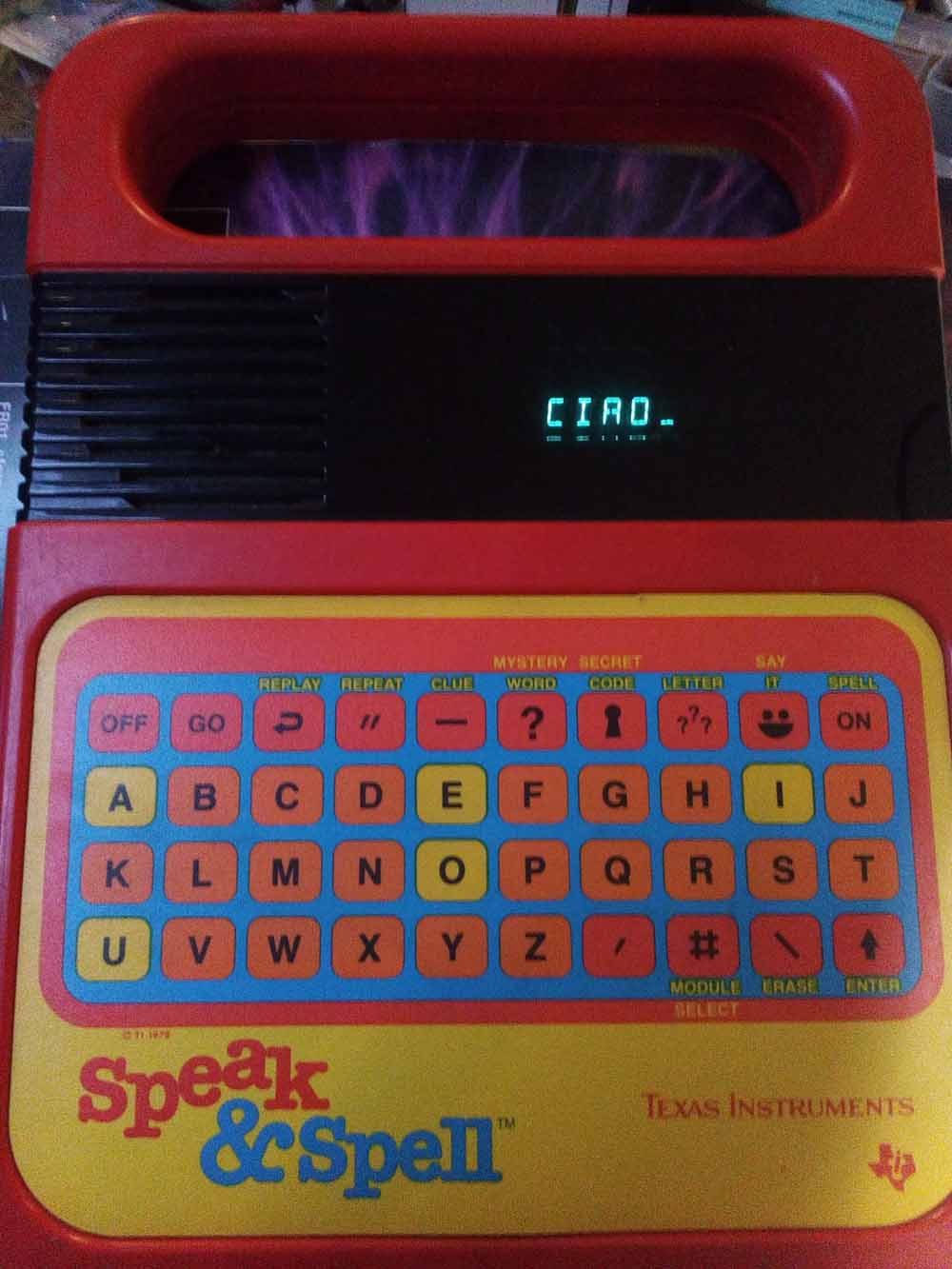 Model: Speak & Spell 2v
Battery: 4 x 1,5 C
AC adapter:
Year: 1986
Chip:
Info: 2 series red logo on the right
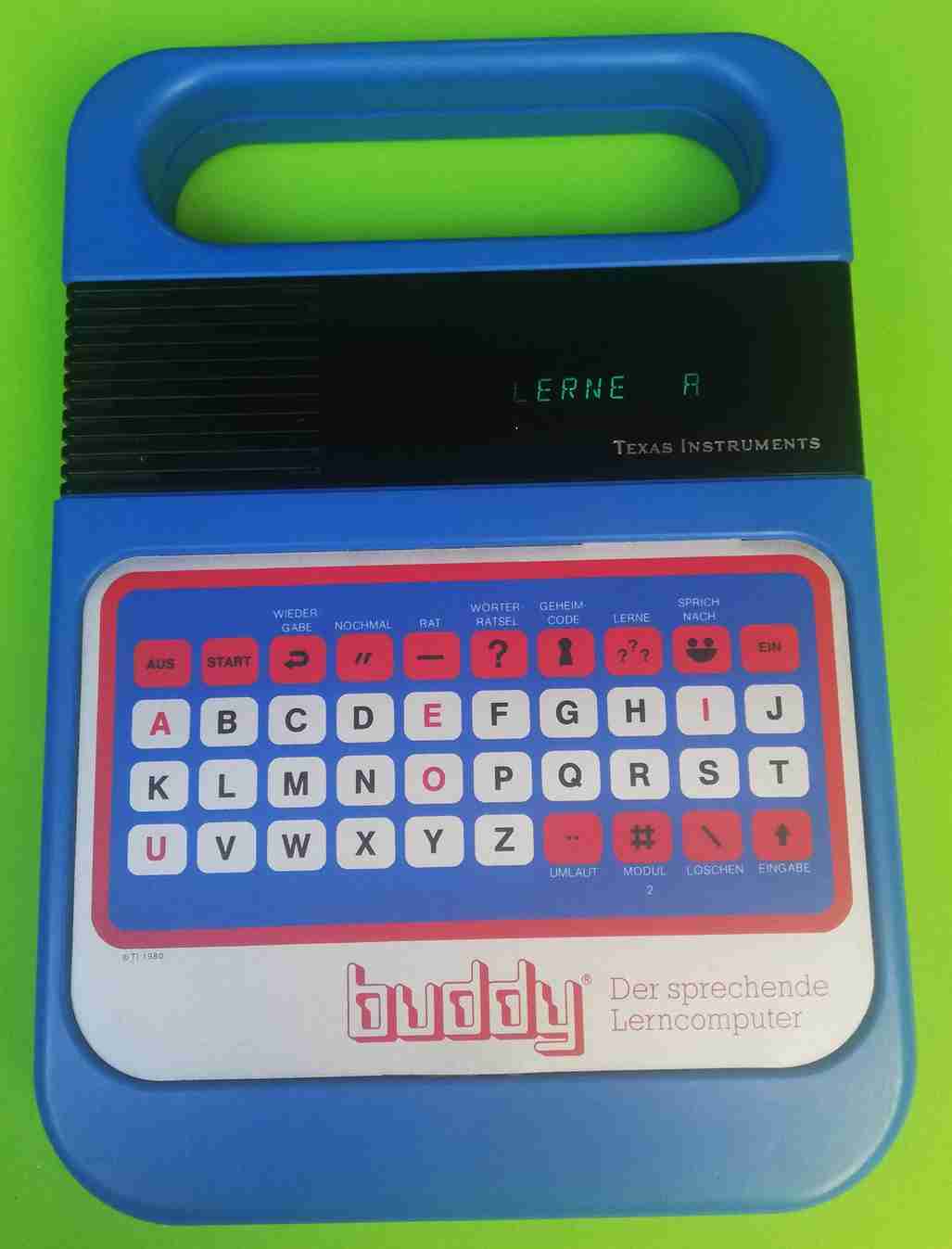 Model: Buddy Speak and Spell German
Battery: 4 x 1,5 C
AC adapter:
Year: 1981
Chip:
Info:It is the German version of the well known Speak & Spell (Type 2).Extremely rare Speak & Spell in German version, called Buddy.Dismantling the Buddy manufactured in December 1981 by Texas Instruments in their Rieti, Italy facility reveals a small surprise: The green fluorescent display of the Buddy uses only 8 alphanumeric characters compared to the 9 characters of the 2nd generation Speak & Spell manufactured in the same timeframe in the United States.
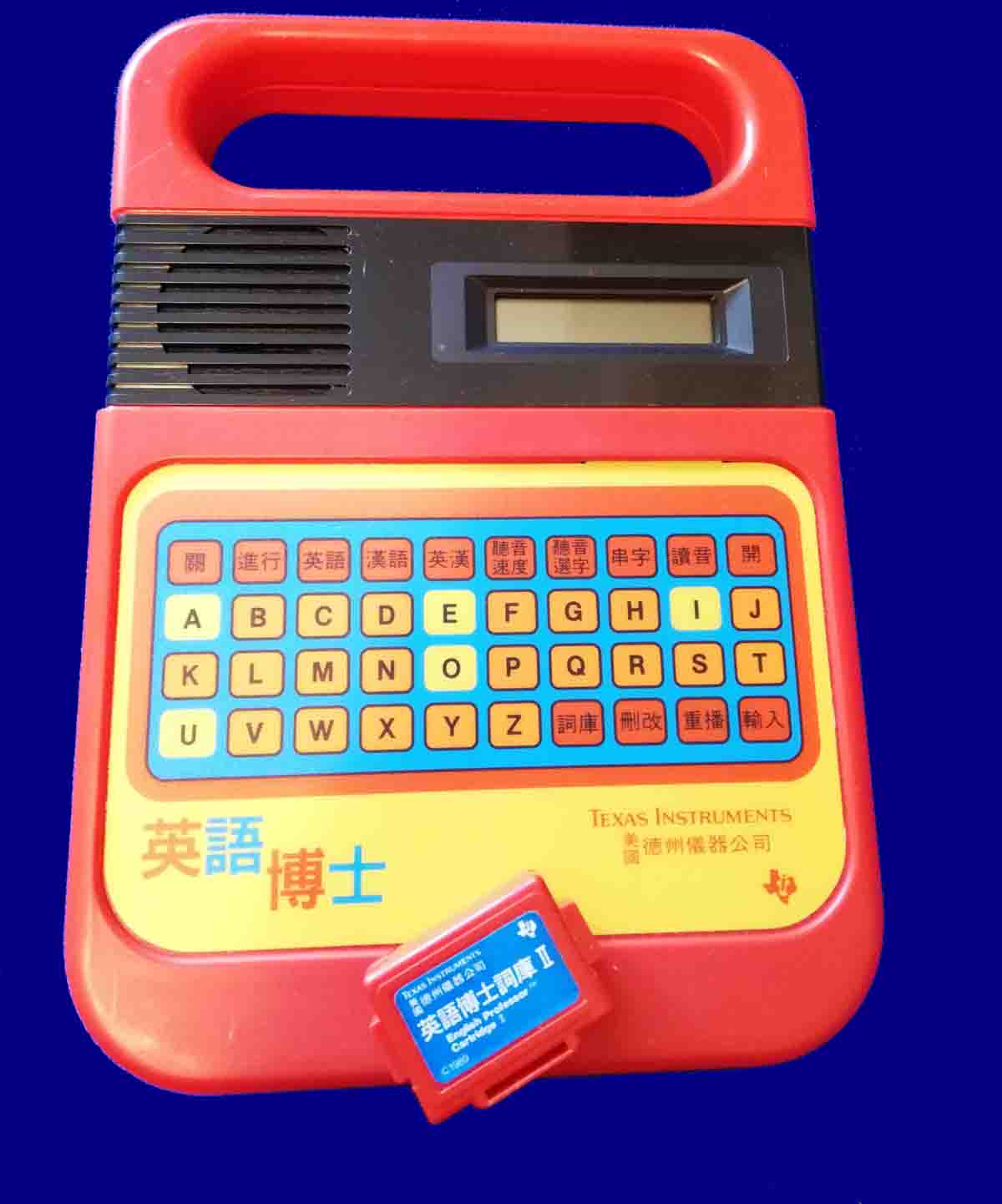 Model: Speak and Spell
Battery: 4 x 1,5 C
AC adapter:
Year: 1991
Chip:
Info: Chines series
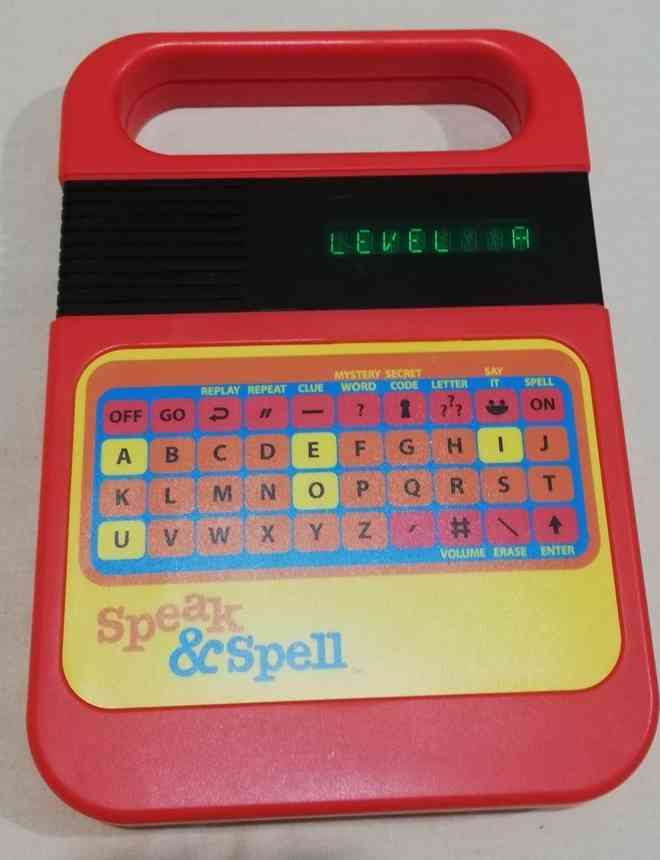 Model: Speak and Spell clone China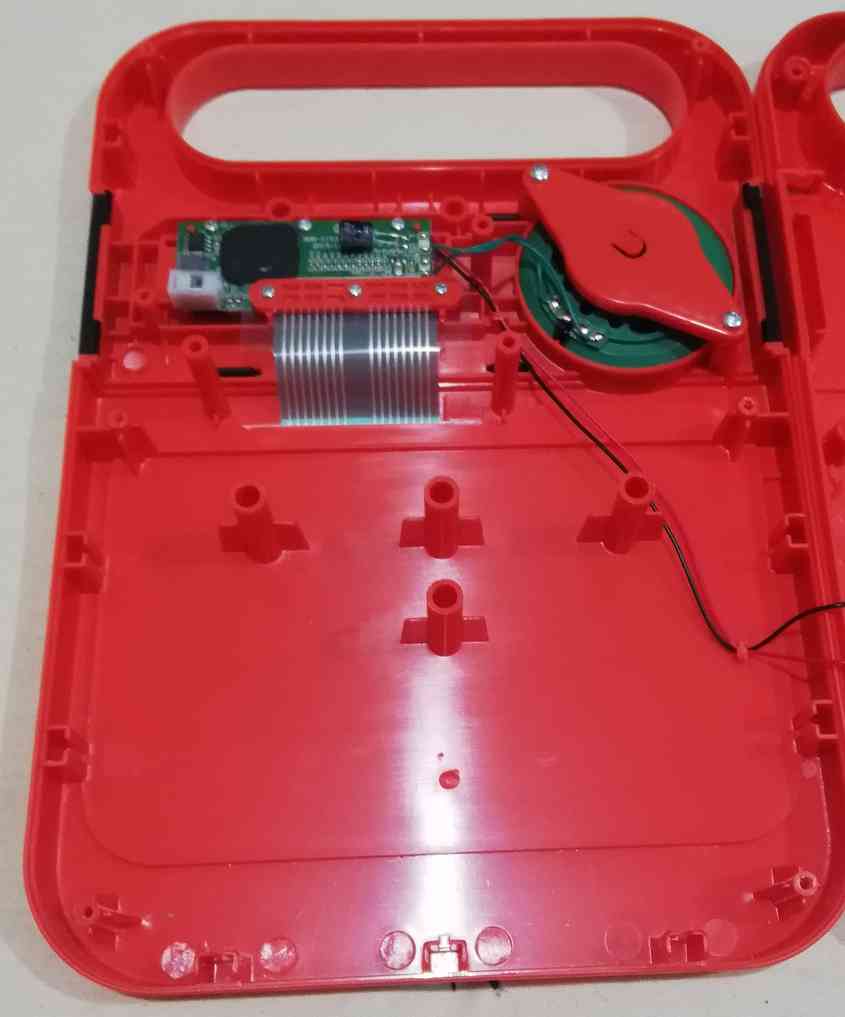
Battery: 3 x 1,5 C
AC adapter:ear: 2019
Chip:
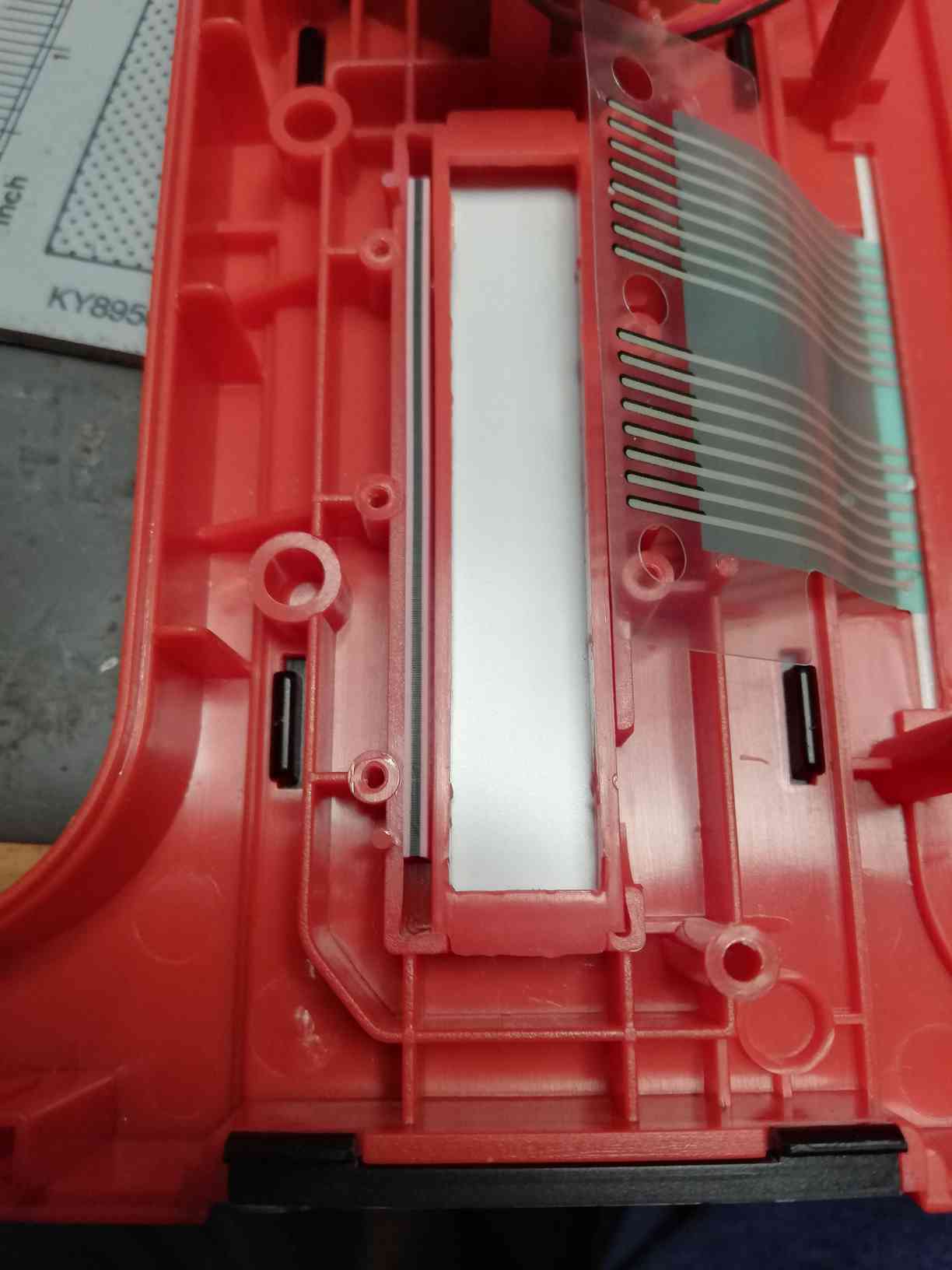
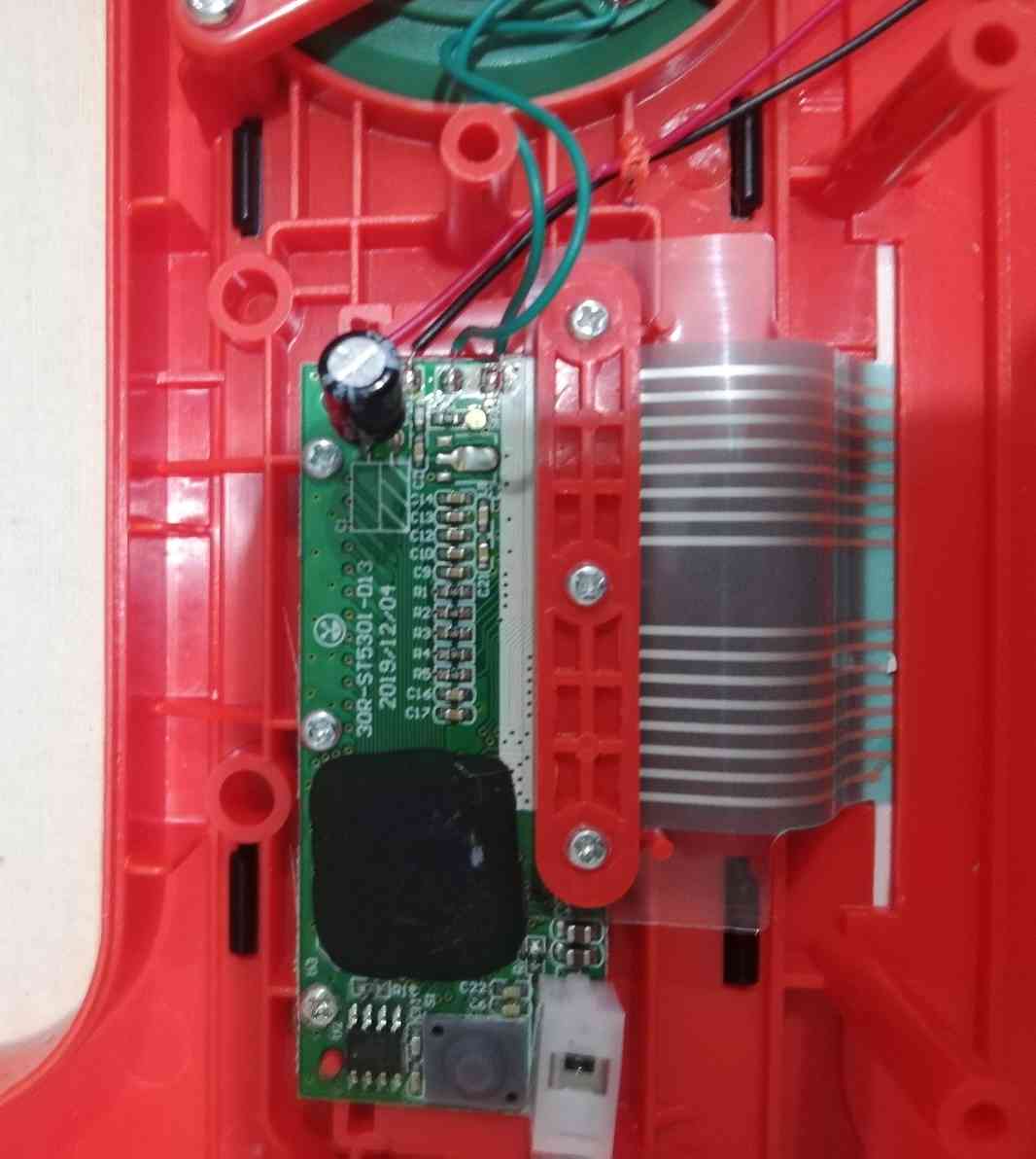
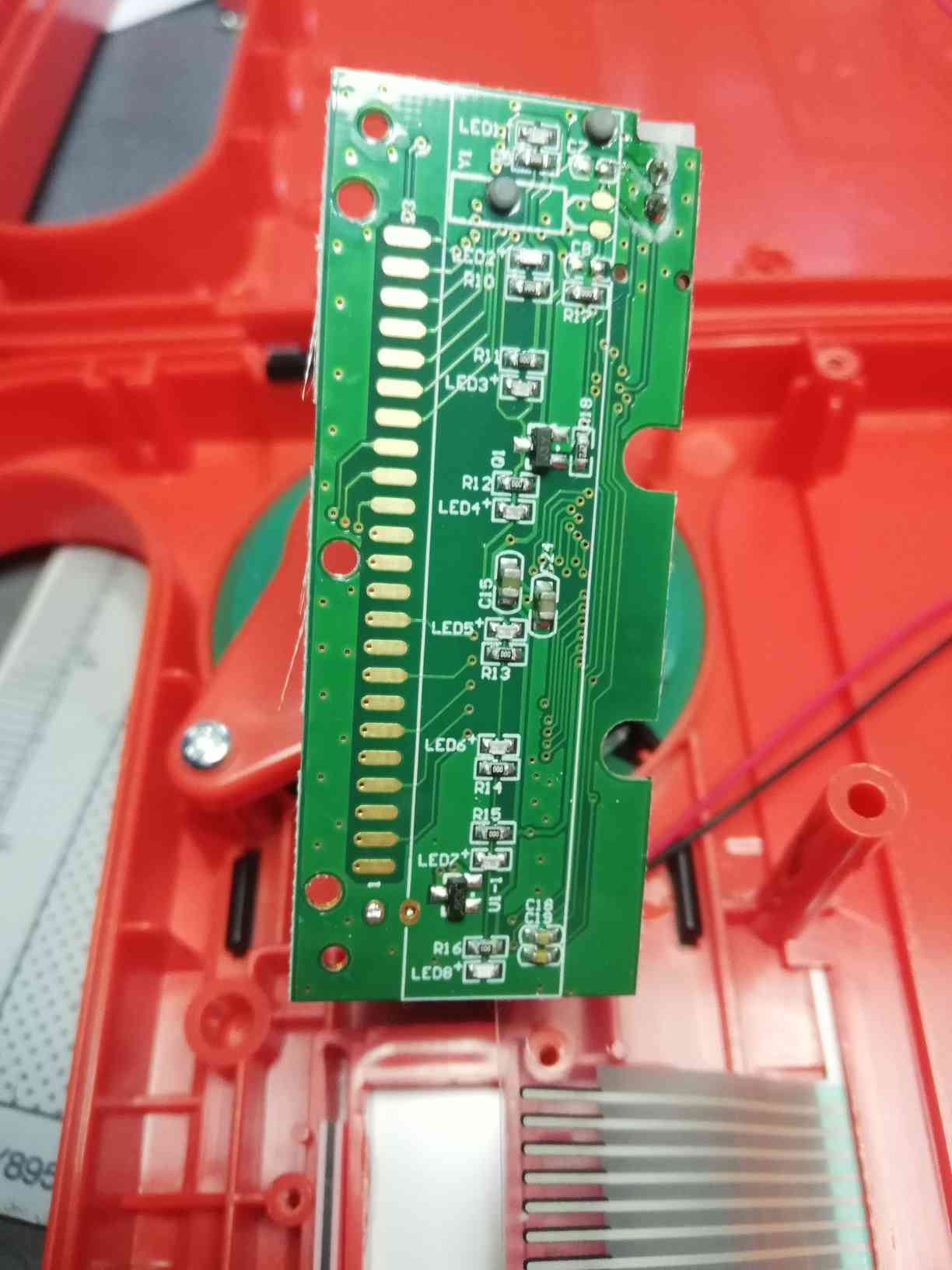
Info: Here is a clone of the famous "Speak & Spell" produced in China in 2019, it uses an LCD display with a green backlight, has the polarizer in reverse, so as to have the green writing on a black background.
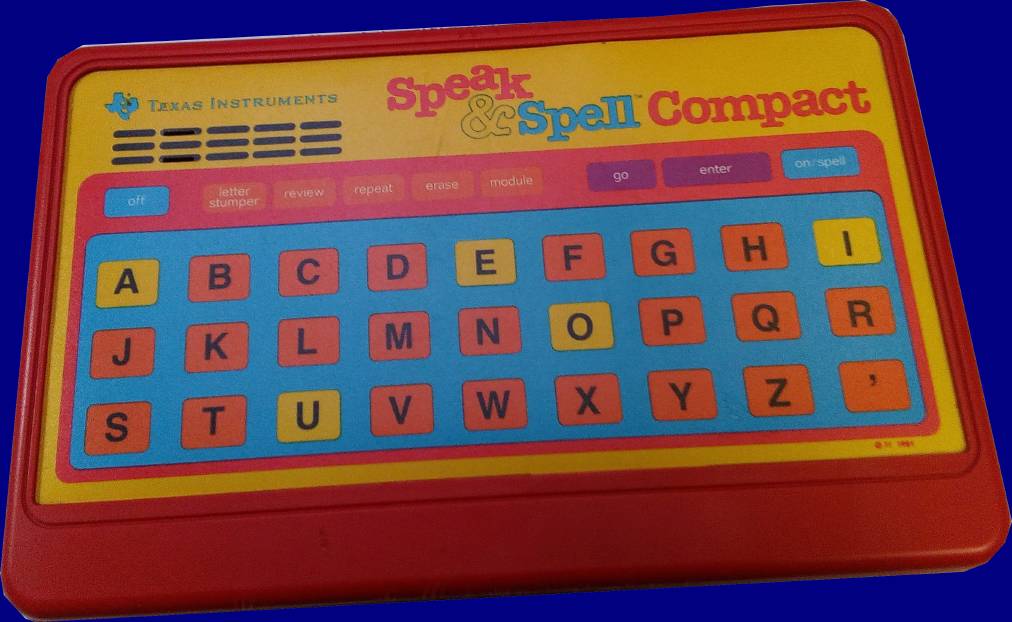 Model: Speak and spell Compact
Battery: 9 volt
AC adapter:
Year: 1982
Chip:
Info:
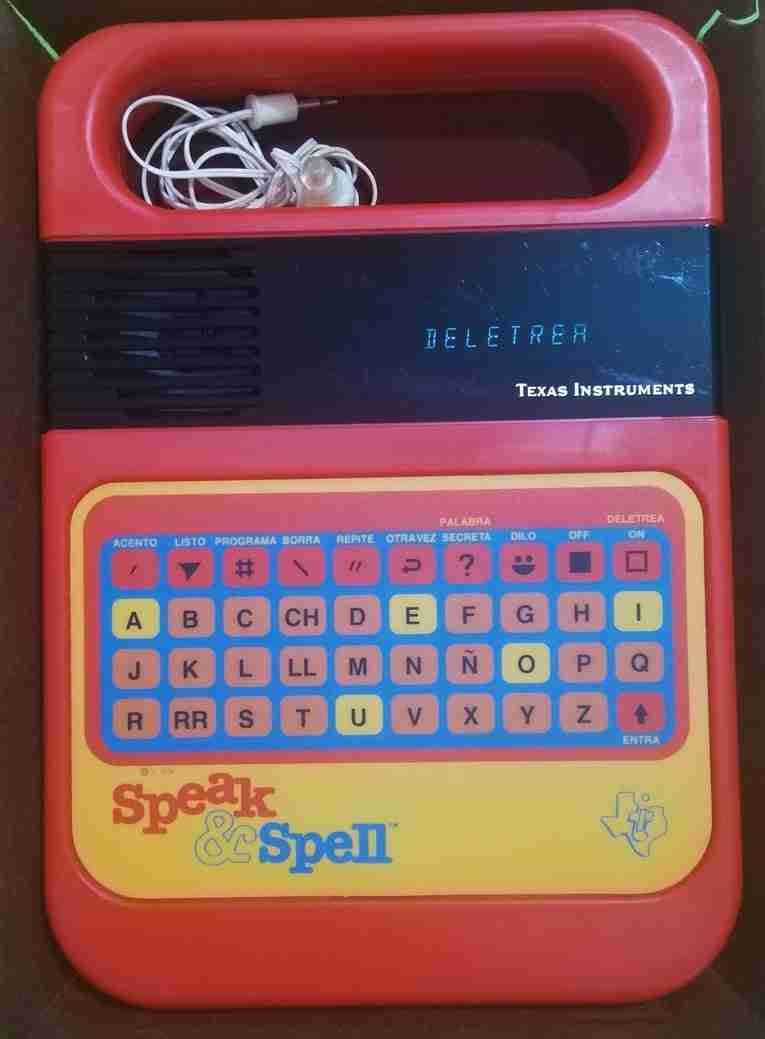 Model: Speak and Spell ESP
Battery: 4 x 1,5 C
AC adapter:
Year: 1981
Chip:
Info:Spain Series. This Prototype of the Speak & Spell Spanish Voice is based on Version 2, please notice the gold lettered "Texas Instruments" on the display screen and the large "TI" logo on the keyboard.
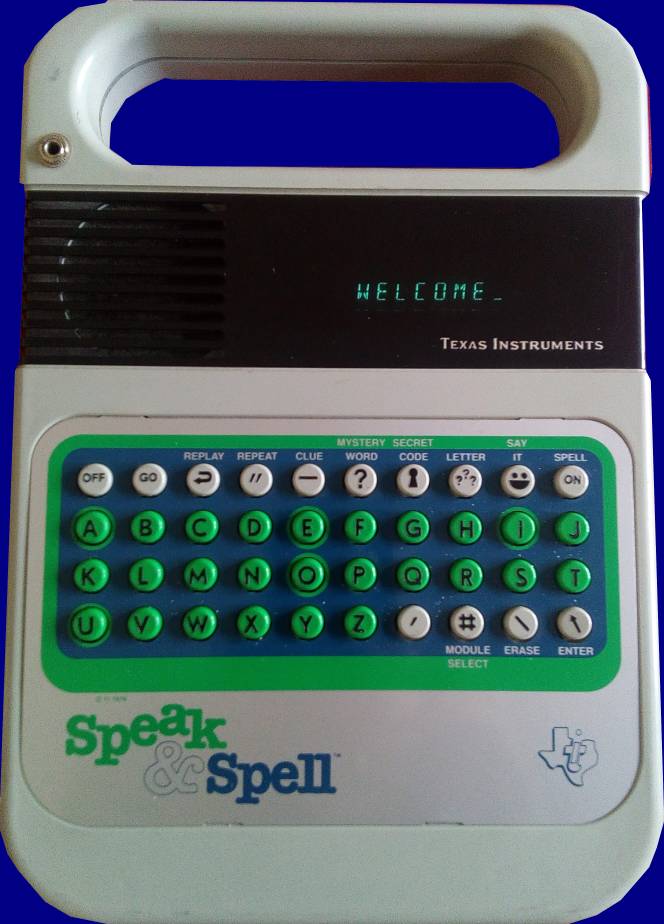 Model: Speak and Spell JAP
Battery: 4 x 1,5 C
AC adapter:
Year: 1979
Chip:
Info: Japan series
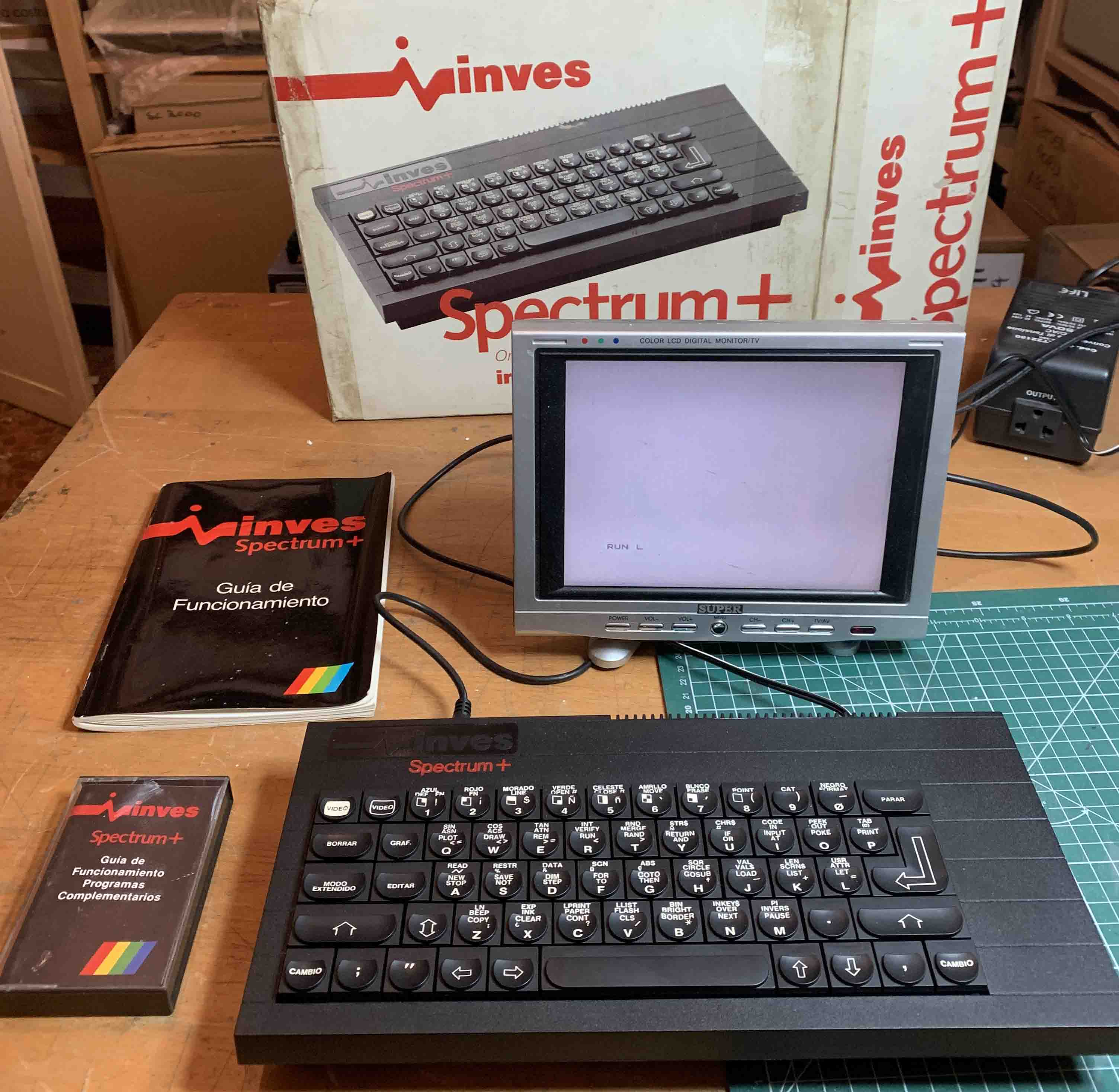 Spectrum Inves +. A clone of the ZX Spectrum+ developed by Investrónica in Spain in 1986, based on the work developed by Investrónica for the ZX Spectrum 128. Released just after Amstrad bought Sinclair Research Ltd, looked much like a normal 48+, but all the inner parts were redesigned. As the ROM was also modified, it has compatibility problems with some games (Bombjack, Commando, Top Gun, etc.).[1] On the rear there was a Kempston joystick connector.
Due to the fact that Invéstronica was the distributor of Sinclair's products in Spain, and because Amstrad already had its own exclusive distributor in Spain (Indescomp, later bought by Amstrad itself), in 1987 Amstrad sued Investrónica to stop the sale of the computer.[2] The court agreed with Amstrad, but the decision was not issued until 1991, when the computer was discontinued as the 8-bit computer market in Spain was dead in favor of 16-bit computers.
On this page you can find the correspondence between the various games that used speech synthesis and the chip used.
| Type | Year | Function | Product | Comments |
| First Voice Synthesis Processors (VSP) | ||||
| TMS5100 (TMC0281) |
1978 | 4-bit peripheral | Speak & Spell, Math, Read, Language Tutor | First VSP (TI internal name ‘0280’) |
| TMS5100A (TMC0281) |
1980 | 4-bit peripheral | Speak & Spell line | Die shrink of TMS5100 |
| TMS5110 (TMC0280/CD2801) |
1980 | 4-bit peripheral | Speak & Spell line | New version of TMS5100, updated LPC table |
| TMS5110A (TMC0280/CD2801) |
1981 | 4-bit peripheral | Speak & Spell line | Die shrink of TMS5110 |
| TMS5110A (TMC0280/CD2802) |
1981 | 4-bit peripheral | Touch & Tell | Different LPC table |
| TSP5110A (TMC0281/CD2801A) |
1985 | 4-bit peripheral | Speak & Spell line | |
| TMS5100 | ||||
| TMS5200 (TMS0285/CD2501E) |
1981 | 8-bit FIFO | (TI internal name ‘0285’) | |
| TMS5220 (CD2805E?) |
1982 | 8-bit FIFO | Speak & Learn | Improved TMS5200, updated LPC table |
| TMS5220C | 1983 | 8-bit FIFO | Enhanced TMS5220 | |
| TSP5220C | 1985 | 8-bit FIFO | Identical with TMS5220C | |
| First Voice Synthesis Memories (VSM) | ||||
| TMS6100NL (TMC0350) |
1978 | 128kBit | Speak & Spell | First VSM |
| TMS6125NL (TMC0355) |
1978 | 16kBit | Spelling B | |
| TMC0351 | 1978 | 128kBit | Speak & Spell (1978) | First VSM |
| TMC0352 | 1978 | 128kBit | Speak & Spell (1978) | Memory, 8 digits |
| TMC0350/CD2302 | 1978 | 128kBit | Speak & Spell Module | © 1978 Vowel Power |
| TMC0350/CD2305 | 1978 | 128kBit | Speak & Spell Module | © 1979 Super Stumpers 4-6 |
| TMC0350/CD2307 | 1978 | 128kBit | Speak & Spell Module | © 1979 Super Stumpers 7-8 |
| TMC0350/CD2308 | 1978 | 128kBit | Speak & Spell Module | © 1979 Basic Builders |
| TMC0350/CD2309 | 1978 | 128kBit | Speak & Spell Module | © 1979 Mighty Verbs |
| TMC0350/CD2310 | 1978 | 128kBit | Speak & Spell Module | © 1980 Homonym Heroes |
| TMC0350/CD2311 | 1979 | 128kBit | Language Tutor | © 1979 Spoken English |
| TMC0350/CD2312 | 1979 | 128kBit | Language Tutor | © 1979 Spoken English |
| TMC0350/CD2313 | 1979 | 128kBit | Language Tutor | © 1979 Spoken English |
| TMC0350/CD2314 | 1979 | 128kBit | Language Tutor | © 1979 Spoken English |
| TMC0350/CD2315 | 1979 | 128kBit | Language Tutor | © 1979 Spoken Spanish |
| TMC0350/CD2316 | 1979 | 128kBit | Language Tutor | © 1979 Spoken Spanish |
| TMC0350/CD2317 | 1979 | 128kBit | Language Tutor | © 1979 Spoken Spanish |
| TMC0350/CD2318 | 1979 | 128kBit | Language Tutor | © 1979 Spoken Spanish |
| TMC0350/CD2327 | 1979 | 128kBit | Language Tutor | © 1979 Spoken French |
| TMC0350/CD2328 | 1979 | 128kBit | Language Tutor | © 1979 Spoken French |
| TMC0350/CD2329 | 1979 | 128kBit | Language Tutor | © 1979 Spoken French |
| TMC0350/CD2330 | 1979 | 128kBit | Language Tutor | © 1979 Spoken French |
| TMC0350/CD2331 | 1979 | 128kBit | Language Tutor | © 1979 Spoken German |
| TMC0350/CD2332 | 1979 | 128kBit | Language Tutor | © 1979 Spoken German |
| TMC0350/CD2333 | 1979 | 128kBit | Language Tutor | © 1979 Spoken German |
| TMC0350/CD2334 | 1979 | 128kBit | Language Tutor | © 1979 Spoken German |
| TMC0350/CD2345 | 1980 | 128kBit | Buddy | |
| TMC0350/CD2346 | 1980 | 128kBit | Buddy | |
| TMC0350/CD2347 | 1980 | 128kBit | Speak & Spell Module | © 1980 Vowel Ventures |
| TMC0350/CD2348 | 1980 | 128kBit | Speak & Spell Module | © 1980 Noun Endings |
| TMC0350/CD2349 | 1980 | 128kBit | Speak & Spell Module | © 1980 Magnificent Modifiers |
| TMC0350/CD2350 | 1980 | 256kBit | Speak & Spell (1980) | Double VSM |
| TMC0350/CD2352 | 1980 | 256kBit | La Dictée Magique | Double VSM |
| TMC0350/CD2353 | 1981 | 256kBit | La Dictée Magique | © 1981 Les Mots de Base |
| TMC0350/CD2354 | 1982 | 256kBit | Speak & Spell Compact (1982) | |
| TMC0350/CD2355 | 1981 | 256kBit | Touch & Tell Module | © 1981 Animal Friends |
| TMC0350/CD2360 | 1982 | 256kBit | Speak & Spell Module | © 1982 ET Fantasy Module |
| TMC0350/CD2361 | 1982 | 256kBit | Touch & Tell Module | © 1982 World of Transportation |
| TMC0350/CD2362 | 1982 | 256kBit | Touch & Tell Module | © 1982 Little Creatures |
| TMC0350/CD2363 | 1982 | 256kBit | Touch & Tell Module | © 1982 E.T. |
| TMC0350/CD2381 | 1986 | 256kBit | Speak & Math | Double VSM |
| TMC0350/CD2392 | 1980 | 256kBit | Speak & Math | Double VSM |
| TMC0350/CD2393 | 1980 | 256kBit | Speak & Math | Double VSM |
| TMC0350/CD2394 | 1980 | 256kBit | Speak & Read | Double VSM |
| TMC0350/CD2395 | 1980 | 256kBit | Speak & Read | Double VSM |
| TMC0350/CD2396 | 1980 | 256kBit | Speak & Read Module | © 1980 Sea Sights |
| TMC0350/CD2397 | 1980 | 256kBit | Speak & Read Module | © 1980 Who´s Who At The Zoo |
| TMC0350/CD3509 | 1980 | 256kBit | Language Teacher | © 1980 German for Travel |
| TMC0350/CD3534 | 1981 | 256kBit | Speak & Read Module | © 1981 A Dog on a Log |
| TMC0350/CD3535 | 1981 | 256kBit | Speak & Read Module | © 1981 The Seal That Could Fly |
| TMC0350/CD3536 | 1981 | 256kBit | Speak & Read Module | © 1981 A Ghost in the House |
| TMC0350/CD3538 | 1981 | 256kBit | Speak & Read Module | © 1981 On The Track |
| TMC0350/CD3539 | 1981 | 256kBit | Speak & Read Module | © 1981 The Third Circle |
| TMC0350/CD3540 | 1981 | 256kBit | Speak & Read Module | © 1981 The Millionth Knight |
| TMC0355/CD2601 | 1978 | 16kBit | Mr. Challenger | Small housing |
| TMC0355/CD2602 | 1978 | 16kBit | Spelling B | Small housing |
| TMC0355/CD2603 | 1978 | 16kBit | LETTERlogic (France) | Small housing |
| TMC0355/CD2604 | 1978 | 16kBit | LETTERlogic | Small housing |
| TMC0355/CD2605 | 1980 | 16kBit | Mr. Challenger (Espaniol) | Small housing |
| TMC0355/CD2607 | 1979 | 16kBit | Spelling ABC | Small housing |
| CD2610 | 1981 | ??? | Touch & Tell | Small housing |
| CD2611 | 1981 | Touch & Tell Module | © 1981 Alphabet Fun | |
| CD2612 | 1981 | Touch & Tell Module | © 1981 Number Fun | |
| CD2613 | 1981 | Touch & Tell Module | © 1981 All About Me | |
| CD2614 | 1981 | Speak & Math | Found in 1986 model | |
| TMC0350/CD62047 | 1981 | ??? | La Dictée Magique | © 198? Les Animaux Familiers |
| TMC0350/CD62048 | 1981 | ??? | La Dictée Magique | © 198? Les Magasins De La Rue |
| TMC0350/CD62170 | 1981 | ??? | Touch & Tell (UK) | |
| TMC0350/CD62171 | 1981 | ??? | Le Livre Magique | |
| TMC0350/CD62172 | 1981 | ??? | Tipp & Sprich | |
| TMC0350/CD62173 | 1981 | ??? | Les Maths Magiques | |
| TMC0350/CD62175 | 1981 | ??? | Speak & Spell (UK) | |
| TMC0350/CD62176 | 1982 | ??? | Libro Parlante | |
| TMC0350/CD62177 | 1982 | ??? | La Dictée Magique | © 198? Les Mots Difficiles |
| TMC0350/CD62178 | 1982 | ??? | La Dictée Magique | © 198? Les Extra-Terrestres |
| TMC0350/CD62190 | 1982 | ??? | Grillo Parlante | |
| TMC0350/CD62313 | 198x | ??? | Grillo Parlante Module | SuperModulo |
| Later Speech Synthesizers (TSP50C0x/1x) | ||||
| TSP50C04 | 4k ROM, 576 bits RAM |
|||
| TSP50C06 | 6k ROM, 576 bits RAM |
|||
| TSP50C10 | 8k ROM, 1088 bits RAM |
3 D/A channels | ||
| TSP50C10/CSM10047 | 16k ROM, 1088 bits RAM |
Super Speak & Math | ||
| TSP50C10/CSM10087 | 16k ROM, 1088 bits RAM |
Super Speak & Spell | Only models manufac. later 1991 | |
| TSP50C11 | 16k ROM, 1088 bits RAM |
3 D/A channels | ||
| TSP50C11/CSM11012 | 16k ROM, 1088 bits RAM |
Peek-A-Boo Zoo | ||
| TSP50C11/CSM11039 | 16k ROM, 1088 bits RAM |
Passport Game | ||
| TSP50C11/CSM11122 | 1992 | 16k ROM, 1088 bits RAM |
Talking Mouse Computer | |
| TSP50C11/CSM11124 | 16k ROM, 1088 bits RAM |
Magic Clown | ||
| TSP50C11/CSM11125 | 16k ROM, 1088 bits RAM |
Storytime Sorter | ||
| TSP50C11/CSM11128 | 16k ROM, 1088 bits RAM |
Mouse Computer | ||
| TSP50C11/CSM11129 | 16k ROM, 1088 bits RAM |
L'Ordinateur Magique | ||
| TSP50C11/CSM11157 | 1993 | 16k ROM, 1088 bits RAM |
My Own Playphone | |
| TSP50C11/CSM11159 | 16k ROM, 1088 bits RAM |
Magic Melody | ||
| TSP50C11/CSM11163 | 16k ROM, 1088 bits RAM |
Teddy Touch & Tell | ||
| TSP50P11 | 16k OTP-ROM, 1088 bits RAM |
User programmable | ||
| TSP50C12 | 16k ROM, 1088 bits RAM |
68 pins, LCD driver | ||
| TSP50C13 | 8k ROM, 1088 bits RAM |
|||
| TSP50C14 | 16k ROM, 576 bits RAM |
|||
| TSP50C14 | 16k ROM, 576 bits RAM |
Discovery Depot | ||
| TSP50C14 | 16k ROM, 576 bits RAM |
Touch & Talkies | ||
| TSP50C14/CSM14042 | 16k ROM, 576 bits RAM |
Touch & Talkies | Crazy Clubhouse | |
| TSP50C14/CSM14053 | 16k ROM, 576 bits RAM |
Touch & Talkies | Wordy Wagon | |
| TSP50C19 | 32k ROM, 576 bits RAM |
|||
| TSP53C32A | 16k ROM, 1088 bits RAM |
TSP50C10 with integrated word list (Female voice, 48 words) |
||
| TSP53C33A | 16k ROM, 1088 bits RAM |
TSP50C10 with integrated word list (Male voice, 48 words) |
||
| Later Speech Synthesizers (MSP50C3x) | ||||
| MSP50C30 | 4k ROM, 8320 bits RAM |
100 pins (package), 68 pins (die) | ||
| CSM30003 | 4k ROM, 8320 bits RAM |
Catalogue part | 100 pins (package), 68 pins (die) | |
| MSP50C32 | 16k ROM, 2176 bits RAM |
16 pins (package), 16 pins (die) | ||
| MSP50C33 | 32k ROM, 2176 bits RAM |
16 pins (package), 16 pins (die) | ||
| MSP50C34 | 64k ROM, 2176 bits RAM |
16 pins (package), 30 pins (die) | ||
| MSP50P34 | 64k OTP-ROM, 2176 bits RAM |
User programmable 16 pins (package), 30 pins (die) |
||
| MSP50C37 | 16k ROM, 2176 bits RAM |
28 pins (package), 28 pins (die) | ||
| MSP50P37 | 16k OTP-ROM, 2176 bits RAM |
User programmable 28 pins (package), 28 pins (die) |
||
| MSP53C39 | Synthesizer for music (FM) and speech (LPC, MELP, CELP) |
|||
| Later Speech Synthesizers (TSP50C50/TSP50C4x) | ||||
| TMP50C40/CM54128 | 1986 | Little Maestro | ||
| TMP50C40/CD54129 | 1986 | Speak & Music | ||
| TMP50C40/CD54148 | 1986 | La Musique Magique | ||
| TMP50C40/CD54149 | 1986 | Speak & Music (UK) | ||
| TMP50C40/CD54169 | 1986 | Fonillo Suonaparla | ||
| TMP50C40/CD54170 | 1986 | Mathe-Fix | ||
| TSP50C41/CSM41014 | 1988 | Voyager | ||
| TSP50C42/CSM42005 | Touch & Discover | |||
| TSP50C42/CSM42008 | 1988 | Super Speak & Read | ||
| TSP50C42/CSM42014 | 1989 | Super Libro Parlante | ||
| TSP50C42/CSM42020 | Super Speak & Spell | Only during the years 1989-1990 | ||
| TSP50C42/CSM42023 | 1989 | Le Super Livre Magique | Like Touch & Discover | |
| TSP50C42/CSM42024 | 1990 | Speak & Spell Professor | Chinese Version | |
| TSP50C42/CSM42025 | 1990 | Lesefreund, Chatter-Book | ||
| TSP50C42/CSM42027 | 1990 | La Super Dictée Magique | ||
| TSP50C42/CSM42030 | 1990 | Super Speak & Spell (91) La Super Dictée Magique |
||
| TSP50C42/CSM42031 | El Loro Parlachín, El Loro Profesor | |||
| TSP50C42/CSM42042 | 1992 | Touch & Discover School Edition | ||
| TSP50C42/CSM42047 | Magic Reading Desk | |||
| TSP50C43/CSM57303 | Music Star | |||
| TSP50C44/CSM44012 | Computer Fun | |||
| TSP50C44/CSM44017 | Computer Fun | English edition | ||
| TSP50C44/CSM44024 | Computer Fun | German edition | ||
| Later Speech Synthesizers (MSP50C6XX) | ||||
| MSP50C601 | 1999/2000 | 128k*17 ROM 640*17 RAM |
17-bit words ROM, 17-bits words RAM | |
| MSP50C604 | 1999/2000 | 64k*17 ROM 640*17 RAM |
||
| MSP50C605 | 1999/2000 | 224k*17 ROM 640*17 RAM |
||
| MSP50C614 | 1999/2000 | 32k*17 ROM 640*17 RAM |
||
| MSP50P614 | 1999/2000 | 32k*17 EPROM 640*17 RAM |
EPROM based MSP50C614 for evaluation | |
| Later Speech Synthesizers Memories (TSP60Cxx) | ||||
| TSP60C18 | 256kBit | DIP16 | ||
| TSP60C81 | 1024kBit | DIP28 | ||
| TSP60C18/CMM18001 | Super Speak & Math | |||
| TSP60C18/CMM18004 | Super Speak & Spell | |||
| TSP60C19/CMM19002 | Touch & Discover | © 1987 | ||
| TSP60C19/CMM19005 | Voyager | © 1988 | ||
| TSP60C19/CMM19006 | Computer Fun | |||
| TSP60C19/CMM19010 | Chatter-Book | |||
| TSP60C19/CMM19016 | Super Libro Parlante | © 1989 | ||
| TSP60C19/CMM19018 | Lesefreund | |||
| TSP60C19/CMM19025 | Le Super Livre Magique | © 1989 | ||
| TSP60C19/CMM19027 | Chatter-Book | |||
| TSP60C19/CMM19028 | Lesefreund Module | |||
| TSP60C19/CMM19031 | La Super Dictée Magique | © 1990 | ||
| TSP60C19/CMM19035 | Grillo Parlante Piu | © 1990 | ||
| TSP60C19/CMM19036 | El Loro Parlanchín | © 1990 | ||
| TSP60C19/CMM19037 | Grillo Parlante Piu | © 1990 Modulo di Espansione No1 | ||
| TSP60C19/CMM19040 | Computer Fun (UK) | © 1990 | ||
| TSP60C19/CMM19041 | El Loro Parlanchín | © 1990 Modulo de Extension No1 | ||
| TSP60C19/CMM19044 | La Super Dictée Magique | © 1991 Module d' extension No2 | ||
| TSP60C19/CMM19048 | Super Speak & Spell (91) | |||
| TSP60C19/CMM19049 | La Super Dictée Magique | © 1991 Anglais 1 | ||
| TSP60C19/CMM19054 | El Loro Profesor | |||
| TSP60C21/CMM21002 | Touch & Discover | © 1987 | ||
| TSP60C21/CMM21003 | Touch & Discover Module | © 1987 New Discoveries | ||
| TSP60C21/CMM21004 | Touch & Discover Module | © 1987 Advanced Discoveries | ||
| TSP60C21/CMM21008 | Super Speak & Read Module | © 1988 | ||
| TSP60C21/CMM21011 | Voyager Module | © 1988 Journey into Space | ||
| TSP60C21/CMM21013 | Voyager Module | © 1988 Journey to Birds & Reptiles | ||
| TSP60C21/CMM21014 | Voyager Module | © 1989 Journey across The United States | ||
| TSP60C21/CMM21016 | Voyager Module | © 1988 Journey to The Prehistoric World | ||
| TSP60C21/CMM21018 | Voyager Module | © 1988 Journey to Exotic Animals | ||
| TSP60C21/CMM21026 | La Lecture Magique | © 1989 Module d' extension No1 | ||
| TSP60C21/CMM21028 | Voyager Module | © 1989 Journey to U.S. Presidents | ||
| TSP60C21/CMM21029 | Voyager Module | © 1989 Journey to Language Arts | ||
| TSP60C21/CMM21030 | Voyager Module | © 1989 Journey to Human Anatomy | ||
| TSP60C80/CMM80002 | Super Speak & Read Magic Reading Desk |
© 1988 | ||
| TSP60C80/CMM80004 | Speak & Spell Professor | © 1991 CHINESE MODULE II | ||
| TSP60C80/CMM80008 | Touch & Discover School Edition | © 1992 ENGLISH MODULE | ||
| TSP60C81/CMM81006 | Passport Game | |||
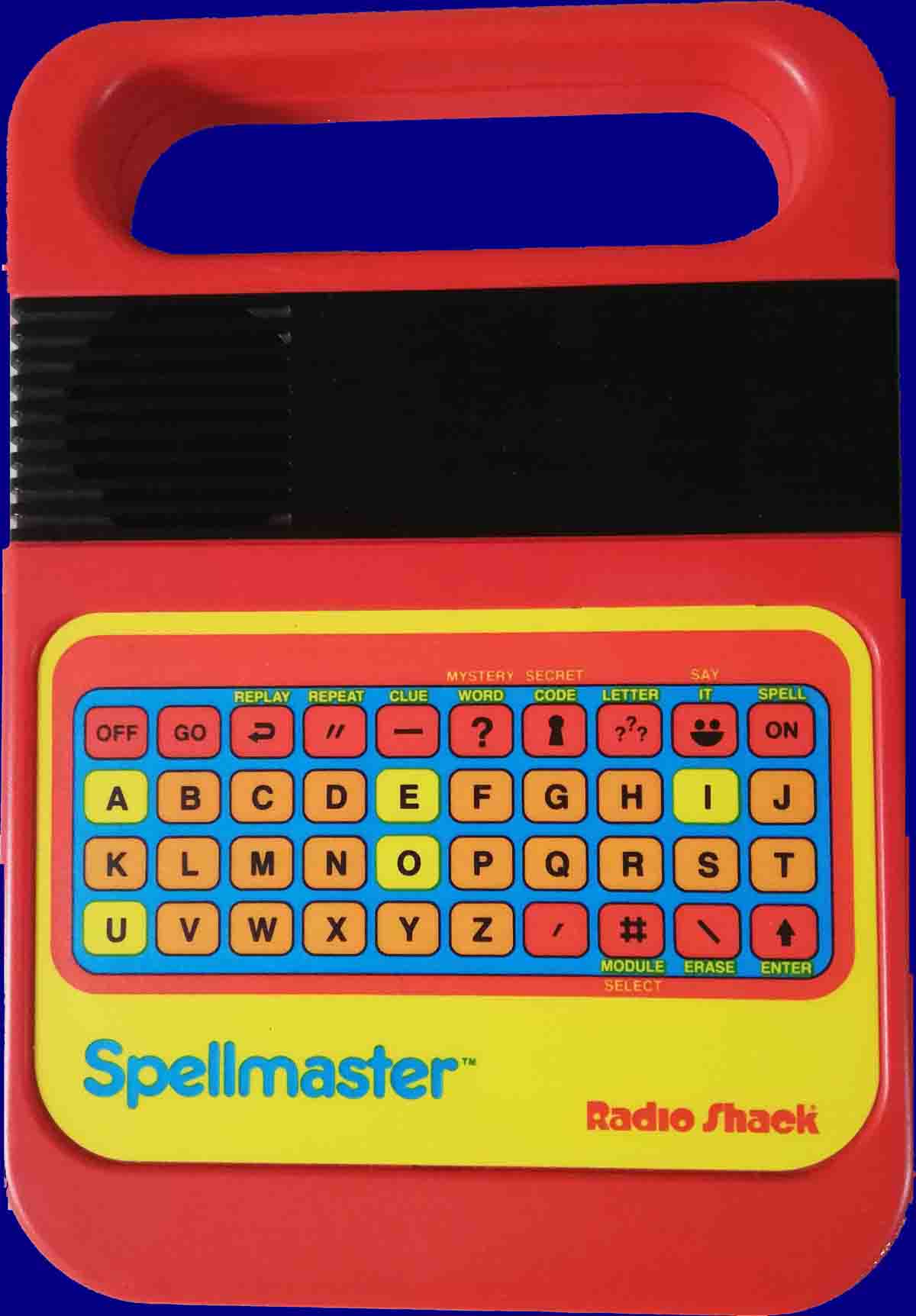 Model: Spell master Radio shack
Battery: 4 x 1,5 V type C
AC adapter:
Year: 1988
Chip:
Info: The Radio Shack Spellmaster) was manufactured in 1988 and represents the last design iteration of the Speak & Spell family. The printed circuit board (PCB) itself is much smaller than the original Speak & Spell design.
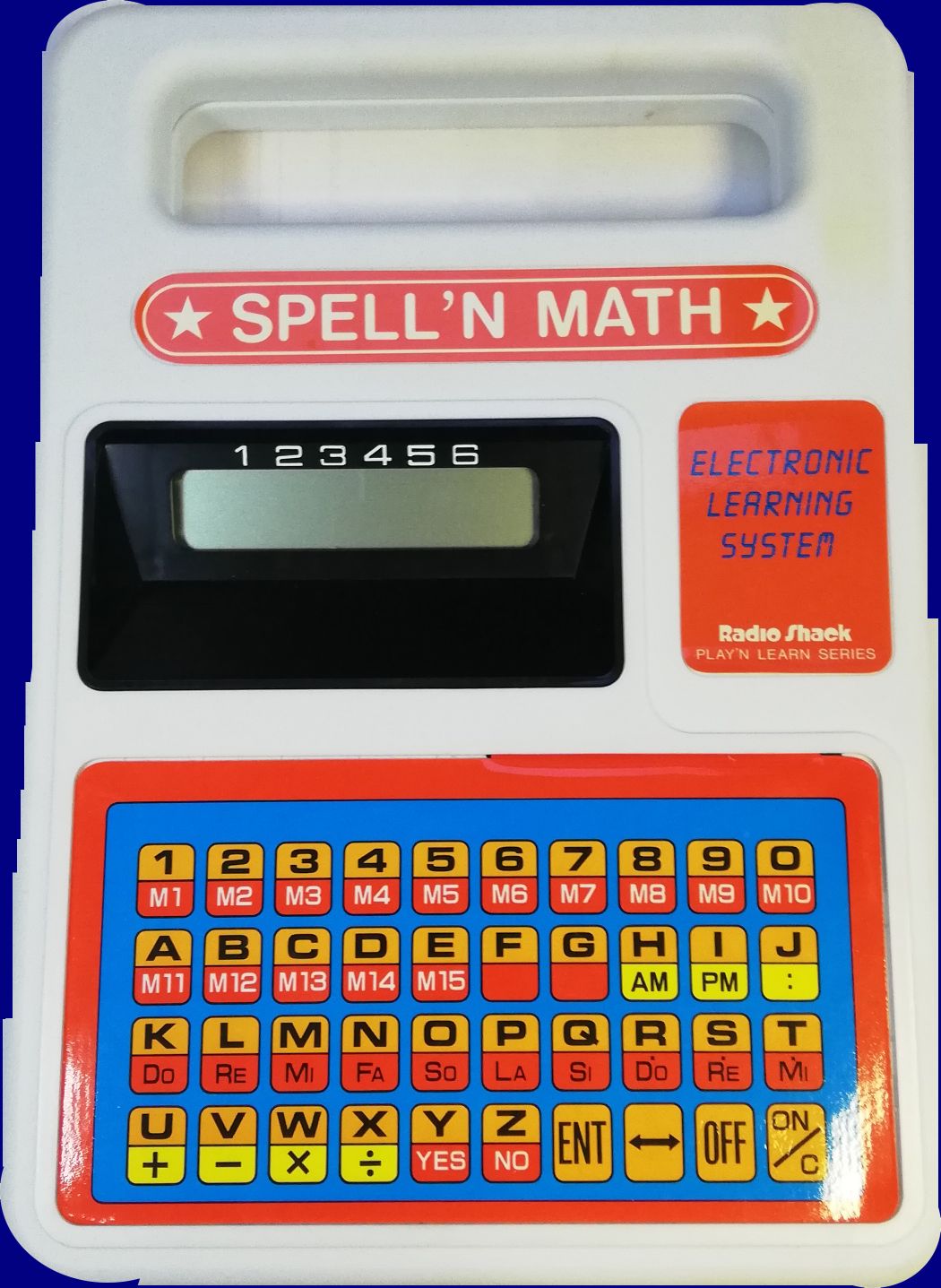 Model: Spell' N
Battery: 4 x 1,5 V type C
AC adapter:
Year: 1992
Chip:
Info:
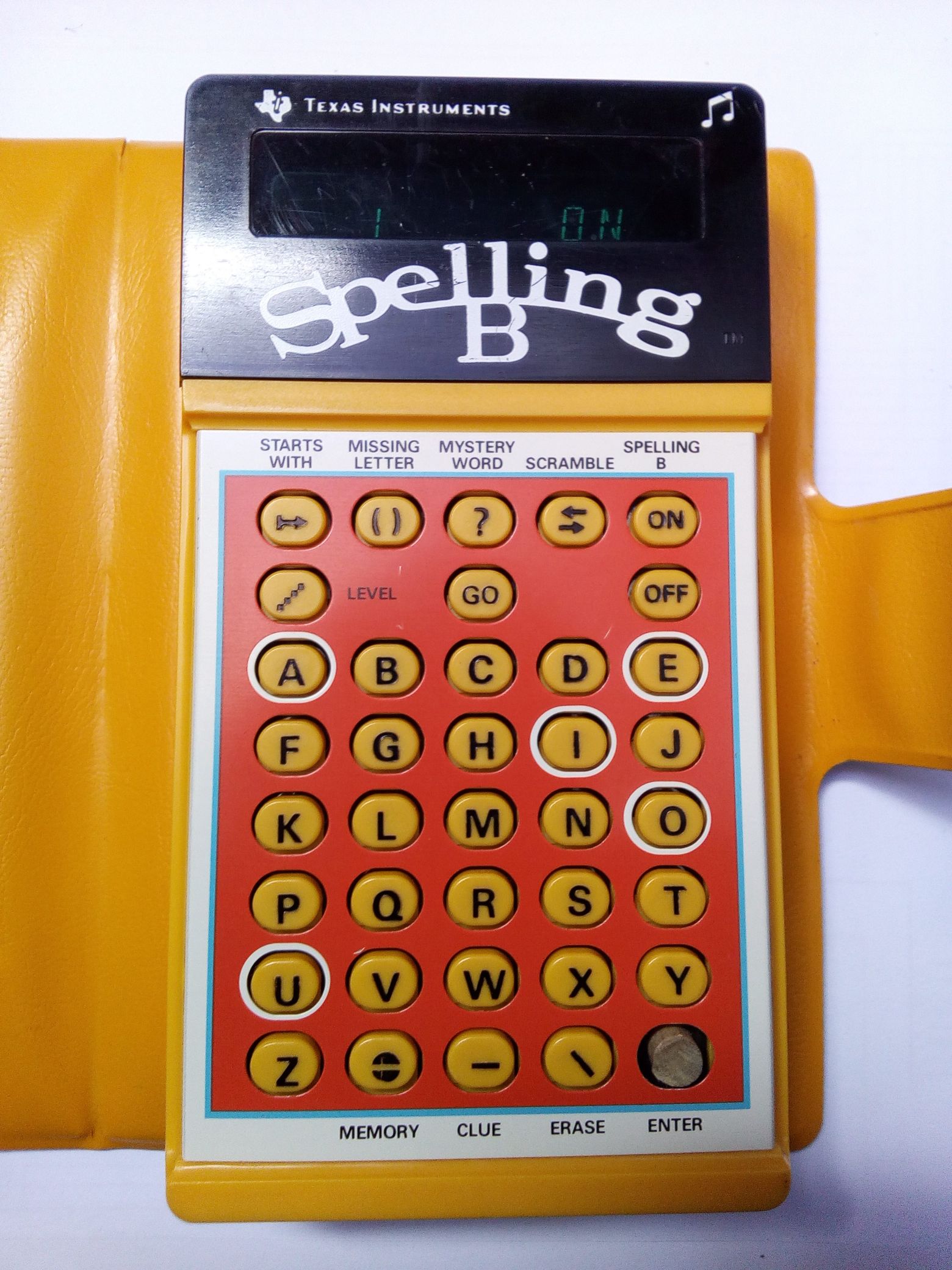 Model: Spelling abc
Battery: 9 volt
AC adapter:
Year: 1981
Chip: TMC0274, TMC0355 (CD2602)
Info:Nothing else than the UK version of the 2nd generation Spelling B.
Model: Spelling B
Battery: 9 volt
AC adapter:
Year: 1978
Chip:
Info:
 Model: Spelling B LCD
Battery: 9 volt
AC adapter:
Year: 1989
Chip: TP0456/CD4617, CD4618
Info:
 Model: Spirit of 76
Battery: 9 volt
Adapter:
Year: 1972
Chip: TMC0952
Info:
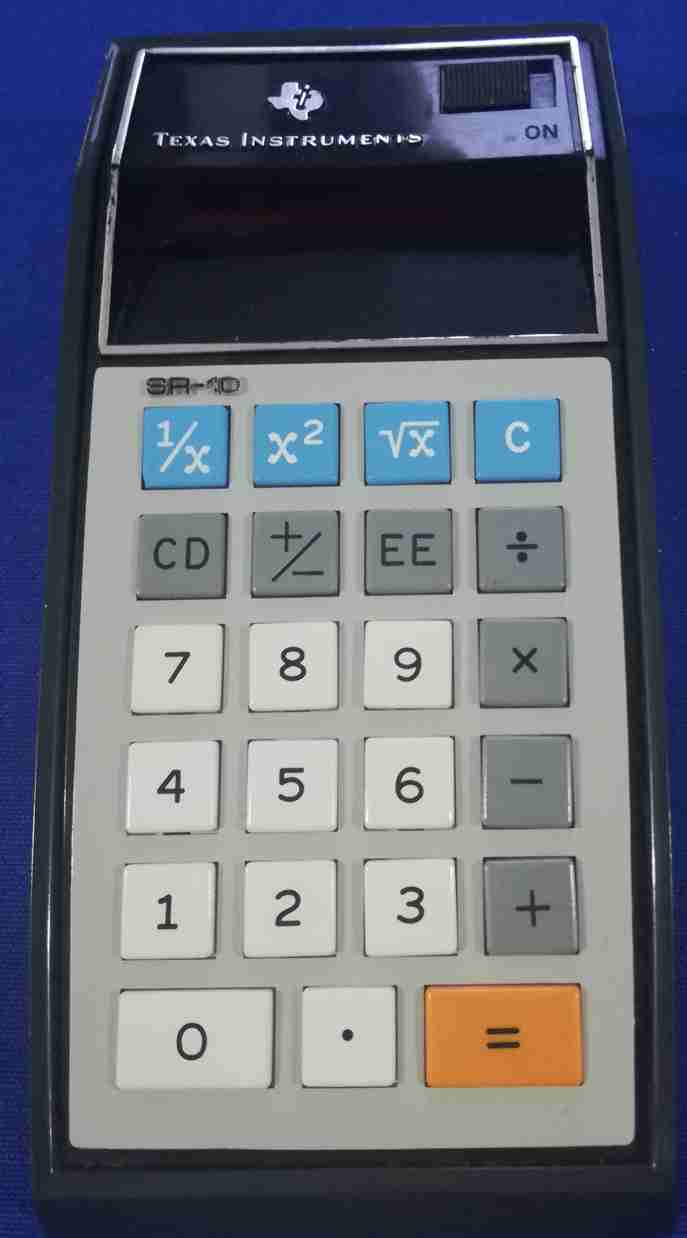
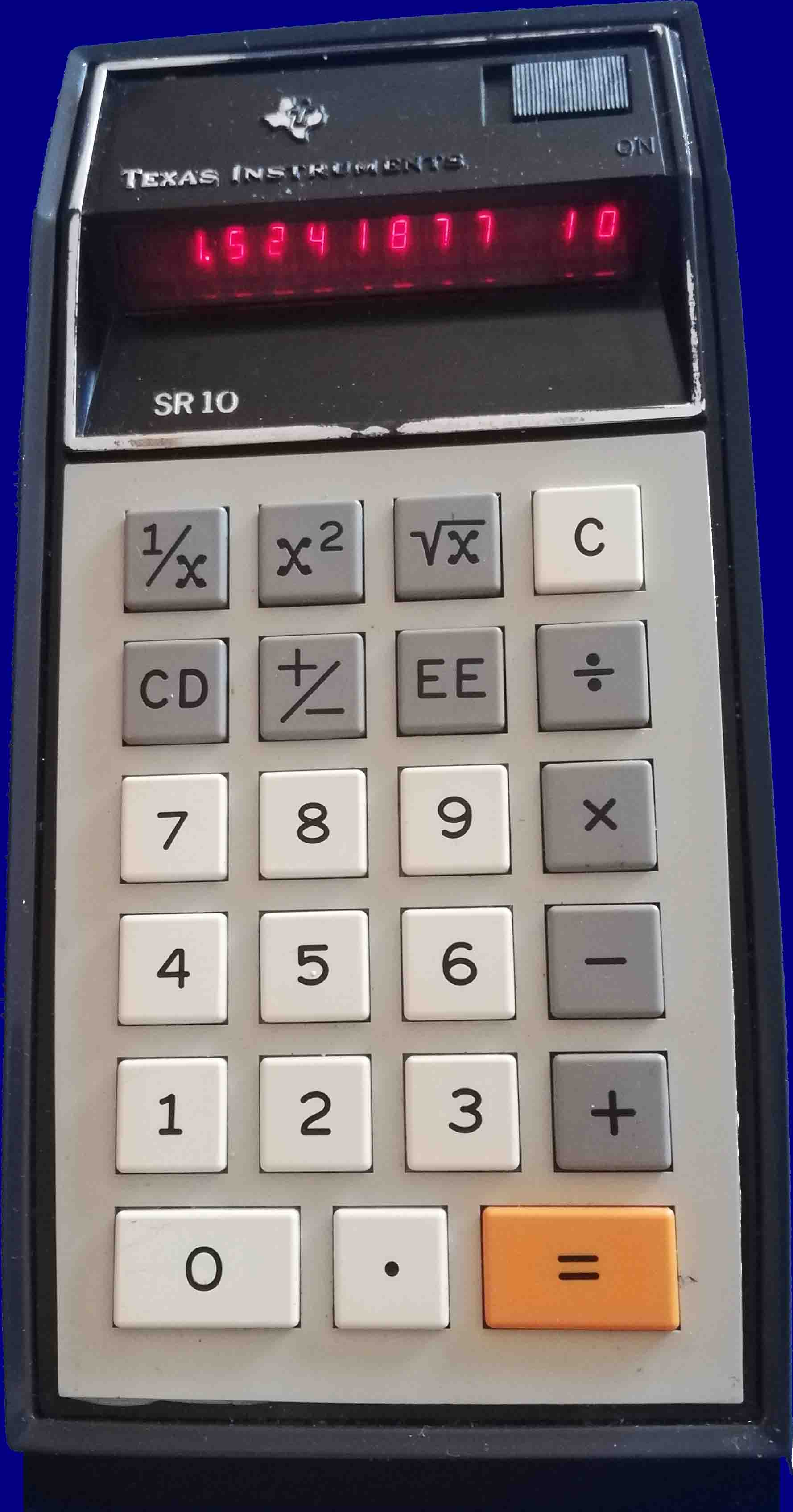 Model: SR-10 Italy
Battery: 3 x AA ni-cd
Adapter: AC9900
Year: 1973
Chip: TMS0120
Info: TIP line - classic first GENERATION the logo is inside the display
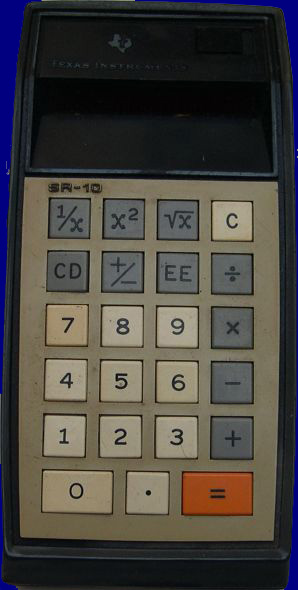
 Model: SR 10 Italy
Battery: 3 x AA ni-cd
Adapter: AC9900
Year: 1973
Chip: TMS0120
Info: This Calculator has 4 upper keys BLUE prototype or Fake ?
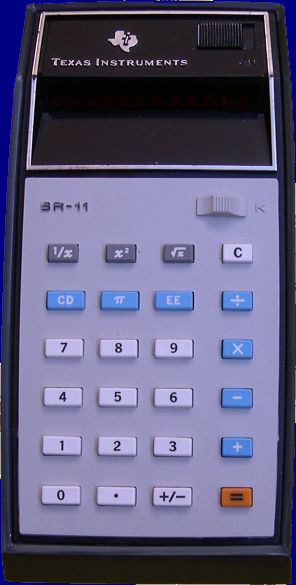
 Model: SR-10 vers. 2
Battery: 3 x AA ni-cd
Adapter: AC9900
Year: 1973
Chip: TMS0120
Manual: with permission www.datamath.org
Info: TIP line - classic first GENERATION
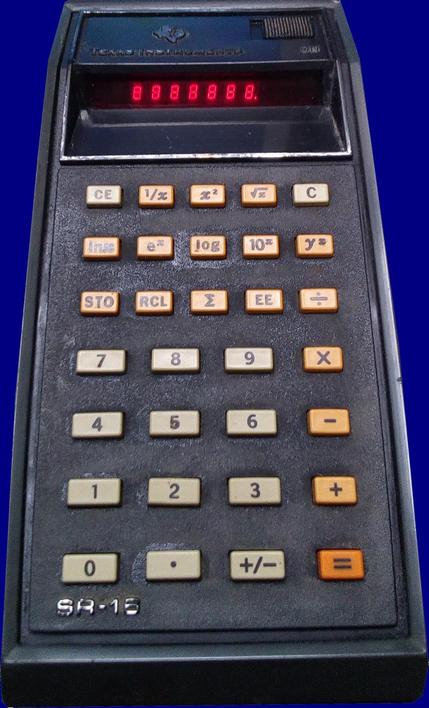
 Model: SR-11
Battery: 3 x AA ni-cd
Adapter: AC9900
Year: 1974
Chip: TMS0602
Manual: with permission www.datamath.orgInfo: TIP line - classic first GENERATION
 Model: SR-16
Battery: 3 x AA ni-cd
Adapter: AC9200
Year: 1975
Chip: TMC1001
Manual: with permission www.datamath.org
Info: TIP line - classic first GENERATION
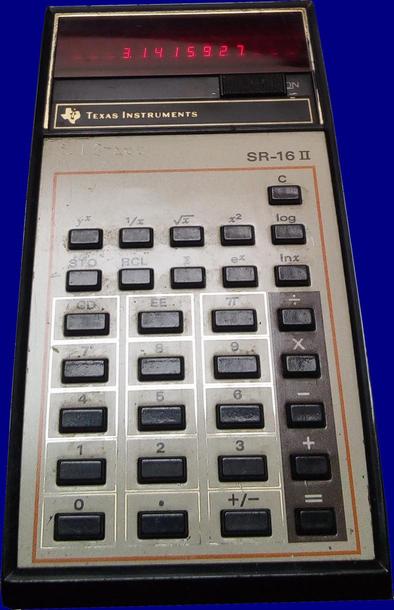 Model: SR-16 II
Battery: 3 x AA
Adapter: AC8190
Year: 1975
Chip: TMC1016
Info: classic second GENERATION
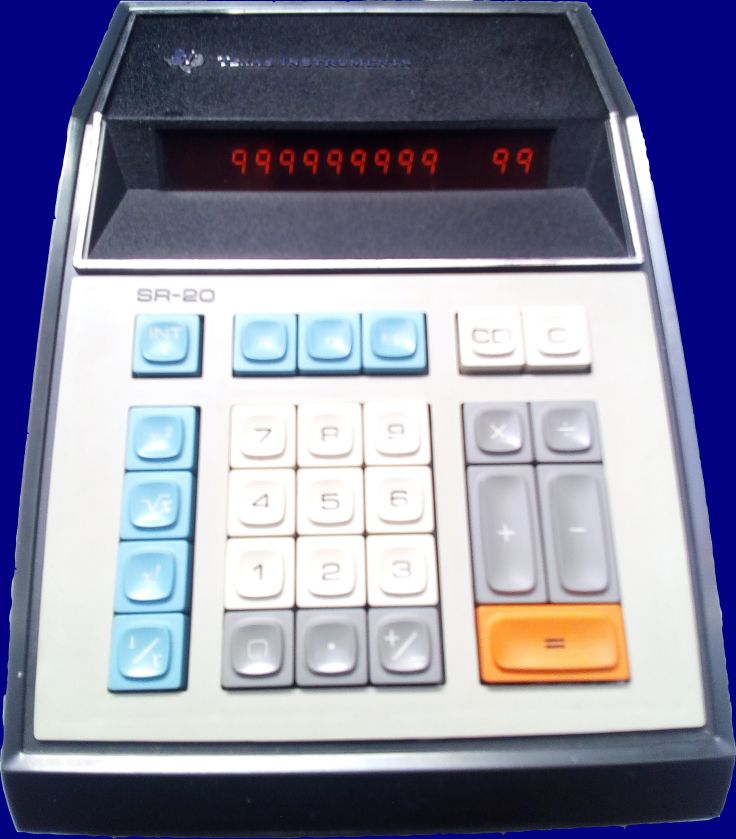 Model: SR-20
Battery:
Adapter: AC 110 volt
Year: 1973
Chip: TMS02020, TMS0304
Manual: with permission www.datamath.org
Info: DESKTOP line
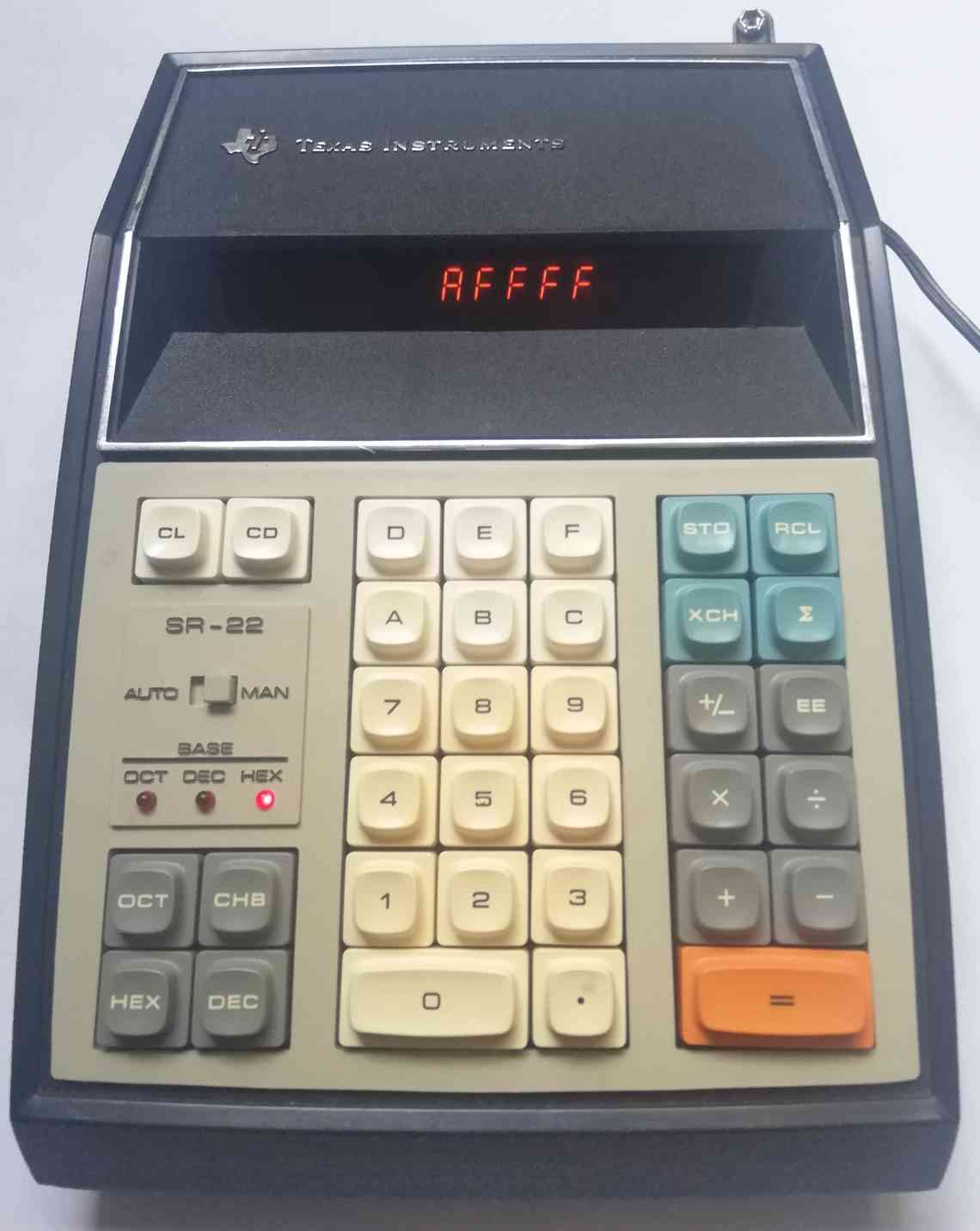
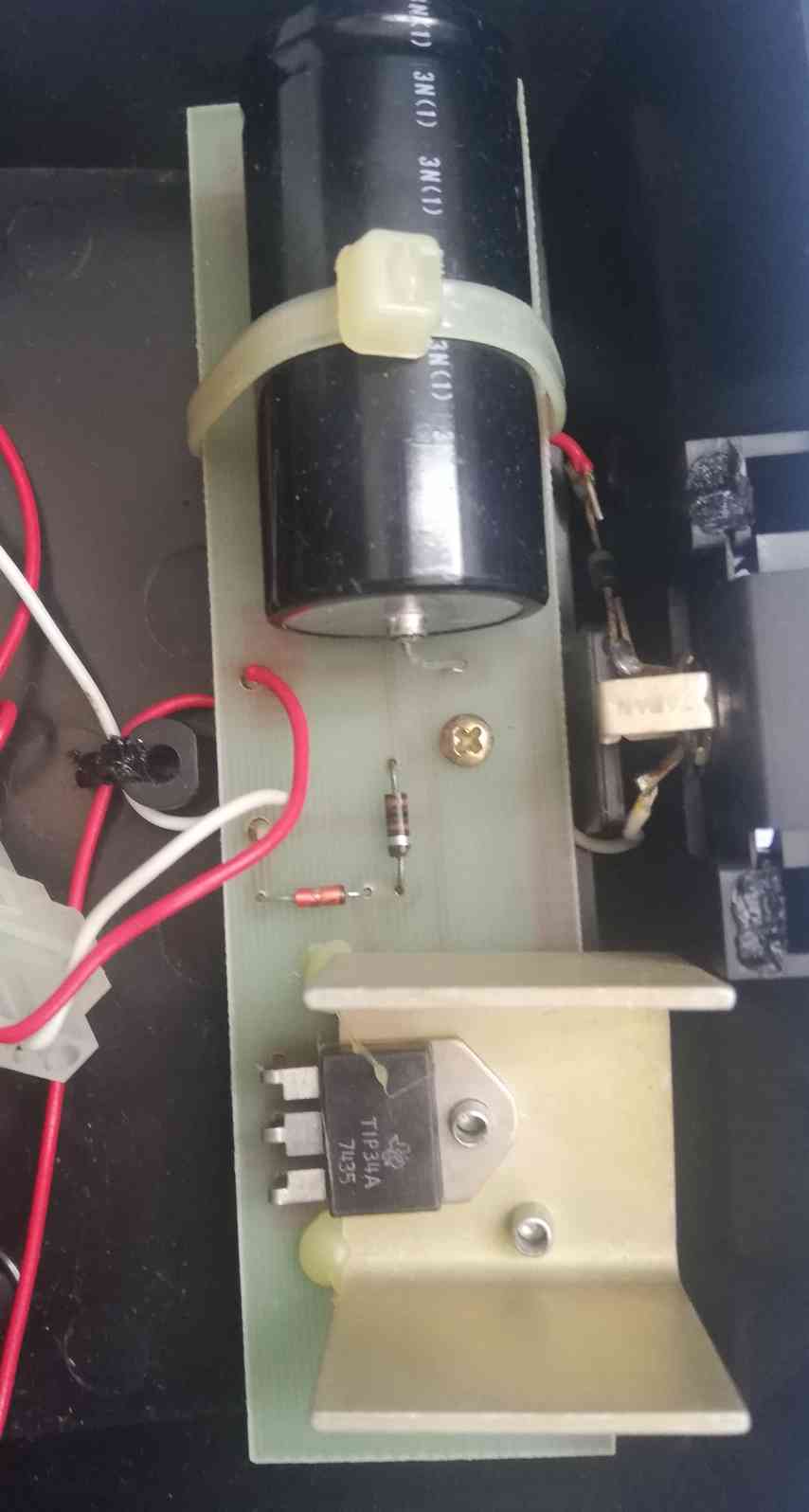 Model: SR-22
Battery: no
Adapter: AC9222
Year: 1974
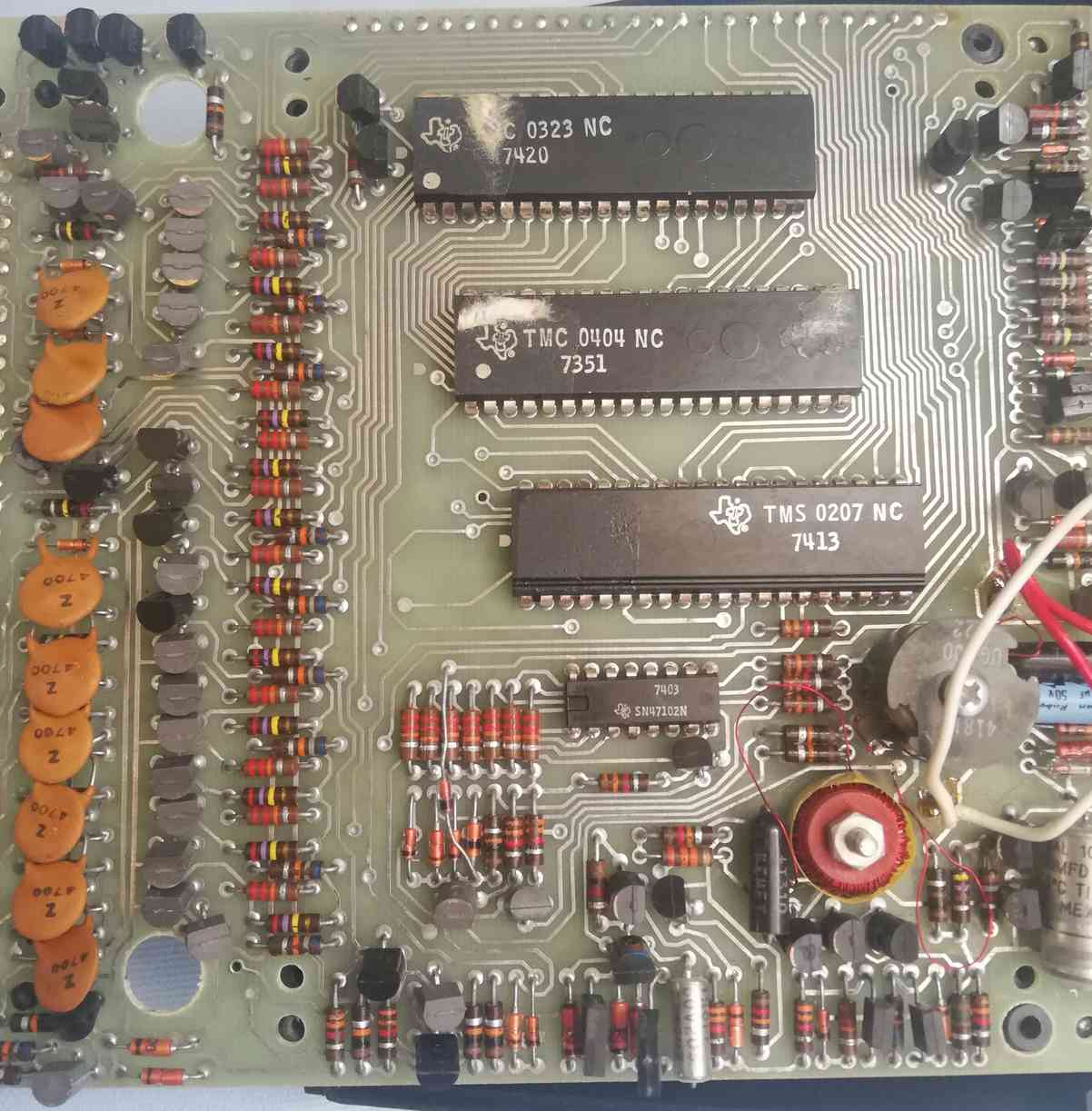
Chip: TMS0207, TMC0323, TMC0404
Info: Look carefully at the display of the SR-22 and you'll notice immediately that this calculator could perform amazing calculations. It is the only calculator reported so far to perform Octal-Decimal-Hexadecimal conversions on the base of floating point numbers.
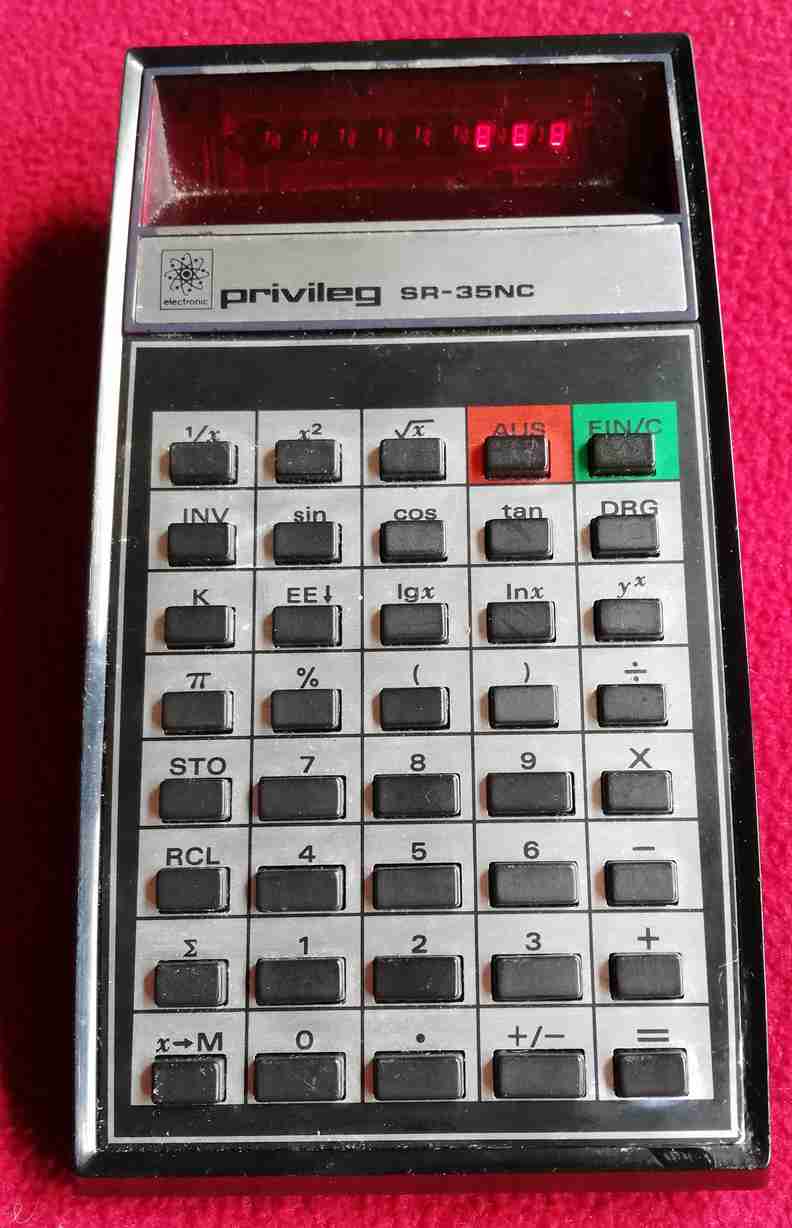 Model: SR-35NC
Battery:
Adapter:
Year: 1978
Chip: TMC0981
Info: Interesting calculator, this German edition of a TI-30. The Privileg SR-35NC is indeed nothing else than a Texas Instruments TI-30 with a restyled and translated key plate, and a sticker instead the molded TI-logo and TEXAS INSTRUMENTS nameplate.
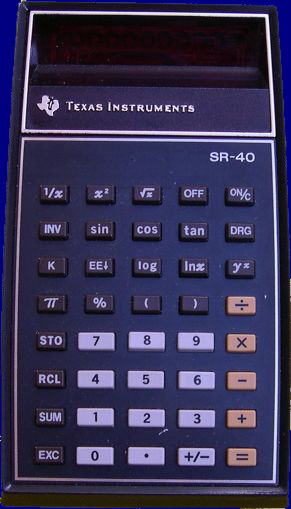 Model: SR-40
Battery: BP 5
Adapter: AC9132
Year: 1976
Chip: TMC0981
Manual: with permission www.datamath.org
Info: MAJESTIC line
.jpg) Model: SR-40 LCD
Model: SR-40 LCD
Battery: 2 x AA
Adapter: NO
Year: 1981
Chip: TP0320
Manual:
Info:The extremely rare SR-40 LCD (1981) calculator produced in Brazil is an interesting model, as at first glance it looks very similar to the European version of the TI-30 LCD. However, a few differences set it apart. One of the most noticeable differences concerns the keys: while the European TI-30 LCD features the **N!** (factorial) key, the Brazilian SR-40 LCD has the **x!** key, a detail that might reflect slight variations in functionality or target use. Another notable difference is the design of the battery compartment. The SR-40 LCD uses two AA batteries, but the compartment cover requires a coin to be opened, unlike the sliding cover of the European TI-30 LCD. This feature probably represents an adaptation for greater durability or security in battery replacement. These small variations between the models highlight production differences between different markets, making the SR-40 LCD a particularly rare and interesting piece for vintage calculator collectors.
.jpg)
.jpg)
.jpg)
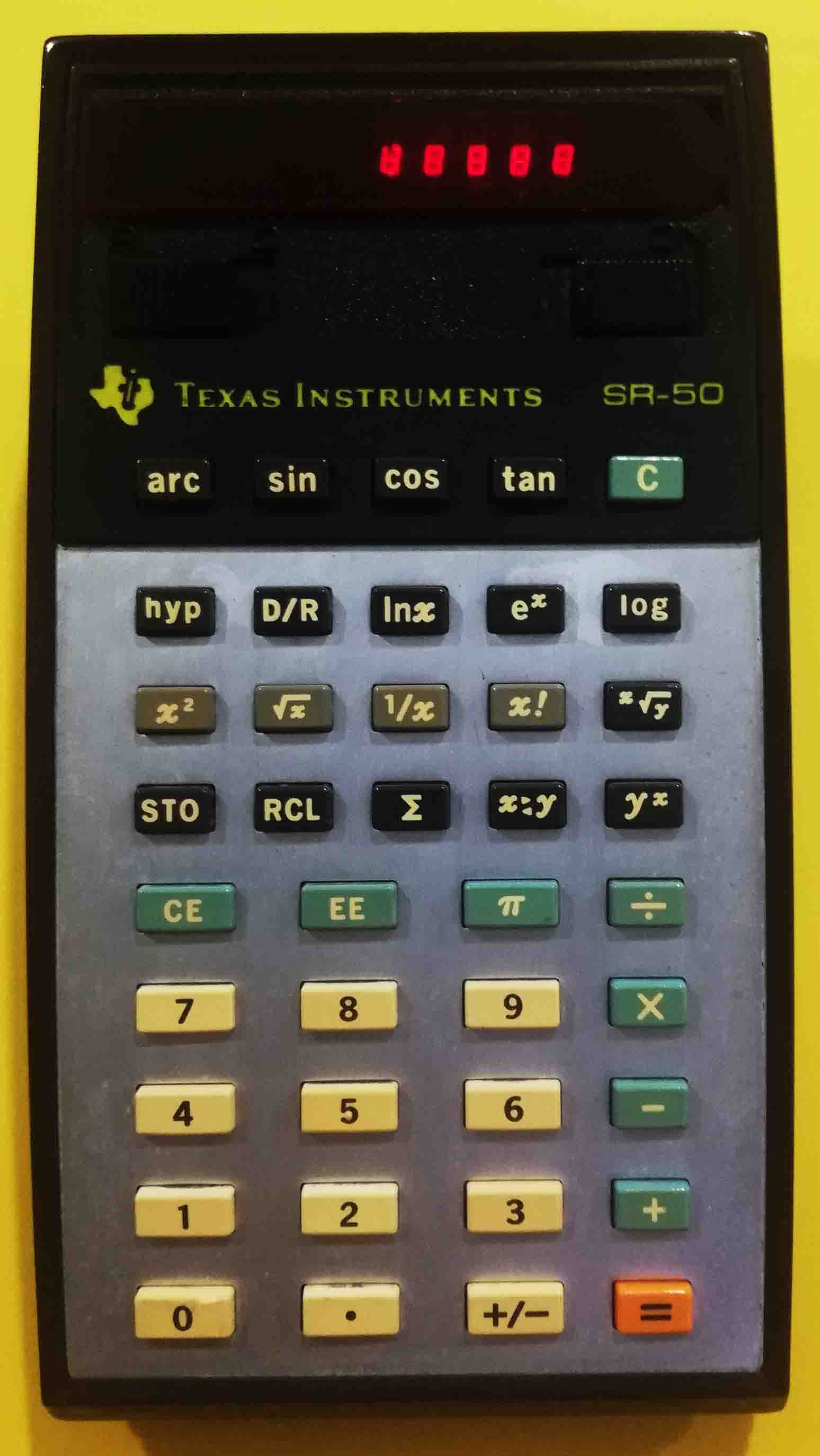
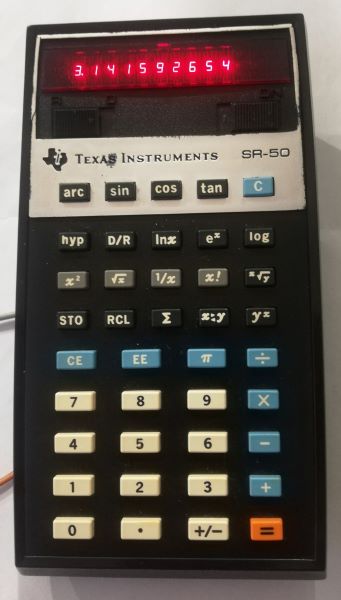 Model: SR-50
Battery: BP 1
Adapter: AC9200
Year: 1974
Chip: TMC0501 / 0521
Manual: with permission www.datamath.org
Info: TIP line - classic first GENERATION
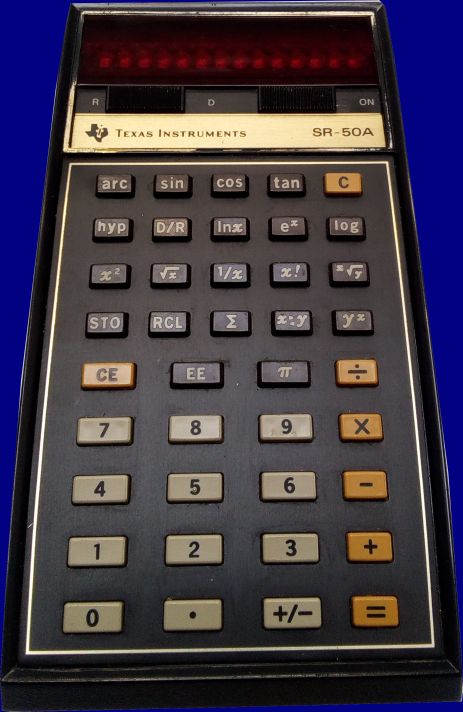 Model: SR-50 A
Battery: BP 1 A
Adapter: AC9130
Year: 1976
Chip: TMC0501 - TMC0503
Manual: with permission www.datamath.org
Info: classic second GENERATION
 Model: SR-50 Dismac
Battery: BP 1
Adapter: AC9200
Year: 1974
Chip: TMC0501 / 0521
Manual:
Info: Fellow calculator collector Marie Lisa Collas surprised us in December 2015 with this unusual looking SR-50manufactured for Dismac Industrial S.A. in Brazil. Texas Instruments changed the appearance of the original dramatically by simply switching the silver colored aluminum bezel from the display frame to the keyboard. Purchased in 2022.
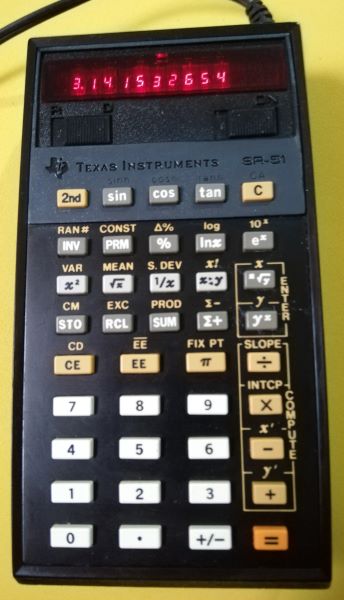 Model: SR-51 1v
Display: 10 + 2
Battery: BP 1
Adapter: AC9200
Year: 1975
Chip: TMC0501, TMS0522, TMC0523
Manual:
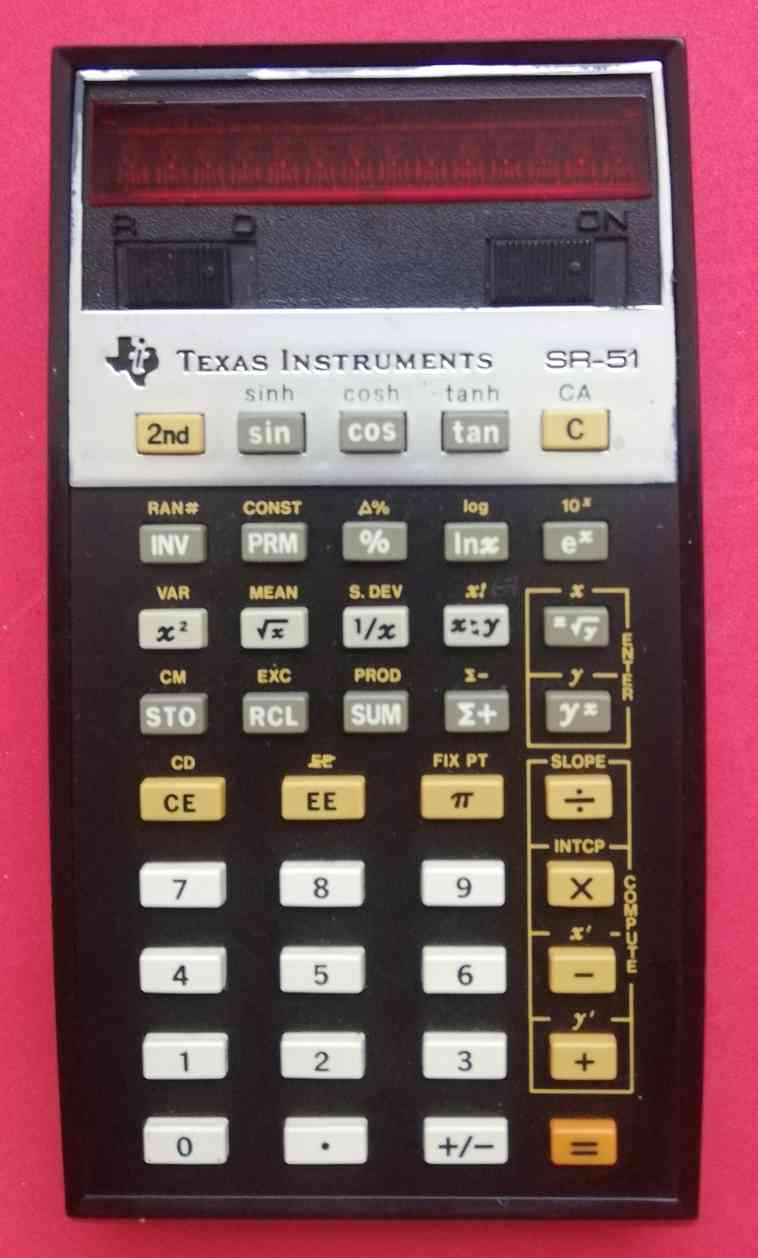
Info:With the SR-51 Texas Instruments began a series of scientific calculators that added statistical functions and conversions to the "usual functions". But none of them are engineered as flawlessly as the SR-51. It was built as a tank to survive decades of use like its close relative SR-50. Compared to previous models, the SR-51 got a keyboard design with white, gray, yellow and orange keys and gave a perspective to later TI calculators. To reduce manufacturing costs and to give a similar look and feel to the SR-52 and SR-56 calculators, the SR-51 was replaced within months with the SR-51A. Logically it is quite rare. However, two different variants are known: this model from an early production batch uses huge yellow characters for the 2 shifted functions, while the later SR-51 sports much finer print.
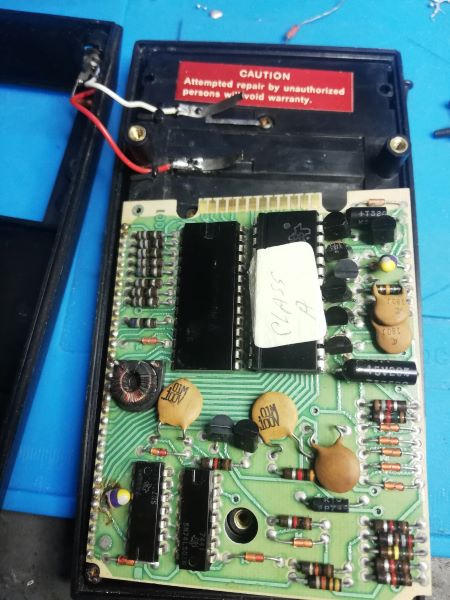
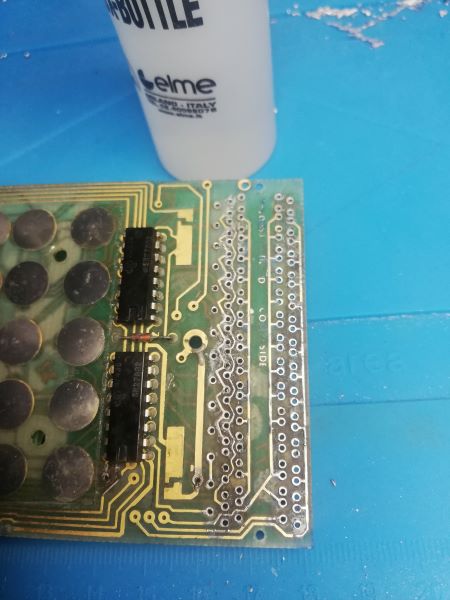
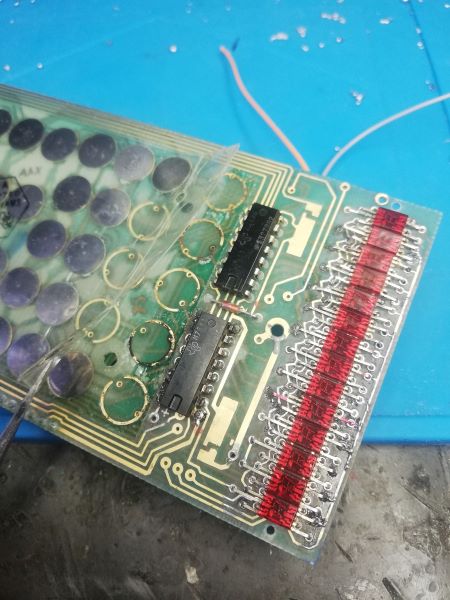
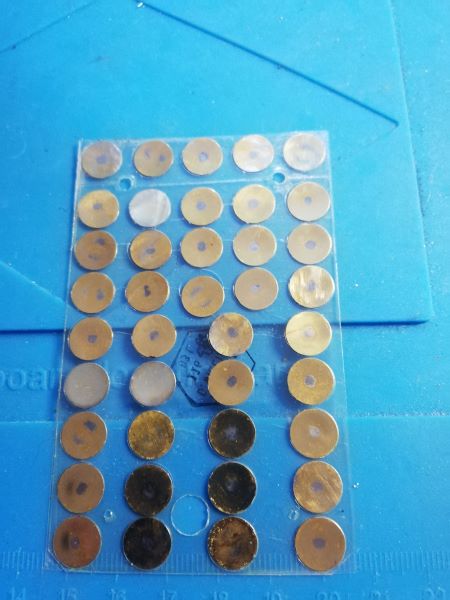
This rare model had many parts corroded by battery acid, the 7-segment displays completely corroded, the replacement and cleaning of the keyboard can be seen on the side.
 Model: SR-51 2v
Battery: BP 1
Adapter: AC9200
Year: 1975
Chip: TMC0501, TMS0522, TMC0523
Manual: with permission www.datamath.org
Info:
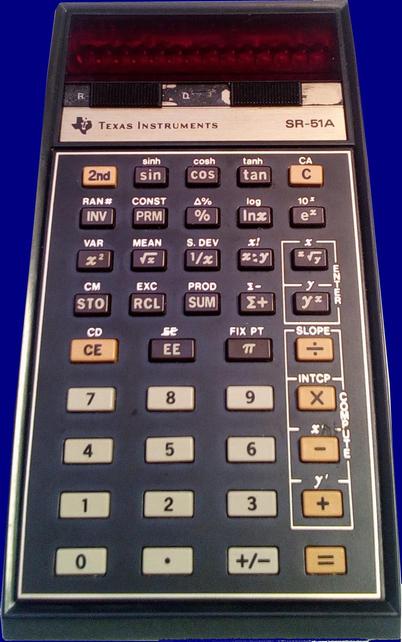 Model: SR-51 A
Battery: BP 1
Adapter: AC9130
Year: 1976
Chip: TMC0501 / 522 / 523
Info: classic second GENERATION
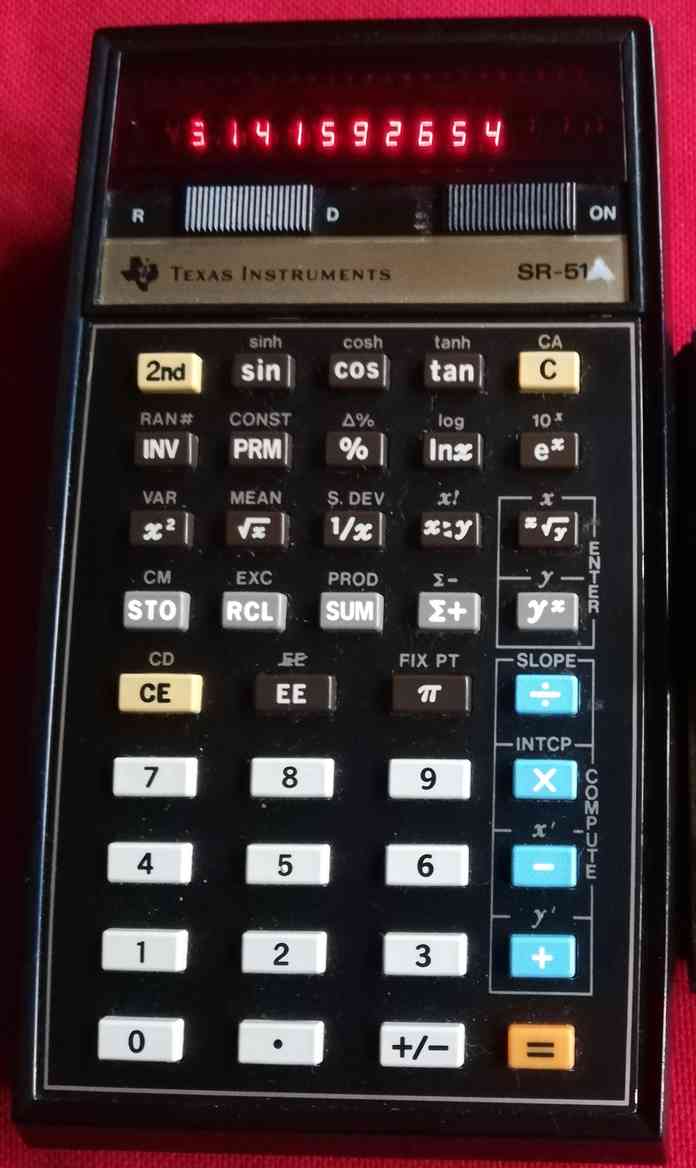 Model: SR-51 A
Battery: BP 1
Adapter: AC9130
Year: 1976
Chip: TMC0501 / 522 / 523
Info:This calculator has the 4 keys for BLUE operations is it a prototype or a fake?
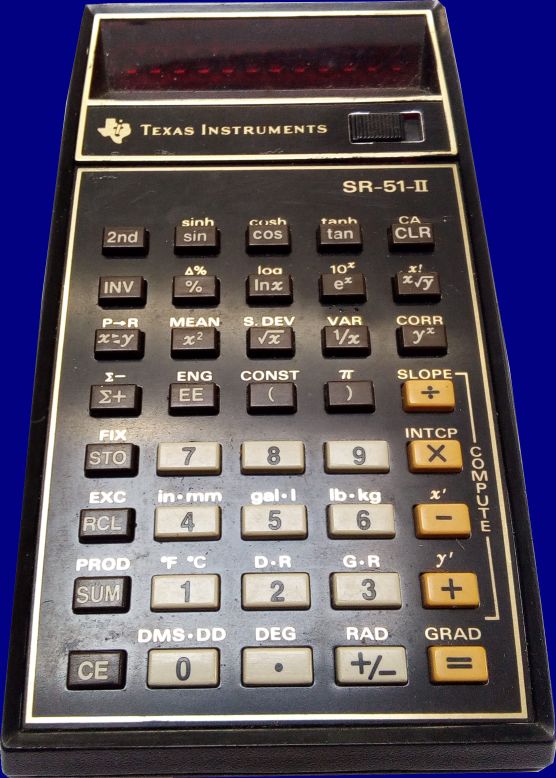 Model: SR-51 II
Battery: BP 6
Adapter: AC9131
Year: 1977
Chip: TMC0501 / 581
Manual: with permission www.datamath.org
Info: MAJESTIC line
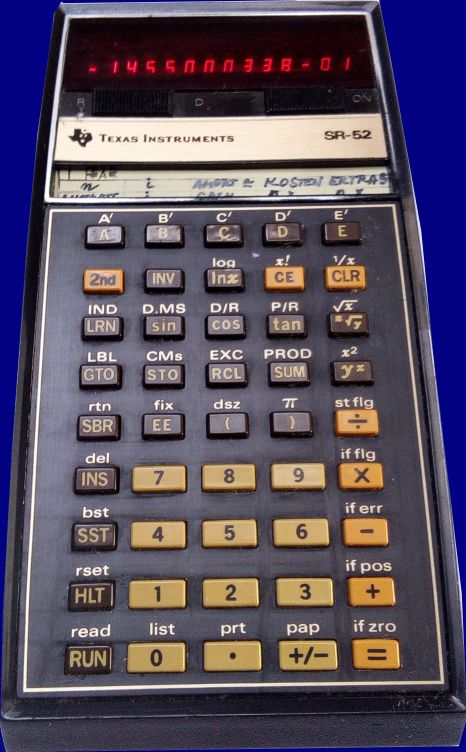 Model: SR-52
Battery: 3 x AA
Adapter: AC9130A or DC9105
Year: 1975
Chip: TMC0501 / 0524 /0595 / 2xTMC0599, 2xTMC0561/0562
Manual: with permission www.datamath.org basic library
Info: classic second GENERATION
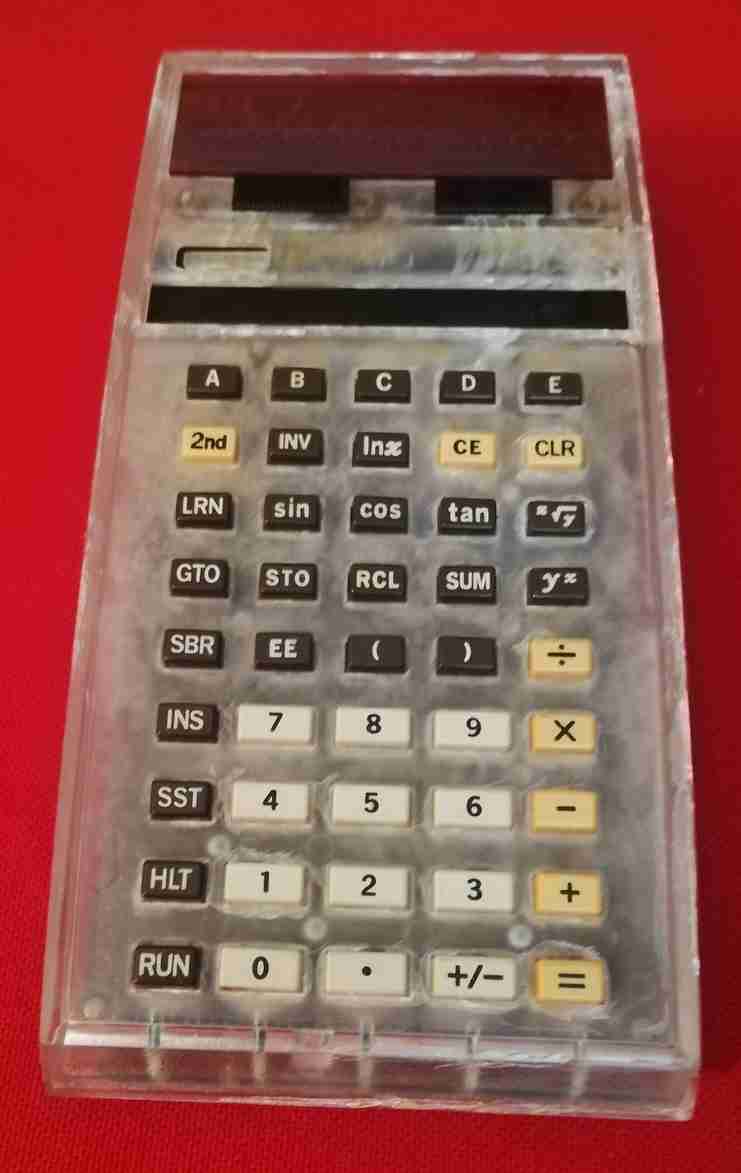 Model: SR-52 clear case
Battery: 3 x AA
Adapter: AC9130A
Year: 1976
Chip: TMC0501, TMS0537, TMC0538, TMC0599
Info: This SR-52 Clear-Clase Prototype was most likely manufactured in November 1974 and is a strange hybrid sporting.
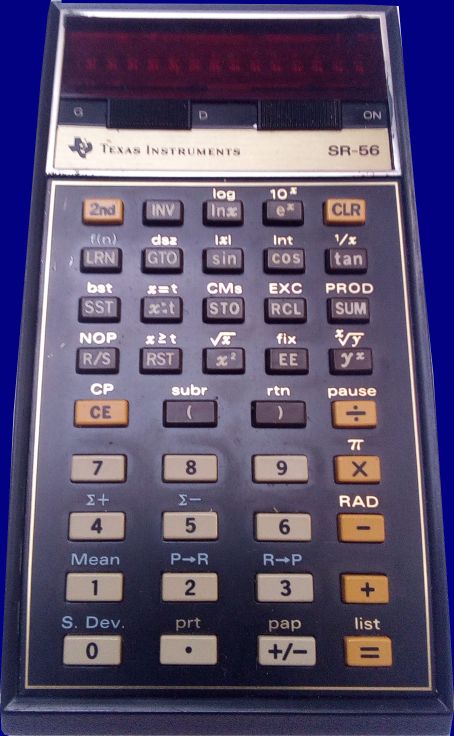 Model: SR-56
Battery: 3 x AA
Adapter: AC9130A
Year: 1976
Chip: TMC0501, TMS0537, TMC0538, TMC0599
Manual: with permission www.datamath.org
Info: classic second GENERATION
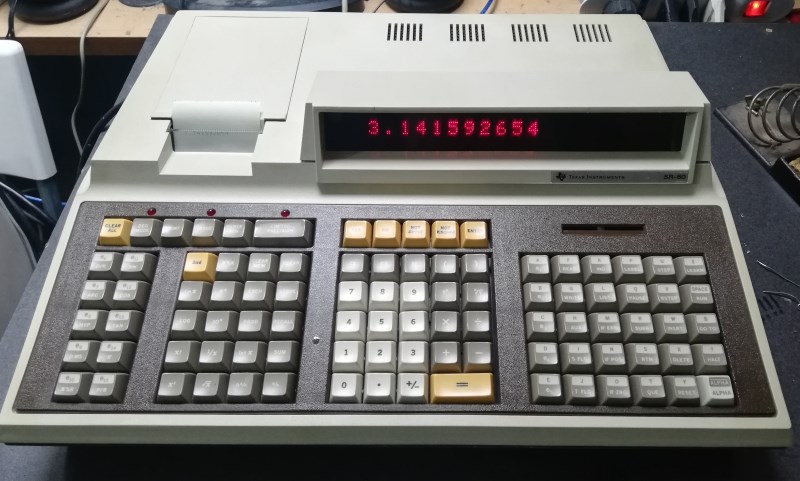
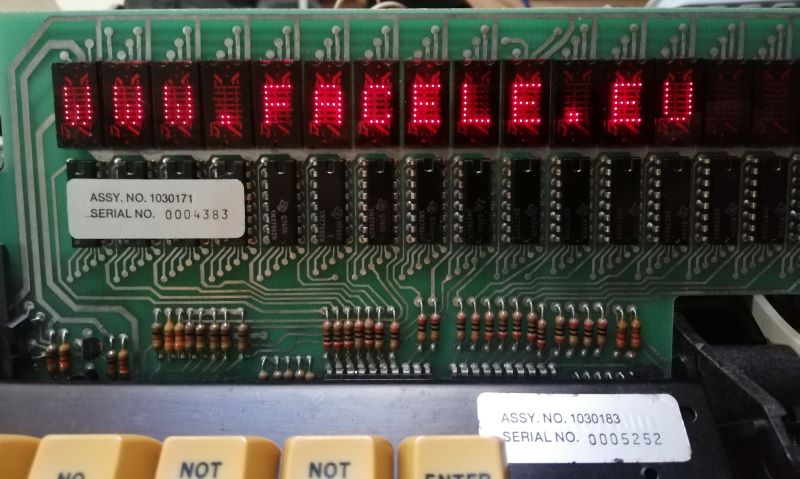 Model: SR-60
Battery: NO
Adapter: AC 110 volt or AC 220 volt
Year: 1976
Chip: TMC0501, TMC0526 or TMC0536, TMC0564, TMC0565, TMC0566, TMC0567, TMC0568 or TMC0570, TMC0596, 5*TMC0599, TMC0253, TMC0254
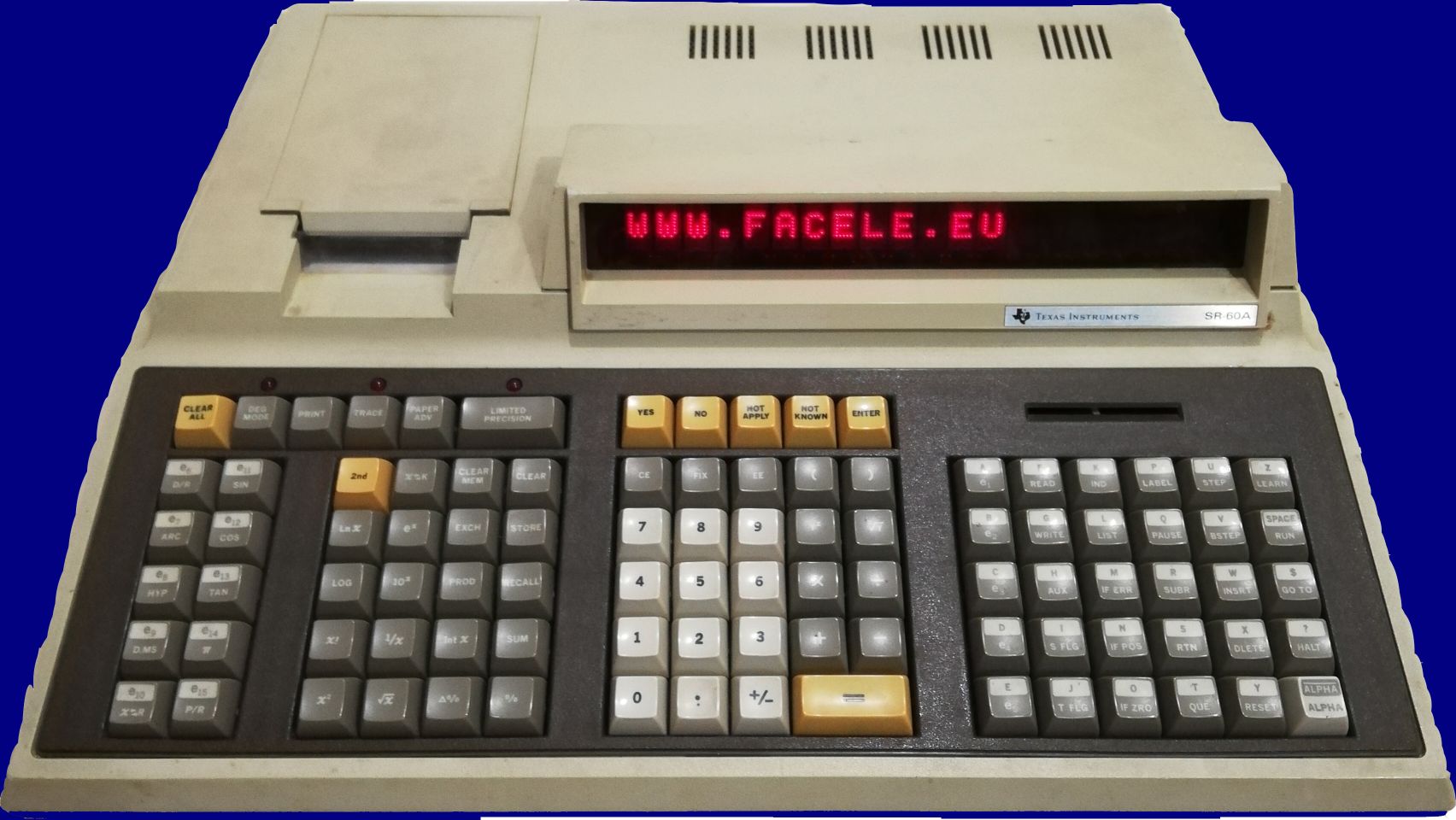
Info: Texas Instruments introduced in 1976 with the SR-60 their first high-end programmable desktop calculator. Priced at $1695 and with a footprint of roughly 17" by 14.5" (430 mm * 370 mm) the SR-60 resembled more a computer than a programmable calculator.
Based on the SR-52 and SR-56 series of programmable calculators, the SR-60 integrated a full-sized keyboard with 95 keys, a large alphanumeric display with 20 characters, a thermal dot-matrix printer with 20 characters and a magnetic card reader for saving and loading both programs and data.
One of the main advantages of the SR-60 is the huge memory for data and program, already the base model could hold 480 program steps and 40 memory registers. Two memory expansion modules were available, one implemented with just two small daughter boards holding 5 resp. 3 TMC0599 RAM chips accessible through a bottom panel in the housing. The second memory expansion, a huge printed circuit board (PCB) with a total of 27 TMC0599 RAM chips, was mounted below the keyboard next to the Main PCB.
The SR-60 operates using pure algebraic logic (e.g., problems are presented to the machine as they would be written on paper). The calculator adheres to the PEMDAS (Parenthesis, Exponentiation, Multiplication, Division, Addition, Subtraction) order of precedence. The [(] and [)] keys may be used to group expressions to override the PEMDAS rules as required. Parentheses can be nested up to ten levels deep. The machine calculates and displays results to ten significant digits, and always formats the display to provide maximum accuracy.
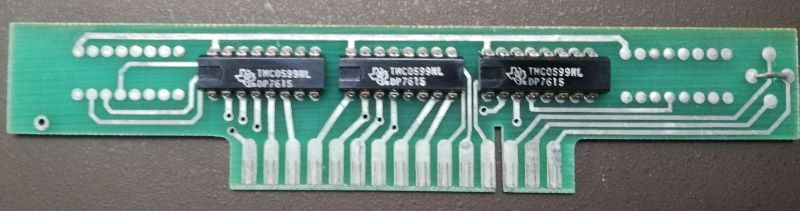
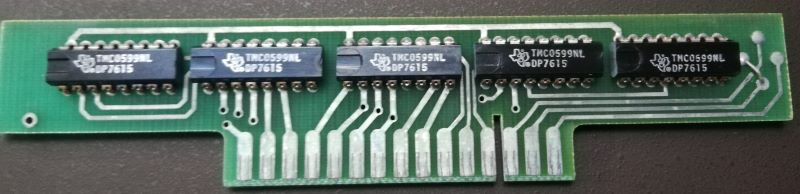
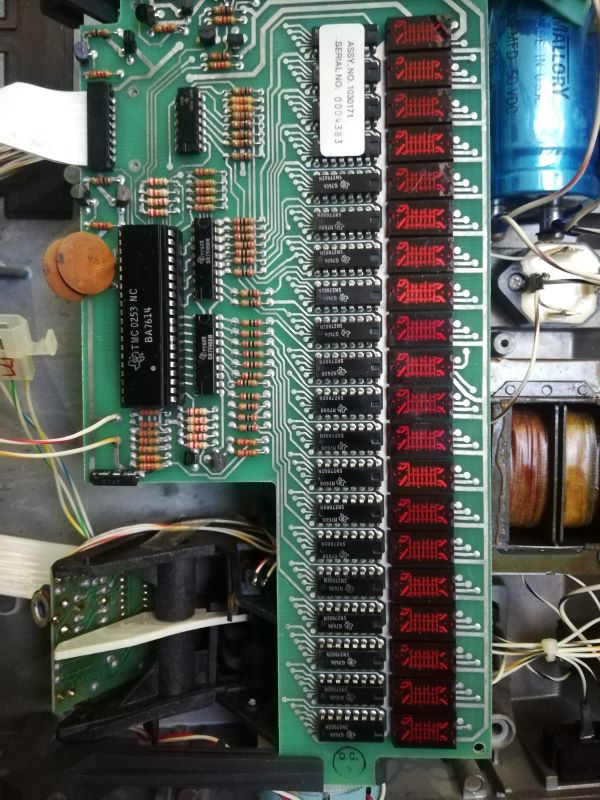
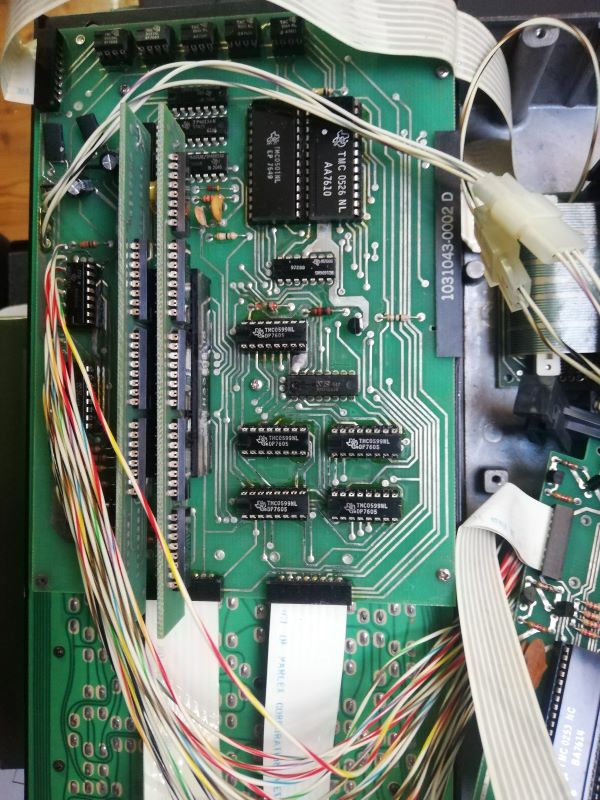
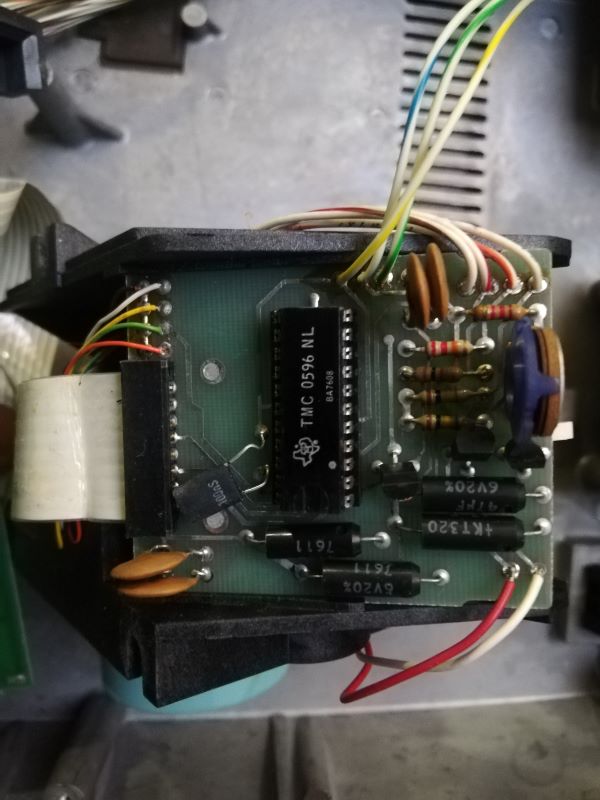
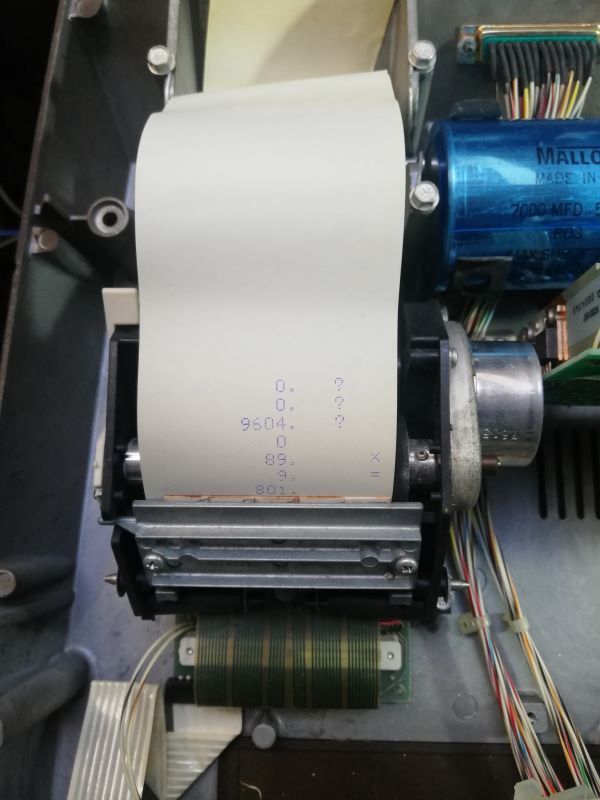
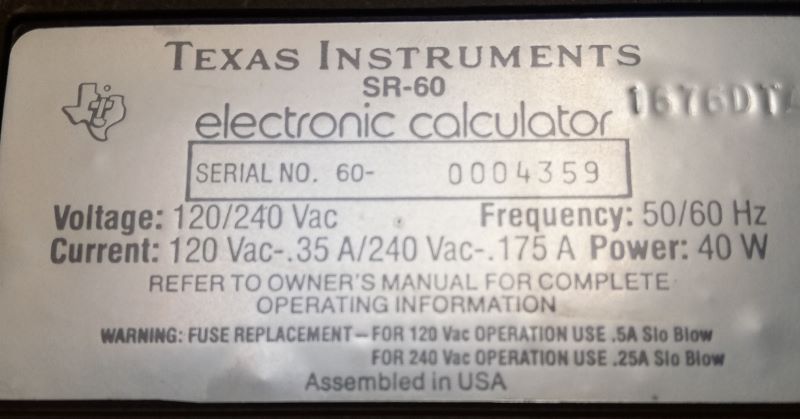
with permission of the author www.datamath.org
Claudio Larini. My interest in the world of information technology was born as soon as I finished high school, before leaving for the university adventure at the Polytechnic of Milan, after having purchased the first issue of a magazine, Micro and Personal Computer in September 1979. So after having consulted the "Market Guide", which was divided between Personal Computers, Programmable Calculators and Microprocessor Boards, and compatibly with the available budget I decided to purchase a programmable calculator.
SR-60 EMULATOR (and others ....) Claudio Larini ITALY
TroubleShooting 
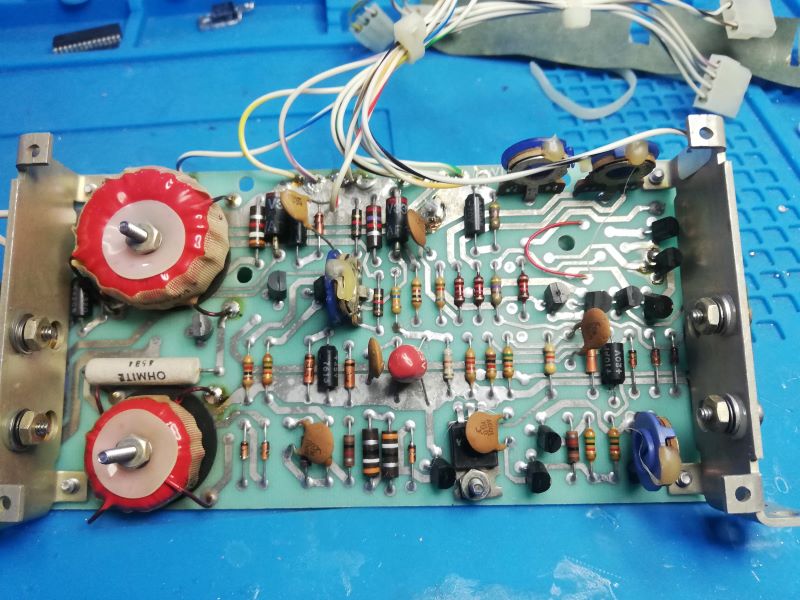 After finding the SR-60 and checking it, we realized that it wasn't working. We started with the power supply. This power supply provides all power for the individual PCBs, (-20, -15.8, -10, -5 and -19) with an input voltage ranging from -26.5 to -42. At this point we realized that the -15.8 voltage that powers the main PCB was not being supplied.

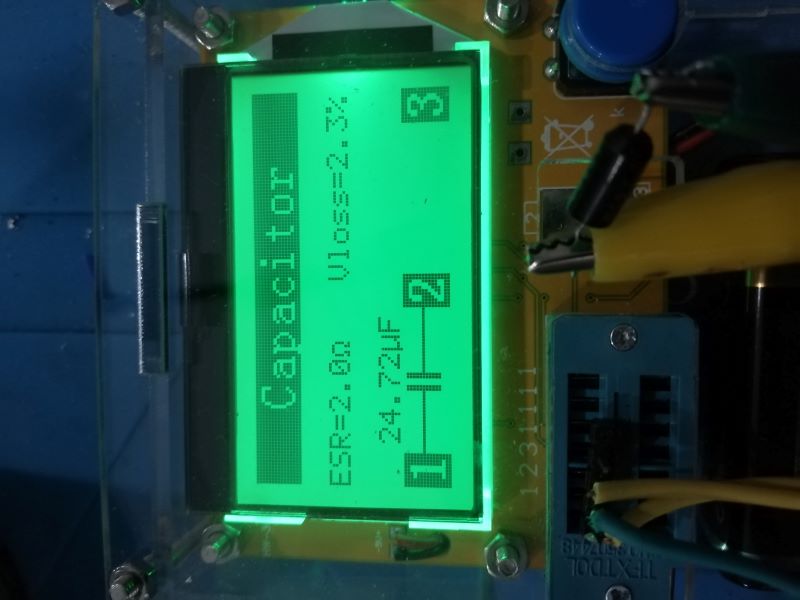 As expected with these 50 year old objects, the filter capacitors, in this case 10uF, failed, one was shorted, another changed value.
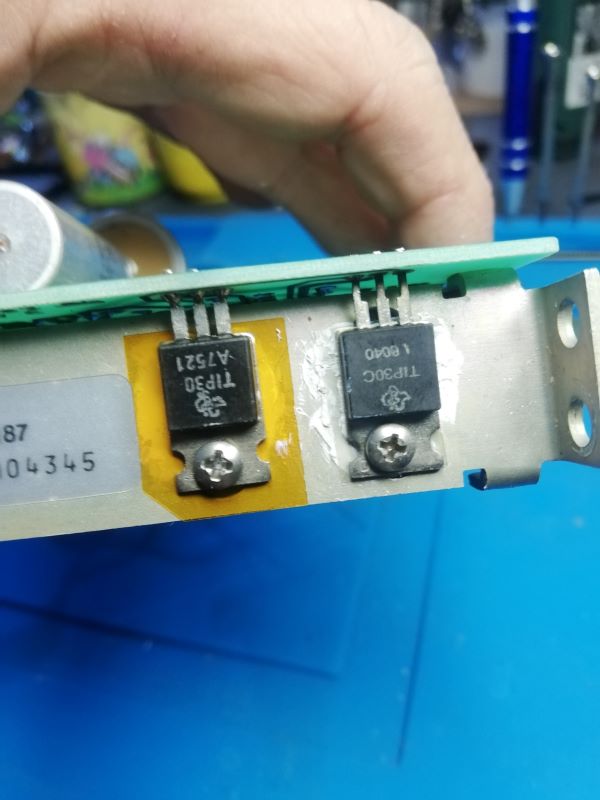
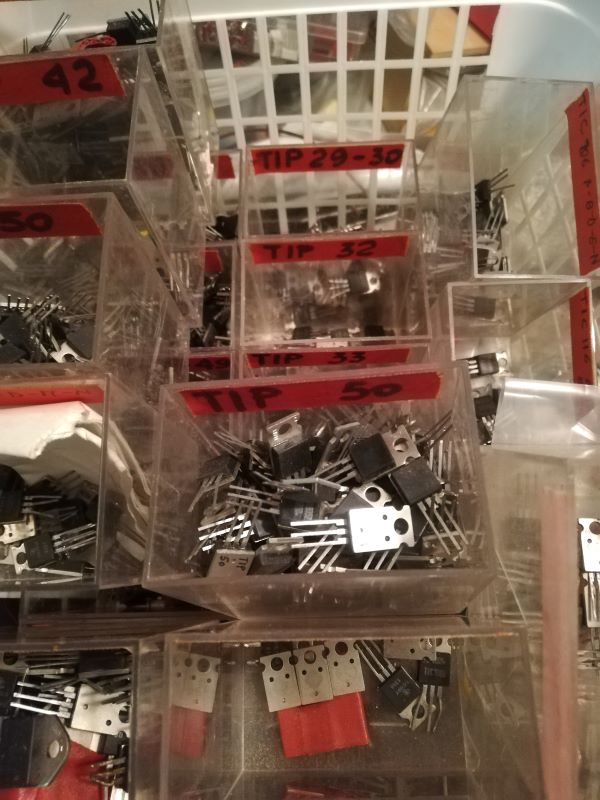
Causing the breakage of three transistors in the power supply, the TIP30 replaced with one from the stock of components we have from the 70s and 80s, in addition to the A1872 replaced with a BC556 and an A2031 replaced with a BC547. We were unable to find the latter the same .
 Model: SR-60 A
Battery:
Adapter: AC 110 volt
Year: 1978
Chip:TMC0501, ...TMC0526, 5*TMC0599, TMC0253
Info: Texas Instruments introduced in 1976 with the SR-60 their first high-end programmable desktop calculator. Priced at $1695 and with a footprint of roughly 17" by 14.5" (430 mm * 370 mm) the SR-60 resembled more a computer than a programmable calculator. Based on the SR-52 and SR-56 series of programmable calculators, the SR-60 integrated a full-sized keyboard with 95 keys, a large alphanumeric display with 20 characters, a thermal dot-matrix printer with 20 characters and a magnetic card reader for saving and loading both programs and data. One of the main advantages of the SR-60 is the huge memory for data and program, already the base model could hold 480 program steps and 40 memory registers. Two memory expansion modules were available, one implemented with just two small daughter boards holding 5 resp. 3 TMC0599 RAM chips accessible through a bottom panel in the housing. The second memory expansion, a huge printed circuit board (PCB) with a total of 27 TMC0599 RAM chips, was mounted below the keyboard next to the Main PCB. A fully-optioned SR-60 could hold programs with a maximum of 5760 steps and 430 memory registers.


 Model: Star Trekulator
Battery: 4 x AA
AC adapter:
Year: 1976
Chip: TMS0855
Info:Vintage Mego Corporation 1976 Star Trek The Original Series Star Trekulator Electronic Calculator Of The Future. Released by Mego Corporation in 1976 as part of their series of Star Trek Toys and Action Figures. This fantastic Star Trekulator is a working replica of the calculator used aboard the USS Enterprise. It adds, subtracts, divides, multiples, figures square root and percentages at the flick of a switch. Watch the console flash the computer lights on the bridge of the Enterprise as you work. Great for homework and all your important calculations. Every time you press the total button, your answerappears on the display screen accompanied by Star Trek alarm sounds. A winner any way you add it up.
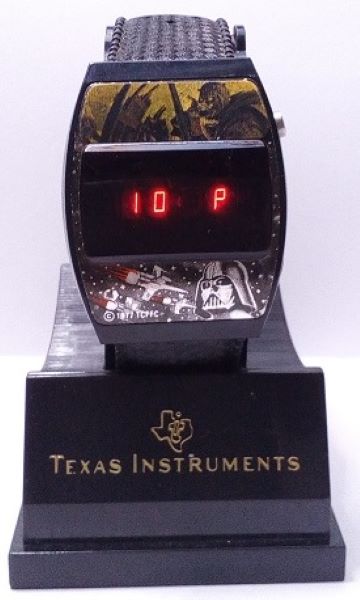 Model: TI-527-01 (Stars Wars black) Code: ok (different label)
Battery: 2 x D386 or 2 x 396
WCase: black plastic WBand: black rubber Face: red
Manual: Yes Box: No Light: led
Year: 1977 Price: xxxx
Function: The watch has five functions- hours, minutes, seconds, month and date
Info: The excitement of Star Wars, only Texas Instruments has the official Star Wars digital watches ,combining five-functions.
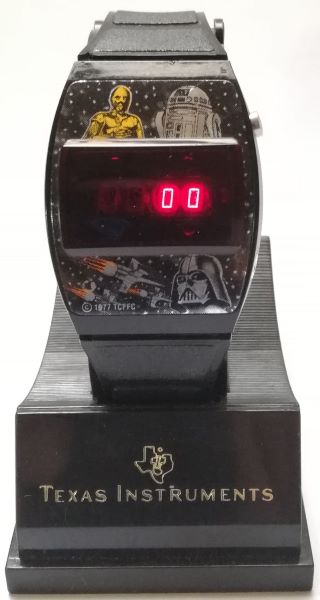 Model: TI-527-01 (Stars Wars black gold ) Code: ok (different label)
Battery: 2 x D386 or 2 x 396
WCase: black plastic WBand: black rubber Face: red
Manual: Yes Box: No Light: led
Year: 1977 Price: xxxx
Function: The watch has five functions- hours, minutes, seconds, month and date
Info: The excitement of Star Wars, only Texas Instruments has the official Star Wars digital watches ,combining five-functions.
Texas Instruments Starburst lcd analogue watch.
Introduced in July 1978. The first analog watch without moving parts.
Gently used - rare, very stylish and unusual 1978 Texas Instruments, "STARBURST" mens LCD analog display wrist watch. This was one of the first watches that revolutionized the wrist watch market using a high precision digital display. The watch is highly accurate!
This watch also has the unique feature of having 7 different timekeeping functions are at your fingertips:
Normal Display = Hours & Minutes
Minutes : Seconds ...1 button push up
Day / Date ... 2 button push up
Alternate Time Zone... push button up together with button down
Stopwatch Mode # 1 = Hour Minute ...push button down
Stopwatch Mode # 2 = Minute / Second...second push button down
Stopwatch Mode # 3 = Seconds / Tenths...thirt push button down
the difference between the first timezone and the second timezone are 1 or 2 stripes of the hours marker.
A fine example of a first totally electronic quartz LCD analog. The combination of several technology firsts made the watch design practical.
Among the technology firsts for this watch were: 1) Use of low voltage liquid crystal material for multiplexed LCD watches displays. 2) Use of a lithium-manganese dioxide cell for watch LCD's. 3) Use of an I2L chip to drive watch LCD's. 4) Use of only 26 contacts for 120 display elements using two-way multiplexing. The watch design, called "Starburst," was manufactured until 1981 when TI closed out all watch activity.
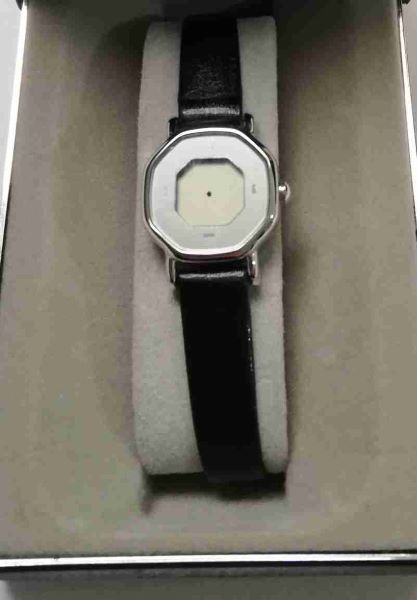

Model: TI-starburst (hexagon) Code:
Battery: ???
WCase: white tone metal WBand: black leather Face: silver
Manual: no Box: yes Light: no
Year: xxxx Price: xxxx
Function: The three-function shows constant display of hours, minutes, seconds.
Info: Module inside is Modutek L1D
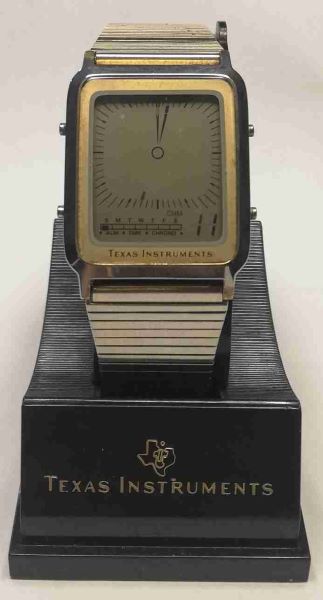 Model: TI-starburst (rectangular) Code:
Battery: AG10 or LR1130
WCase: gold tone metal WBand: matching bracelet Face: gold
Manual: no Box: no Light: no
Year: 1977 Price: xxxx
Function: The eight-function chronograph shows constant display of hours, minutes,seconds, month, date and day of week.
Info: the same model in white tone metal
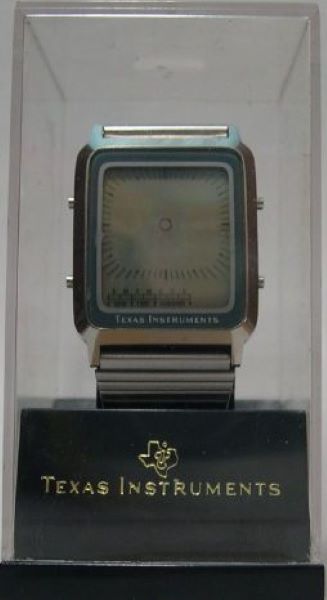 Model: TI-starburst (rectangular) Code:
Battery: AG10 or LR1130
WCase: white tone metal WBand: matching bracelet Face: blue
Manual: no Box: no Light: no
Year: 1977 Price: xxxx
Function: The eight-function chronograph shows constant display of hours, minutes,seconds, month, date and day of week.
Info: the same model in gold tone metal
Statuto dell' Organizzazione di Volontariato
" Texas Instruments Watch Museum "
CF: 90094080570

Statuto dell' organizzazione di volontariato "TI Watch Museum - ODV"!!!
Il nostro obiettivo è quello di aprire un museo nella città di Rieti dedicato alla Texas Instruments. ( Per aprire il file è necessaria una password da richiedere nel modulo contatti. )
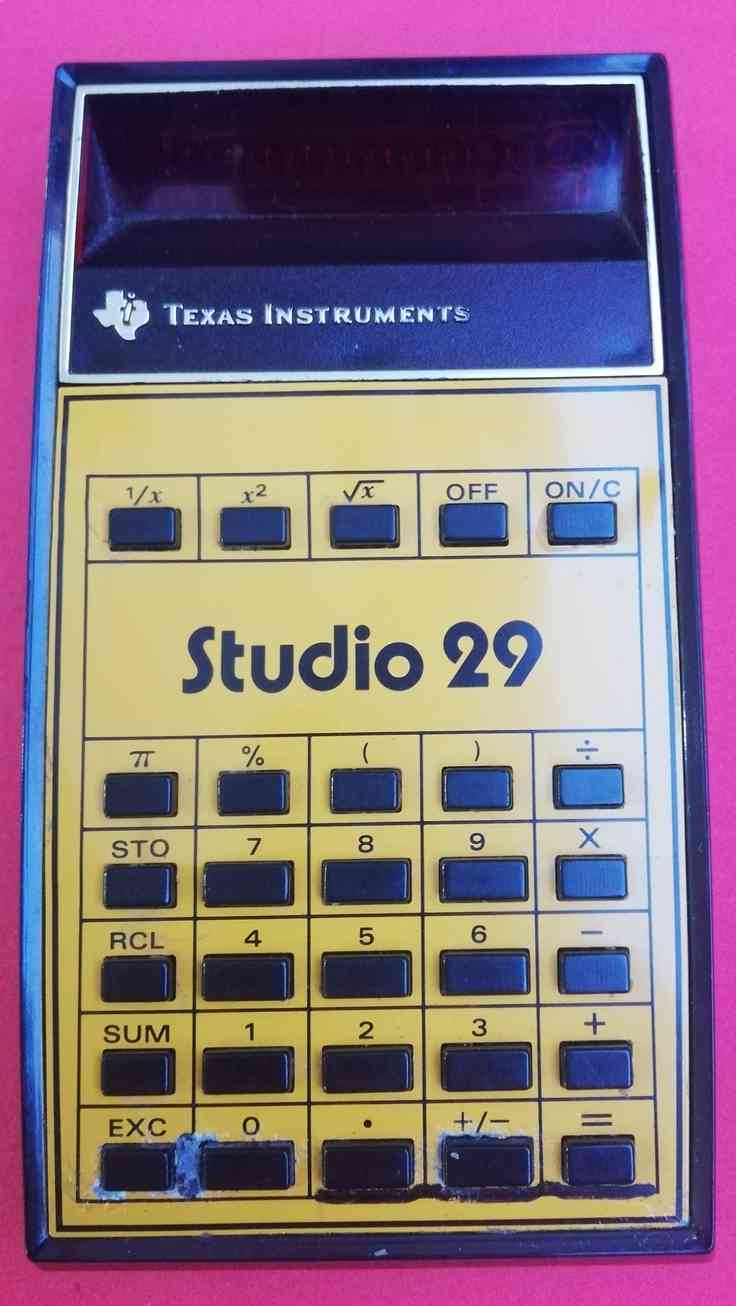 Model: Studio 29 Koh-I-Noor
Battery: 9 vot
Adapter:
Year: 1979
Chip: TMS0981
Info: Made in Italy (RIETI) RCI
Summit International Corporation
Summit International Corp., Salt Lake City, Utah.Manufactured by NCE Nuclear, made in U.S.A.
In 1971 Ed Price made a prototype hand-held electronic calculator using a carved wooden case and breadboarded electronics.
Nuclear Controls and Electronics (NCE) of Salt Lake City were interested in diversifying and contracted Ed and his calculator. They were marketed by the affiliated Summit International Corporation and a series of generally very small calculators was developed and sold from 1972.
Trans Atlas took over NCE and Summit in 1974, by which time there was a glut of manufacturers in a maturing, low profit market and manufacture of Summit calculators ceased.
Ed Price went on to form a new company, Price Research Associates, which made one characteristically tiny hand-held model.
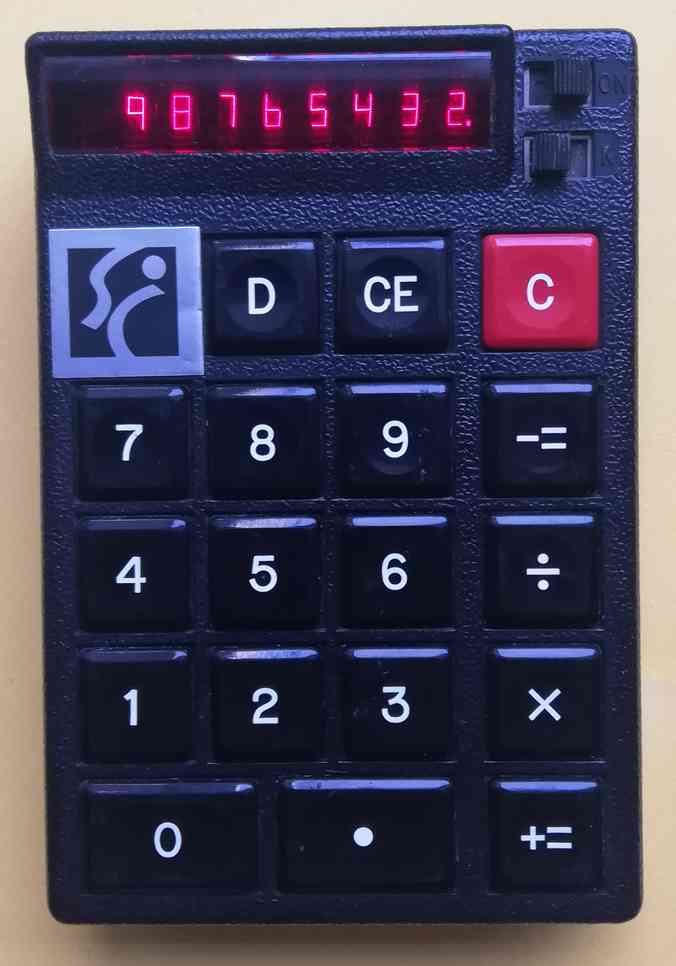 Model: Summit K16
Battery: 9 volt
Adapter: 9 volt
Year: 1972
Chip: TMS0103NC
Info: Made in U.S.A
 Model: Suonoparla Fonillo
Battery: 4 x AA alkaline
AC adapter:
Year: 1987
Chip: TMP50C40A ( CD54169), CF60034
Info:This funny synthesizer based product from Texas Instruments generates a lot of different sounds and stores them into an internal memory to replay. (ITALY). TMP50C40A/CD54169: TSP50C50 VSP (Voice Synthesis Processor) with 8-bit microcontroller and 8k Bytes Mask ROM for both program and voice and 32 Bytes RAM.CF60034: Not yet discovered, probably a Port-Expander for the VSP
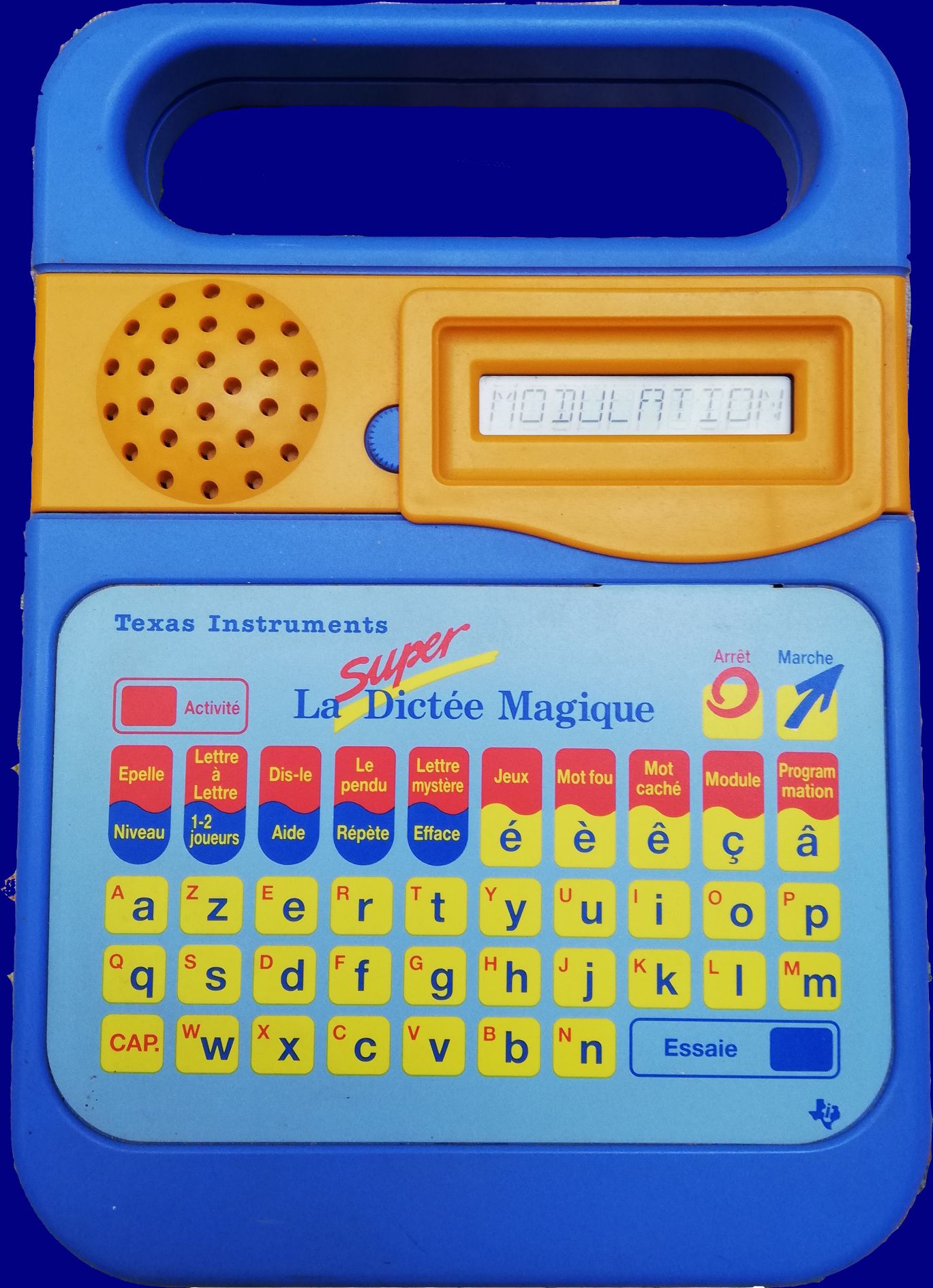 Model: Super Le dictee magique
Battery: 4 x 1,5 C
AC adapter:
Year: 1992
Chip:
Info: Super Line
 Model: Super Libro Parlante
Battery: 4 x AA alkaline
AC adapter:
Year: 1990
Chip: TSP50C42 (CSM42014), TSP60C19 (CMM19016)
Info:Nothing else than a colored Touch & Discover distributed by Clementoni with Italian voices stored in the Speech-ROM's.The toy is intended for players ages 2 to 5.The idea of the product is simple: Switch the game on and wait for the instructions. The only thing you need is your fingertip.

 Super NES. The Super Nintendo Entertainment System, commonly shortened to Super Nintendo,Super NES or SNES, is a 16-bit home video game console developed by Nintendo that was released in 1990 in Japan, 1991 in North America, 1992 in Europe and Oceania and 1993 in South America. In Japan, it is called the Super Famicom (SFC). In South Korea, it is called the Super Comboy and was distributed by Hyundai Electronics. The system was released in Brazil on August 30, 1993, by Playtronic. In Russia and CIS, the system was distributed by Steepler from 1994 until 1996. Although each version is essentially the same, several forms of regional lockout prevent cartridges for one version from being used in other versions.
Donated from Marco Santini (IT)
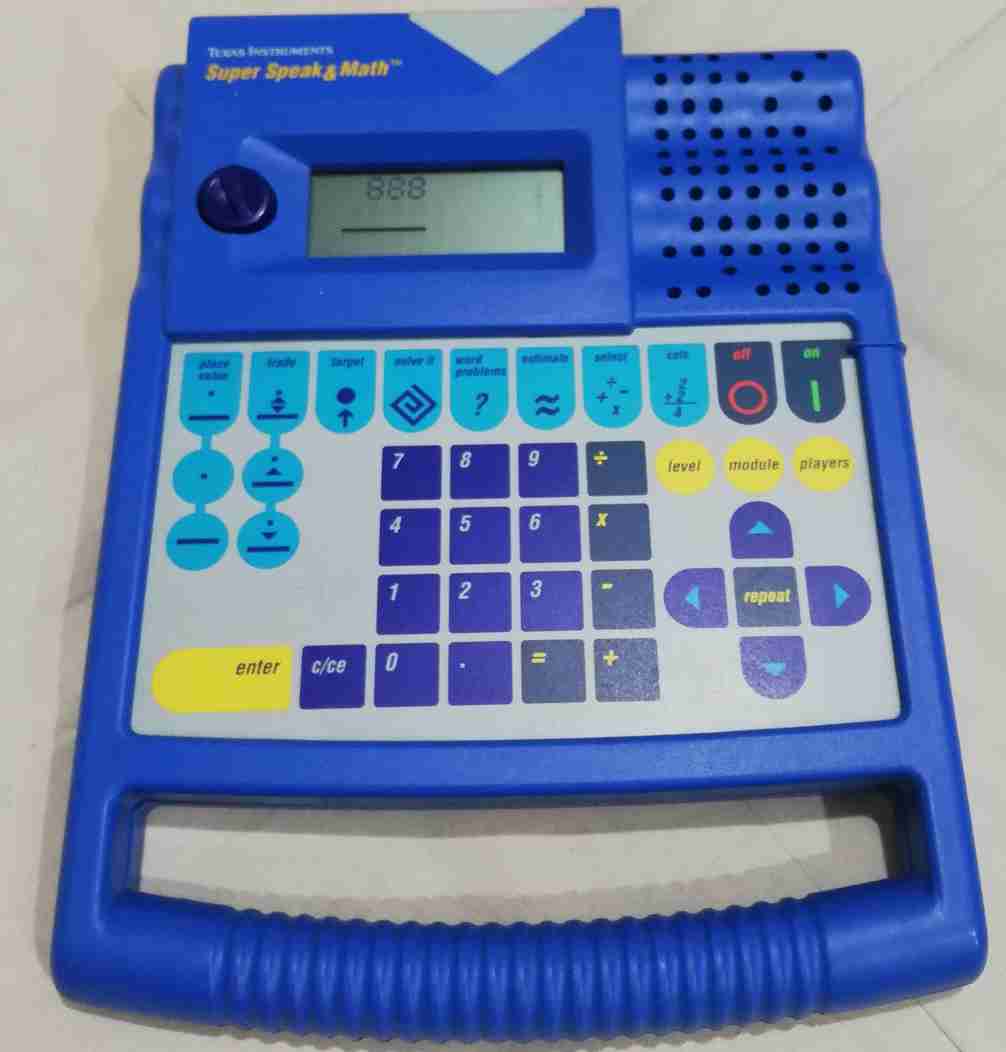 Model: Super Speak & Math
Battery: 4 x AA
AC adapter:
Year: 1991
Chip: TSP50C10 (CSM10047), TSP60C18 (CMM18001), Samsung KS0062
Info: With the Super Speak & line Texas Instruments introduced educational toys similar to the well known kids-computers with there small LCD-screens and ASCII-keyboards.
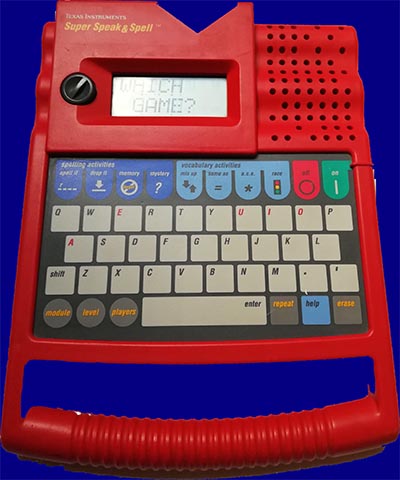 Model: Super Speak & Spell
Battery: 4 x AA
AC adapter:
Year: 1989
Chip:
Info: TSP50C42 (CSM42019) TSP60C18 (CMM18004) or TSP50C10 (CSM10087) HD44780
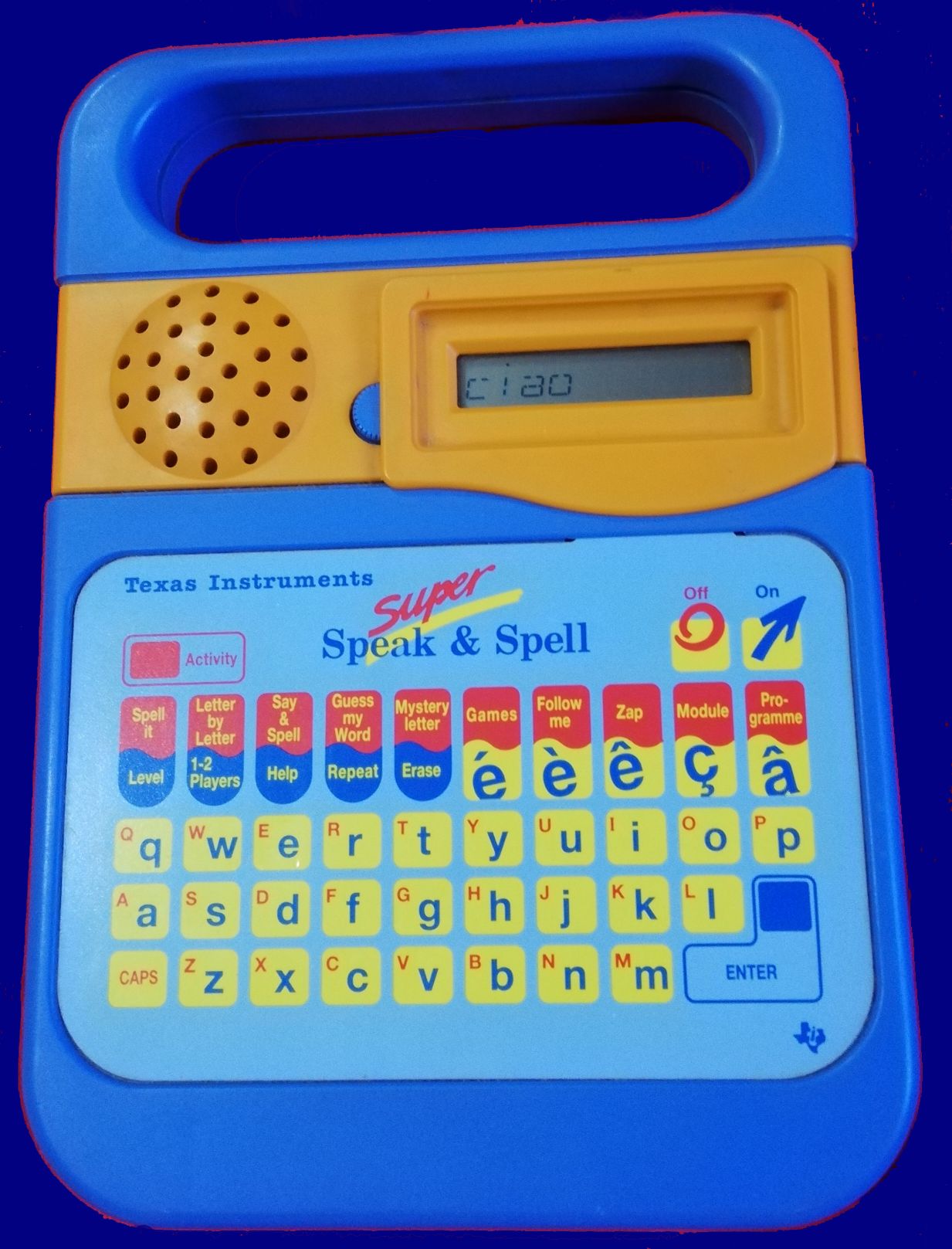 Model: Super Speak and Spell 2v
Battery: 4 x 1,5 C
AC adapter:
Year: 1992
Chip:
Info: 2 version
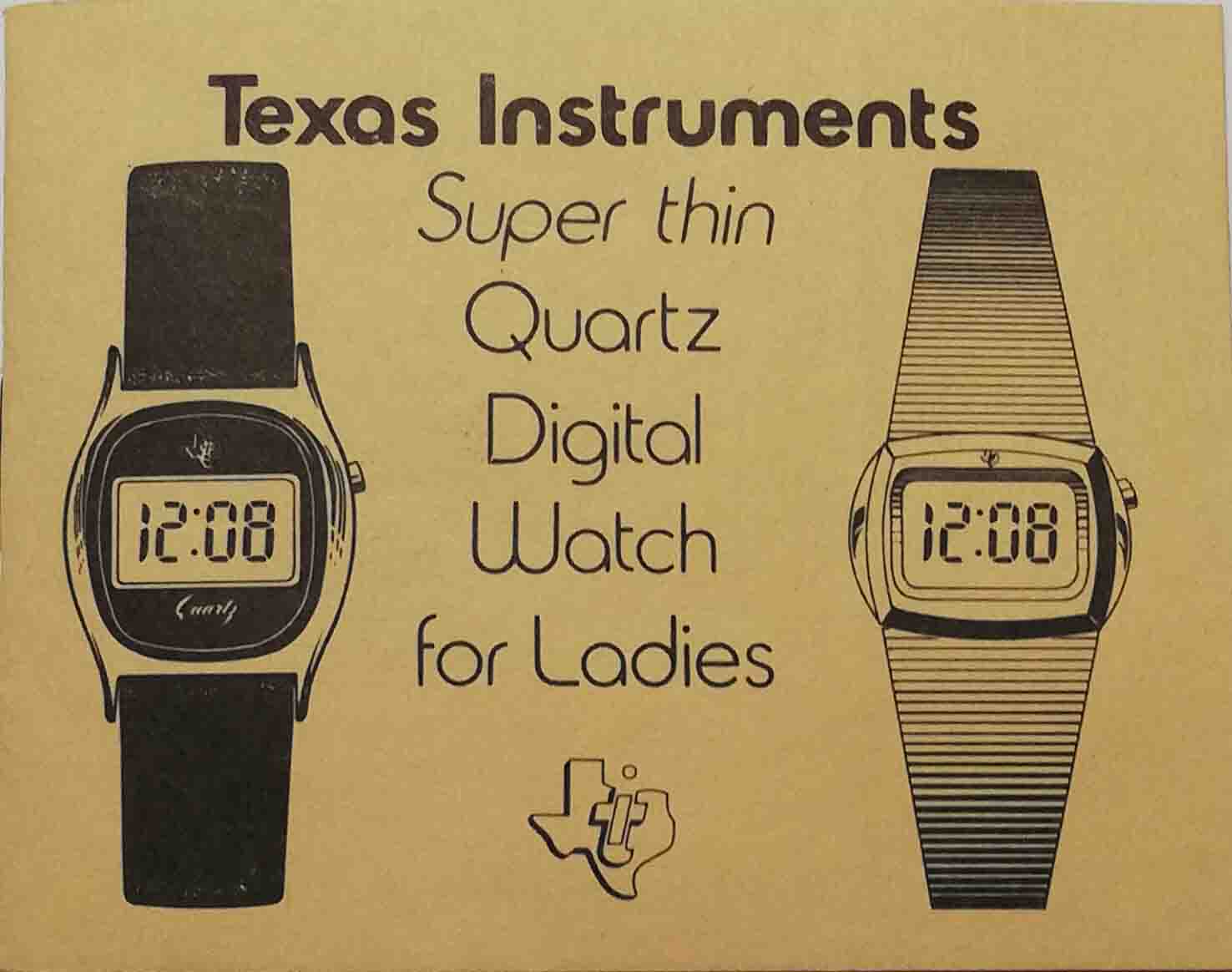 Description: Super Thin Quartz digital watch
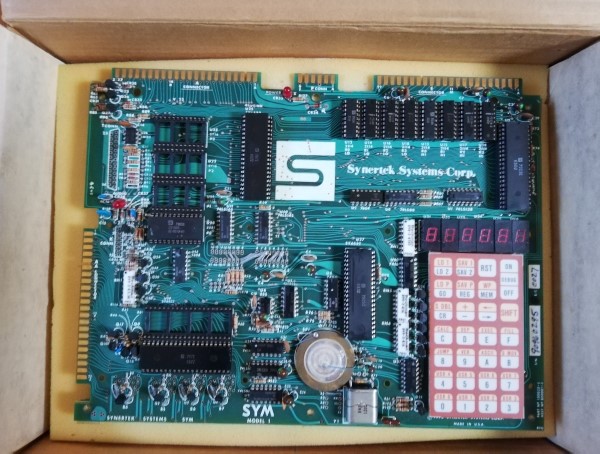
The SYM-1 is a single board "trainer" computer produced by Synertek Systems in 1975. It was designed by Ray Holt. Originally called the VIM-1 (Versatile Input Monitor), that name was later changed to SYM-1.The SYM-1 is a close copy of the popular MOS Technology KIM-1 system, with which it is compatible to a large extent. Compared to the KIM-1, enhancements include the ability to run on a single +5 volt power supply, an enhanced monitor ROM, three configurable ROM/EPROM sockets, RAM expandable on board to 4 KB, an RS-232 serial port, and a "high speed" (185 bytes/second, the KIM-1 supports about 8 bytes/second) audio cassette storage interface. It also features on-board buffer circuits to ease interfacing to "high voltage or high current" devices.
One capability of the SYM-1 is its ability to allow an oscilloscope to be added to provide a 32 character display under software control. As explained in Chapter 7 of the "SYM Reference Manual", the vertical input, ground and trigger input of the oscilloscope are to be connected to the "Scope Out" connector AA on the SYM-1 board. The "Oscilloscope Output Driver Software" code provided in this chapter of the manual is to be entered into the SYM-1's memory and executed to enable the oscilloscope display. This code provides control of the oscilloscope display, as well as a rudimentary character set. Resistors R42 and R45 are to be adjusted to refine the displayed image.
 Model: TE-8000
Battery: no
Adapter: AC 110 volt
Year: 1973
Chip: TMS0105
Info:TE8000 is a four-function desk calculator from 1973, built with a Texas Instruments single-chip processor.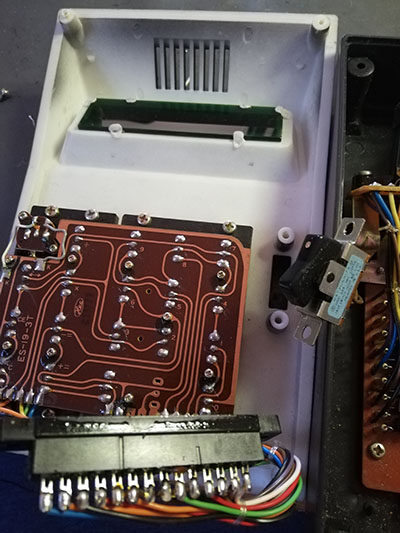
The calculator is housed in a rectangular plastic box finished in imitation woodgrain.
The main circuit board and the display tube board are fastened to the base with a pair of light metal brackets. A 2-pin mains connector and the power transformer are mounted at the rear of the box, with the power switch attached to the moulded top cover. The transformer secondaries are hard-wired to the circuit board.
The display uses a set of miniature eight-segment vacuum fluorescent tubes, Futaba type DG10R1. (The small eighth segment at the centre right gives a "proper" numeral 4, but the processor only drives the usual seven segments). Eight tubes are used for the numerical display, and one (at the right) for polarity and error indication.
The keyboard is built as a single module and is attached to the main board via a cable and edge connector.
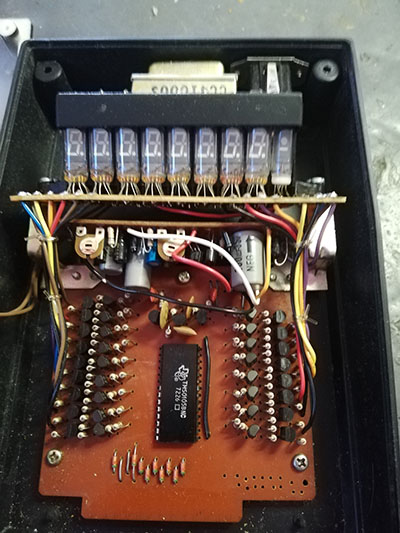
The TMS-0105 series single-chip processors contain all of the calculator circuitry with the exception of the power supplies and display drivers.
The rather untidy circuit board has a simple power supply at the rear and the TMS-0105 chip in the centre. The anode drivers for the nine tubes are at the left, with the eight segment drivers (seven plus decimal point) at the right. The keyboard attaches to the edge connector at the bottom.
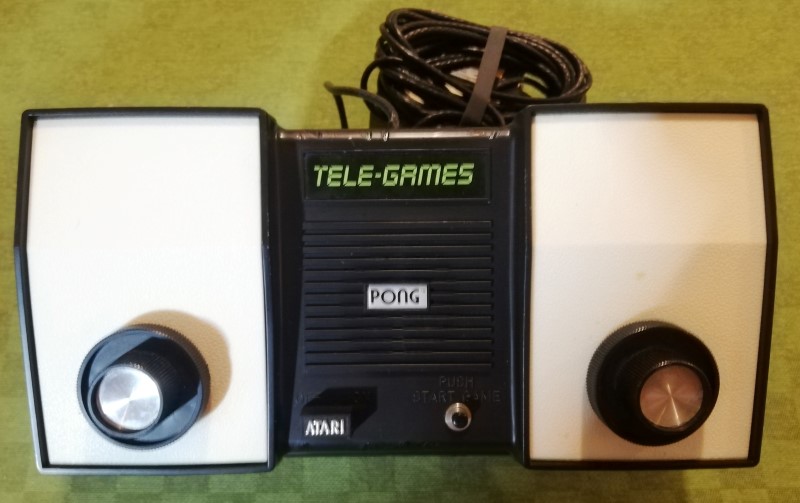 Telegames Pong
In 1975, Atari started looking for ways to distribute their new home “Pong” system, but it wasn’t easy finding a distributor due to the track record that Magnavox had with the Odyssey. Retailers felt the price of the system was too expensive to draw an interest from the general public. After being rejected by numerous toys and electronics manufacturers Atari tried contacting Sears & Roebuck to see if they would have any better luck trying to work out a distribution agreement. They were directed to Tom Quinn who was the buyer for Sears’ sporting goods department, and he expressed interest but wanted the system demonstrated for a few executives first. Al Alcorn travelled to Chicago to demonstrate the pong home system prototype for the Sears executives and despite some minor technical issues with the prototype was able to obtain their approval.
Now that the executives gave their blessing, Quinn started to work with Nolan Bushnell to see if they could reach an agreement. Quinn wanted exclusive rights to the system as well as 150,000 systems before the holiday season. Bushnell agreed to the terms even though he knew that Atari would not be able to produce 150,000 units with their current facility. Atari acquired a new factory through funding by venture capitalist Don Valentine in order to produce the promised 150,000 units for Sears. In the end Atari was able to fulfill the order for Sears. All systems manufactured in 1975 were branded with Sears’ “Tele-Games” name but in 1976 Atari started releasing a version under their own brand name.
The success of home pong just like the video arcade version resulted in a multitude of clone pong consoles. Unlike the Magnavox Odyssey the home pong console and the clone consoles were only able to play one game “Pong”. Even with the limited ability of playing just one game the Pong systems became extremely popular and easily outsold the Odyssey.
Sears’ first venture into video games was very successful and they decided to continue the partnership with Atari expanding the tele-games brand by offering other video game systems with built in games. Atari continued to manufacture systems branding them with the Sears Tele-Games brand and by early 1977 many systems with built in games were released under both the Atari brand and the Sears Tele-Games brand.
.
The history of Texas Instruments.
Audio Guide

|
|

|
|
1930 Texas Instruments was officially born as GSI (Geophysical Service Incorporated), which deals with geological surveys
for the oil industry
1951 GSI changes its name to Texas Instruments Incorporated.
1954 TI launches a real technological revolution by making the first silicon transistor, which it will soon make germanium is
obsolete, and starting the production of the first transistor radio, the Regency TR-1.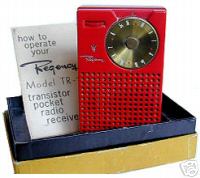
1955 TI creates the first infrared image sensor 1958 by Jack St. Clair Kilby, develops the first integrated circuit (chip), that is,
a series of passive and active electronic components that are different but connected in a circuit way, capable of fulfilling to a
specific function and made on a single semiconductor material platform, through a single manufacturing process.
The invention of the integrated circuit will be worth the Nobel Prize in Physics in Kilby in 2000. Also in 1958 TI made the
first analog-to-digital converter.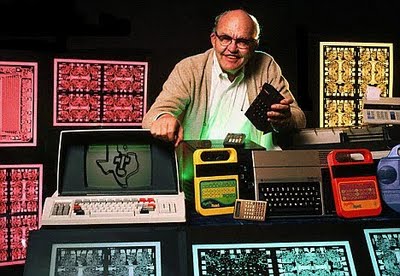
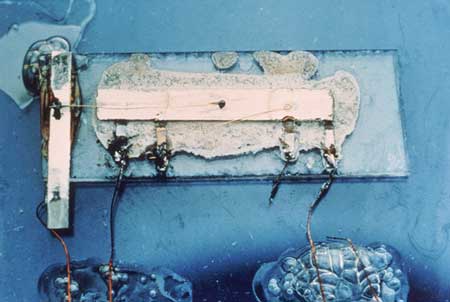
1964 TI is launching a new family of digital-logic devices (Series 7400) technology, TTL (Transistor-transistor logic),
the wide variety of logic functions offered by these devices available, the decree will become a worldwide success
standard adopted by most semiconductor companies.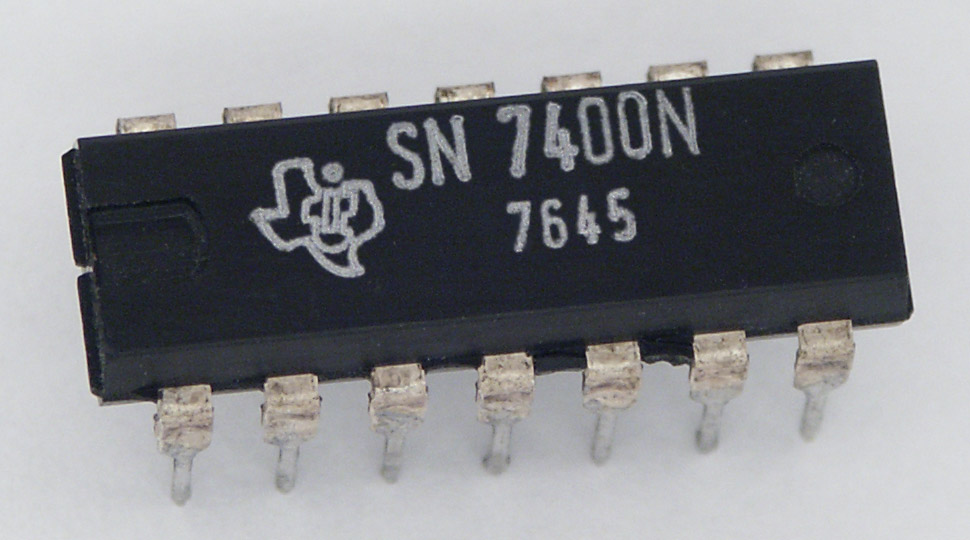
1967 TI developed the first prototype of a pocket calculator. This is a project called Cal Tech and is represented by a
calculator integrated circuits capable of performing the four basic arithmetic operations with a precision of 12 decimal
places. The keyboard consists of 18 keys and the results of the calculations is displayed on a paper tape by a small
built-in thermal printer. The Cal Tech, however, is not the first pocket calculator business model as the first pocket
calculator, developed in collaboration with their IT, will be sold by Canon in 1970, the not insignificant price
of $ 400 for that period.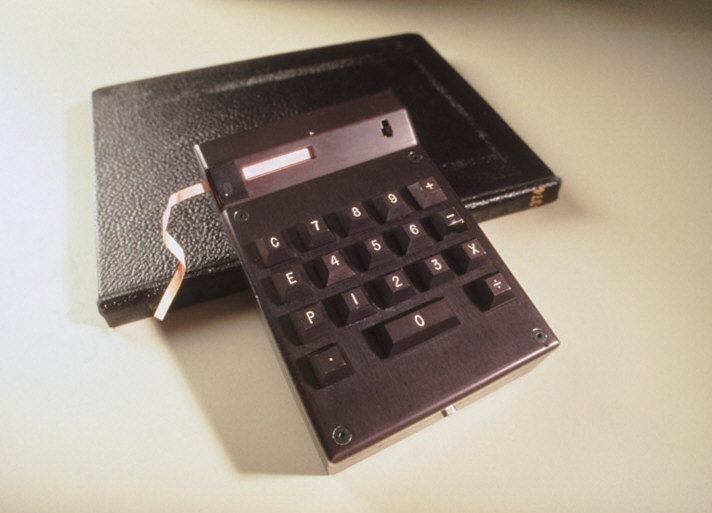
1972 TI enters the market with the TI-2500 Datamath model, the cost of only $ 150. The calculator used for the first
time a single chip to perform all math functions. The device is the ancestor of the modern microprocessor, the invention
of which is attributed to both the RT to Intel.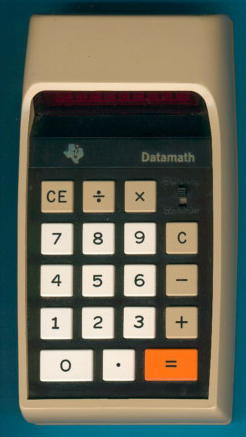
1975 TI enters the market with quartz digital watches.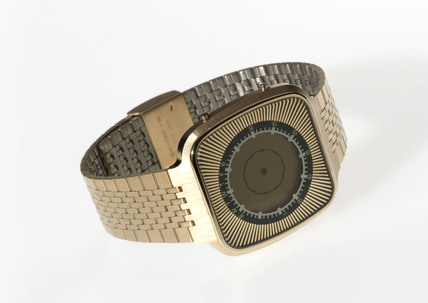
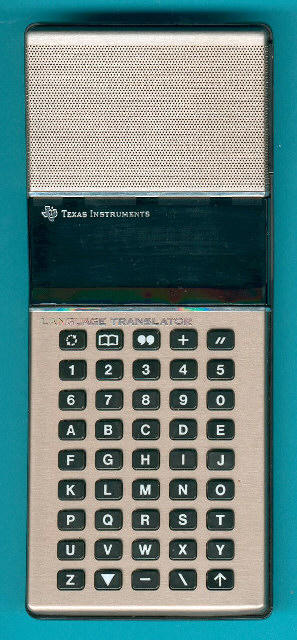
1978 TI developed the first microprocessor for speech kicking off the first production of portable language translators,
and a line of teaching aids speakers including the "Speak & Spell," or "Il Grillo Parlante" and immortalized in the
famous film Steven Spielberg, ET.
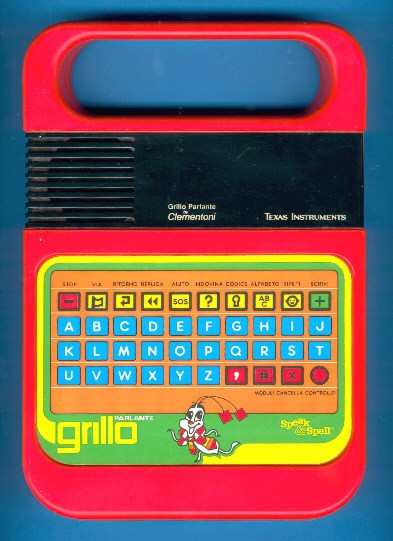
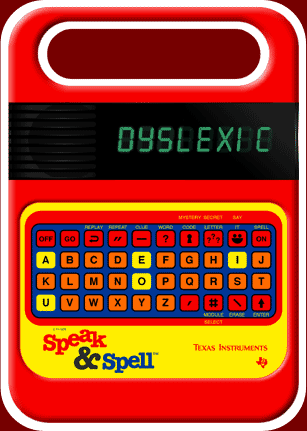
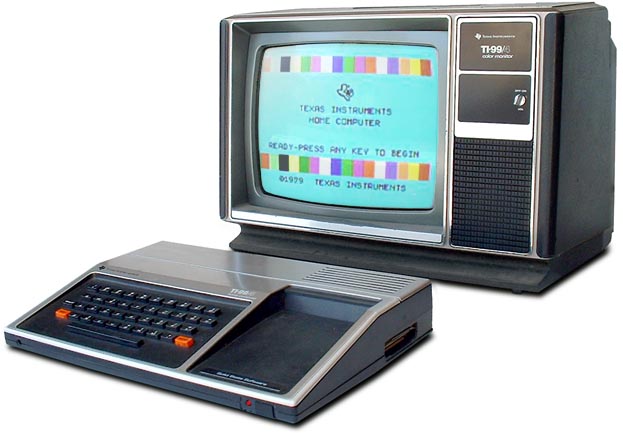
1981 TI debut in the world of home computers with the model equipped with a TI 99 TI 16-bit microprocessor, the TMS9900.
The computer, equipped with a 13-inch monitor is designed to work with special boxes that contain magnetic memory
management programs, entertainment or educational software and comes with an interesting voice module that can be
used to reproduce stored documents. The market reaction to the launch of TI 99 is good but the initial price of the computer
($ 525) is still considered excessive. In the same year launched a major operation of commercial promotion and marketing
that includes the involvement of schools and universities. The number of users of the TI 99 is growing rapidly and will
grow the library of software available. Under the pressure of the increased sales volume and especially the increasingly
fierce competition, the TI reduces the price of the TI 99 and only $ 299 in April 1982 appears to be the leading producer of
home computer. In early 1983, TI will further reduce the price of his computer at $ 100 and sells its millionth copy
distribution network now includes more than 20,000 stores around the world and are more than 2000 software
packages developed.
1982 TI produced its first DSP (digital signal processor), a microprocessor from highly specialized functions that can run
fast times in digital signal processing.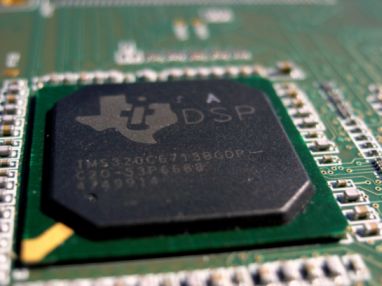
1988 sees the light of the first device Digital Light Processing (DLP) projectors that will be used on commercial video
only from the early years of the twenty-first century.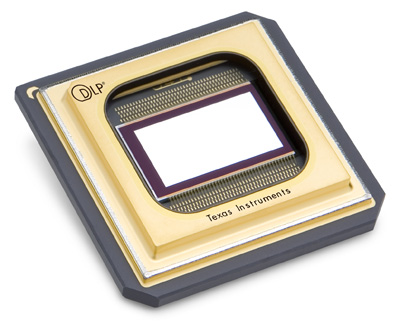
In the mid-nineties the company alive, perhaps one of its most difficult moments. The cyclical nature of the semiconductor
market seems to increase and big moments of elation are racing moments of deep depression and instability. The company,
similar to what happens for various companies competing, he decided to quit the business sectors to greater volatility,
including that of personal computers, the military, that of DRAM and software and focus on those sectors where may have
and maintain a position of commercial and technological supremacy. Several production centers are closed or sold to
competitors and thousands of redundant employees worldwide. At this time the sale of Italian sites located in
Rieti and TI Avezzano and the closure of the Aversa.
La Storia della Texas Instruments.
Audio Guide
|
|
1930 La Texas Instruments nasce ufficialmente come GSI (Geophysical Service Incorporated), la quale si occupa di
rilevazioni geologiche per l'industria petrolifera
1951 GSI cambia la denominazione e diventa Texas Instruments Incorporated.
1954 la TI lancia una vera e propria rivoluzione tecnologica realizzando il primo transistor al silicio, che renderà ben presto
obsoleto il germanio, e dando il via alla produzione della prima radio a transistor, la Regency TR-1.
1955 la TI realizza il primo sensore di immagini ad infrarossi
1958 per opera di Jack St. Clair Kilby, sviluppa il primo circuito integrato (chip), ovvero una serie di componenti elettronici
passivi ed attivi diversi ma connessi in modo circuitale, in grado di adempiere ad una specifica funzione e realizzati su una
unica piattaforma di materiale semiconduttore, mediante un unico processo di lavorazione.
L'invenzione del circuito integrato varrà a Kilby nel 2000 il premio Nobel per la fisica.
Sempre nel 1958 la TI realizza il primo convertitore analogico-digitale.
1964 la TI introduce sul mercato una nuova famiglia di dispositivi logico-digitale (serie 7400), in tecnologia
TTL (Transistor-transistor logic), l'ampia varietà di funzioni logiche disponibili offerte da questi dispositivi,
ne decretano il successo mondiale e diventerà uno standard adottato dalla maggior parte delle aziende di semiconduttori.
1967 La TI sviluppa il primo prototipo di una calcolatrice tascabile. Si tratta del progetto denominato Cal Tech ed
è rappresentato da una calcolatrice a circuiti integrati in grado di eseguire le 4 operazioni aritmetiche fondamentali
con una precisione di 12 cifre decimali. La tastiera è composta da 18 tasti e il risultato dei calcoli viene visualizzato
su un nastro cartaceo da una piccola stampante termica incorporata. La Cal Tech non rappresenta comunque la prima
calcolatrice tascabile commerciale in quanto il primo modello di pocket calculator, sviluppato in collaborazione
proprio con la TI, verrà messo in vendita dalla Canon nel 1970, al prezzo non trascurabile per quel periodo di
400 dollari.
1972 la TI entra nel mercato con il modello TI-2500 Datamath, del costo di soli 150 dollari. La calcolatrice impiega
per la prima volta un singolo chip per la esecuzione di tutte le funzioni matematiche. Il dispositivo costituisce il
progenitore del moderno microprocessore, l'invenzione del quale è attribuita sia alla TI che alla Intel.
1975 La Texas Instruments entra nel mercato mondiale con i primi orologi al Quarzo.
1978 TI sviluppa il primo microprocessore per la sintesi vocale dando il via alla produzione dei primi traduttori
linguistici portatili e di una linea di supporti didattici parlanti tra i quali lo “Speak & Spell”, o “ Il Grillo Parlante “
e immortalato nel celebre film di Steven Spielberg, E.T.
1981 TI esordisce nel mondo degli home computer con il modello TI 99 fornito di un microprocessore TI a 16 bit,
il TMS9900. Il computer, fornito di un monitor a 13 pollici è progettato per funzionare con speciali cassette di memoria
magnetica che contengono programmi di gestione, intrattenimento o di software didattico e viene fornito di un interessante
modulo vocale che può essere utilizzato per riprodurre documenti memorizzati.
La reazione del mercato al lancio del TI 99 è buona ma il prezzo iniziale del computer (525 dollari) è giudicato ancora
eccessivo. Nello stesso anno viene avviata una grossa operazione di promozione commerciale e di marketing che prevede
il coinvolgimento di scuole e università. Il numero di utilizzatori del TI 99 cresce velocemente e cresce di pari
passo la libreria delle applicazioni software disponibili. Sotto la spinta dell'aumentato volume di vendite e soprattutto della
concorrenza sempre più agguerrita, la TI riduce il prezzo del TI 99 a soli 299 dollari e nell'aprile del 1982 risulta essere la
principale produttrice di home computer. Agli inizi del 1983 la TI riduce ulteriormente il prezzo del suo computer a
100 dollari e vende il suo millionesimo esemplare, la rete di distribuzione prevede ormai più di 20.000 negozi sparsi in tutto
il mondo e sono più di 2000 i pacchetti software sviluppati.
1982 la TI produce il suo primo dispositivo DSP (Digital signal processor), un microprocessore dalle funzioni estremamente
specializzate in grado di eseguire in tempi velocissimi elaborazioni di segnali digitali.
1988 vede la luce il primo dispositivo Digital Light Processing (DLP) che verrà impiegato su proiettori video commerciali
solo a partire dai primi anni del XXI secolo.
A metà degli anni novanta la compagnia vive forse uno dei suoi momenti più difficili. L'andamento ciclico del mercato dei
semiconduttori sembra accentuarsi e a momenti di grossa euforia si succedono rapidamente momenti di profonda
depressione e instabilità. L'azienda, analogamente a quanto accade per diverse compagnie concorrenti, decide di uscire
dai settori commerciali a maggiore volatilità, tra i quali quello dei personal computer, quello militare, quello del software e
delle memorie DRAM e di concentrarsi su quei settori strategici nei quali può vantare e mantenere una posizione di
supremazia commerciale e tecnologica.
Numerosi centri di produzione vengono chiusi o venduti alla concorrenza e migliaia di dipendenti licenziati in tutto il mondo.
Risale a questo periodo la vendita dei siti italiani TI localizzati a Rieti ed Avezzano e la chiusura del sito di Aversa.
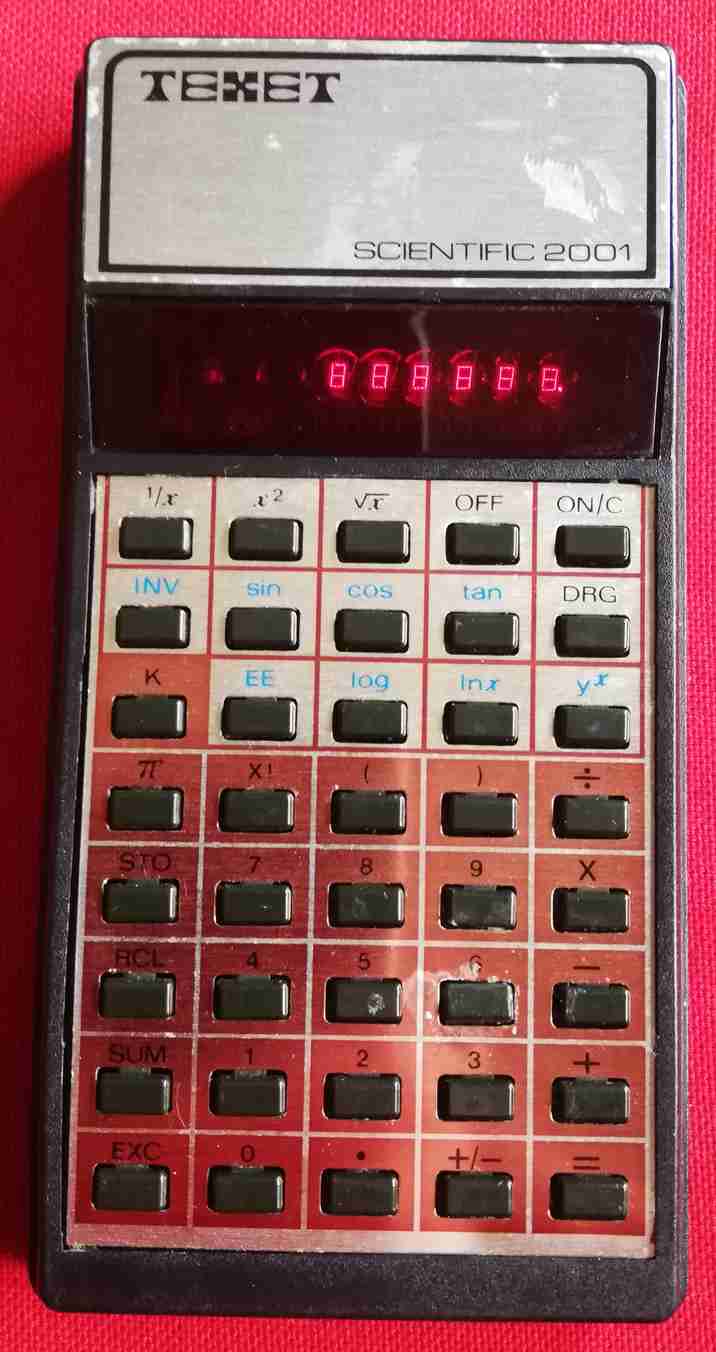 Model: TEXET 2001 scientific
Battery: 9 volt
Adapter:
Year: 1976
Chip: TMS0985
Info:
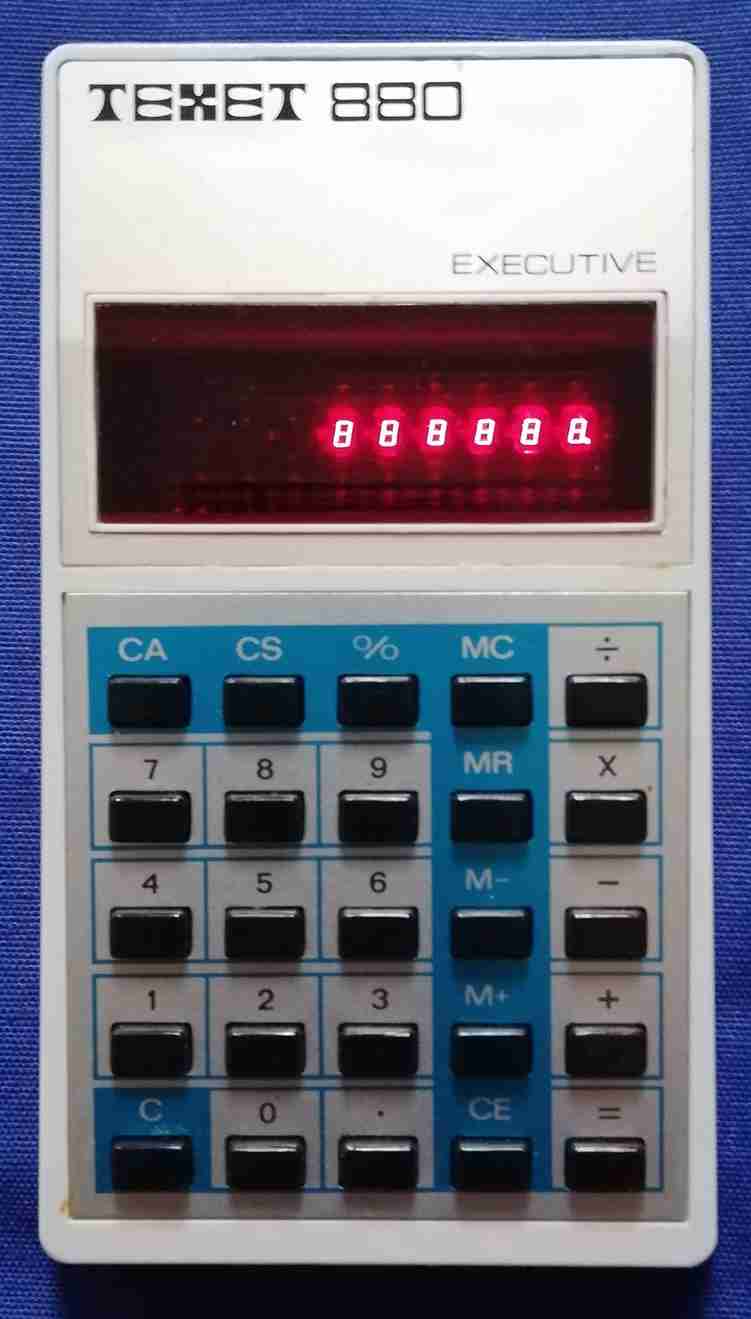 Model: TEXET 880
Battery: 9 volt
Adapter:
Year:
Chip: TMS0972
Info: This is a nearly perfect copy of the TI-1250. Made in Homg Kong
.jpg) THEC64 (2019). The C64 is back, this time in full size and featuring a fully functional keyboard for fans of the best-selling computer of all time. The included joystick has been upgraded with micro switches, making the built-in games more fun than ever. It allows you to load and save your own files and games via USB flash drive and to program in C64 or VIC-20 BASIC.
THEC64 (2019). The C64 is back, this time in full size and featuring a fully functional keyboard for fans of the best-selling computer of all time. The included joystick has been upgraded with micro switches, making the built-in games more fun than ever. It allows you to load and save your own files and games via USB flash drive and to program in C64 or VIC-20 BASIC.
64 games included, with the option to add more
Alleykat, Anarchy, Attack of the Mutant Camels, Avenger, Battle Valley, Bear Bovver, Boulder Dash, Bounder, California Games, Chips Challenge, Confuzion, Cosmic Causeway, Cyberdyne Warrior, Cybernoid II, Deflektor, Destroyer, Everyone's a Wally, Firelord, Galencia, Gateway to Apshai, Gribbly's Day Out, Gridrunner (VIC 20), Heartland, Herobotix, Highway Encounter, Hover Bovver, Impossible Mission, Impossible Mission II, IO, Iridis Alpha, Jumpman, Mega Apocalypse, Mission AD, Monty Mole, Monty in fuga, Nebulus, Netherworld, Nodi di Yesod, Paradroid, Pitstop II, Planet of Death, Psychedelia (VIC 20), Ranarama, Robin of the Wood, Silicon Warrior, Skate Crazy, Speedball 2, Spindizzy, Steel, Street Sports Baseball , Street Sports Basketball, Summer Games II (include eventi Summer Games), Super Cycle, Sword of Fargoal, Temple of Apshai Trilogy,The Arc of Yesod, Thing Bounces Back, Thing on a Spring, Trailblazer, Uridium, Chi osa vince II, Giochi invernali, Giochi mondiali, Zynap.
Here it is on display at the World Chili Fair 2025
The Educator
The California based company Stokes Publishing Company, Inc. distributes under the label "The Educator®"
calculators optimized for teaching purposes. William T. Stokes filed already July 30, 1991 the US Patent Application U.S. Pat. No. 5,035,502 with the title "Transparent calculator for overhead projection".
.jpg) THE Sega Megadrive (2025).
THE Sega Megadrive (2025).
The Sega Mega Drive Flashback HD is a retro game console with 83 built-in games. It includes flagship titles like Sega Sonic and Phantasy Star, as well as save, pause, and rewind functions for every game. It is a remake of the original Sega Genesis console. Two wireless controllers (2.4GHz) and an HDMI output (720p) are included, along with an HDMI cable. The built-in cartridge holder can play original Sega Genesis games (no games included).
Features:
83 built-in classic games
An exceptional selection of Sega classics: Sonic series, Phantasy Star series, and Shining Force series
Two wireless controllers (2.4GHz) in the style of the original Sega Genesis/Mega Drive console
Save, pause, and rewind functions for every game
HDMI cable and 220V power supply included.
Here it is on display at the World Chili Fair 2025
.jpg) THE Spectrum (2024) Relive the magic. A true masterpiece of extraordinary design, born to shine and deserve a place in an art gallery. Decorated in its iconic rainbow colors, this fun, eccentric, and extroverted machine rekindles the joy of simple, immediate games, bringing back that pure, spontaneous experience that modern gaming has slowly forgotten.With a timeless aesthetic and vibrant personality, The Spectrum is more than just an updated replica of the legendary 1980s home computer: it is a true interactive work of art, capable of offering everyone a nostalgic, exciting, and surprisingly contemporary gaming adventure.
THE Spectrum (2024) Relive the magic. A true masterpiece of extraordinary design, born to shine and deserve a place in an art gallery. Decorated in its iconic rainbow colors, this fun, eccentric, and extroverted machine rekindles the joy of simple, immediate games, bringing back that pure, spontaneous experience that modern gaming has slowly forgotten.With a timeless aesthetic and vibrant personality, The Spectrum is more than just an updated replica of the legendary 1980s home computer: it is a true interactive work of art, capable of offering everyone a nostalgic, exciting, and surprisingly contemporary gaming adventure.
Here it is on display at the World Chili Fair 2025
48 built-in games
Contains the best genre defining ZX Spectrum games, such as Manic Miner, Head Over Heels, Saboteur! Remastered, The Hobbit, Army Moves and The Great Escape.
Classic Mode
Switch to Classic Mode and dive into the full ZX Spectrum experience, complete with BASIC programming and virtual cassettes.
48K and 128K compatibility
Compatible with games for 48K to 128K ZX Spectrum models.
Save your progress
Save your progress in one of four save-game slots per game, and return at any time.
Rewind mode
Rewind your gameplay at any time by up to 40 seconds to help you get through those difficult levels!
Extended colours
Supports the ULAplus™ colour mode for richer colour palettes that can be applied to any game.
Load your own
Load and play the programs you already own, optionally with the cassette loading effects you remember.
Display frames
Surround your gameplay with one of 12 attractive frames.
HDMI
High Definition output at 720p 50 or 60Hz.
Four USB ports
Four USB ports support the connection of joysticks, gamepads and USB sticks.
Compatible with game controllers
Compatible with many USB game controllers.
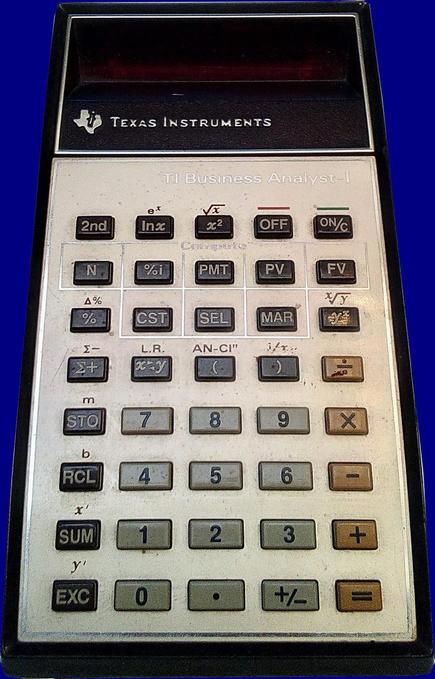 Model: TI business analyst I LED
Battery: 9 volt or RK2
Adapter: AC9132
Year: 1981
Chip: TMC0982
Info: MAJESTIC line
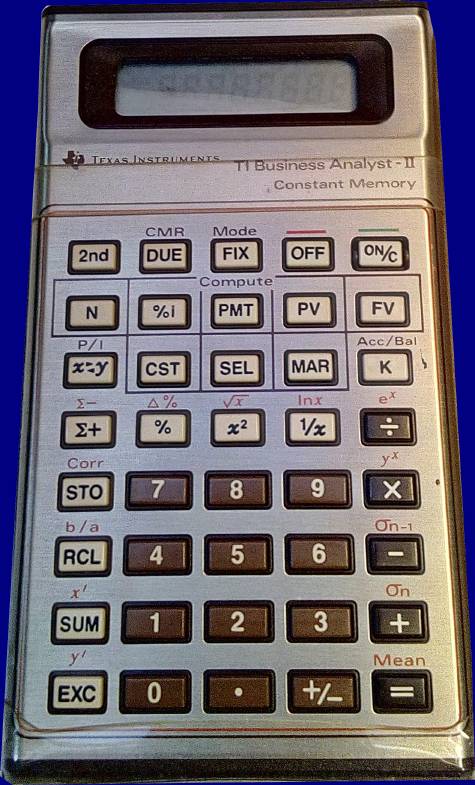 Model: TI business analyst II lcd
Battery: 2 x LR44
Adapter:
Year: 1980
Chip: TPO322
Info: first LCD and slimline LCD
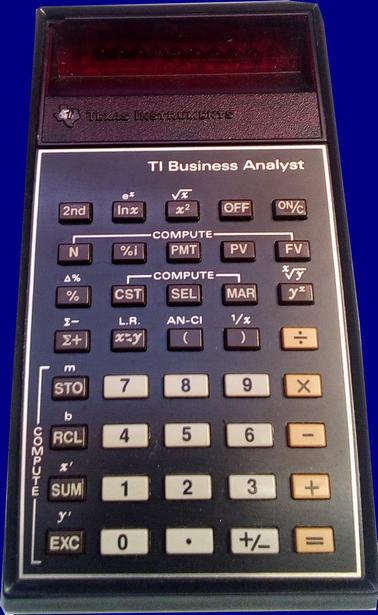 Model: TI business analyst
Battery: BP5 , BP8
Adapter: AC9131 , AC9132
Year: 1978
Chip: TMC0982
Info: MAJESTIC line
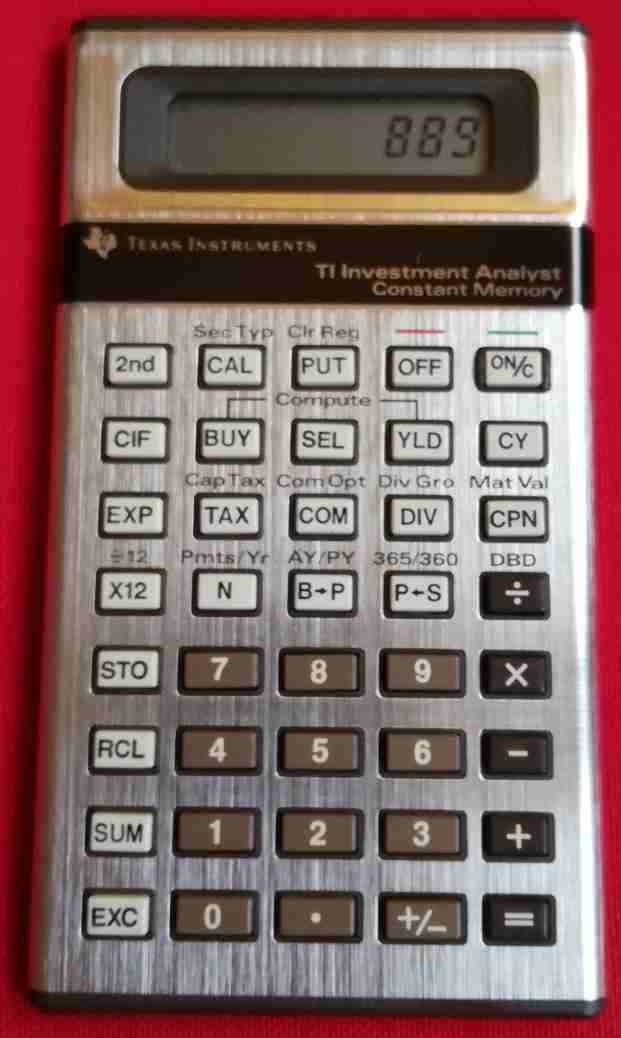 Model: TI Investment Analyst
Battery: 2 x LR44
Adapter:
Year: 1980
Chip: TP0320 (CD3201)
Info:
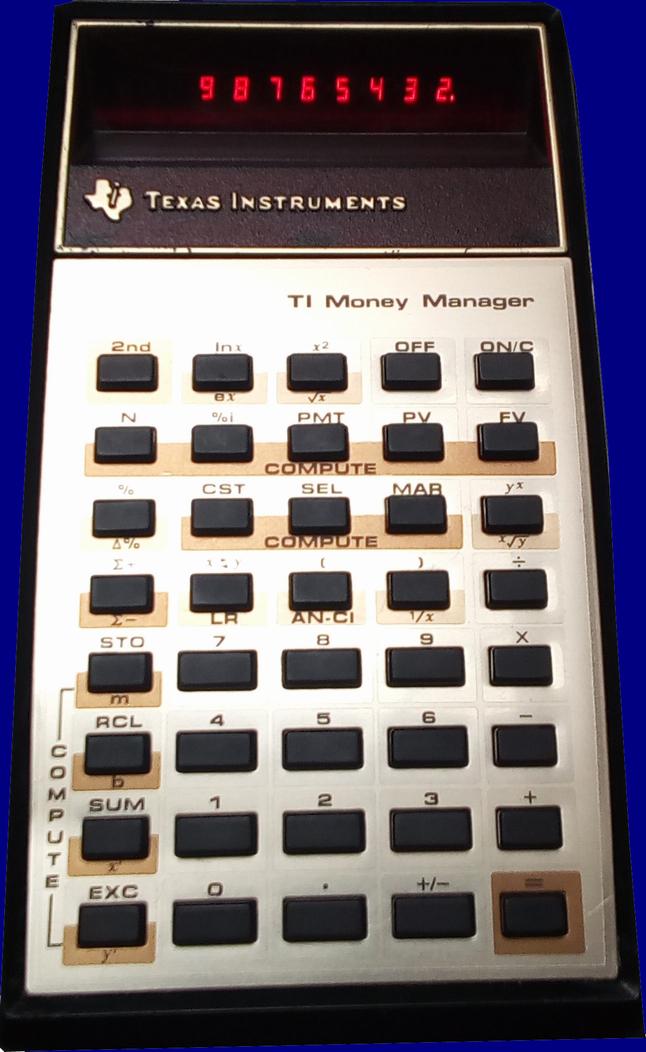 Model: TI money manger led
Battery: BP 7
Adapter: AC9132
Year: 1977
Chip: TMC0982
Info: MAJESTIC line
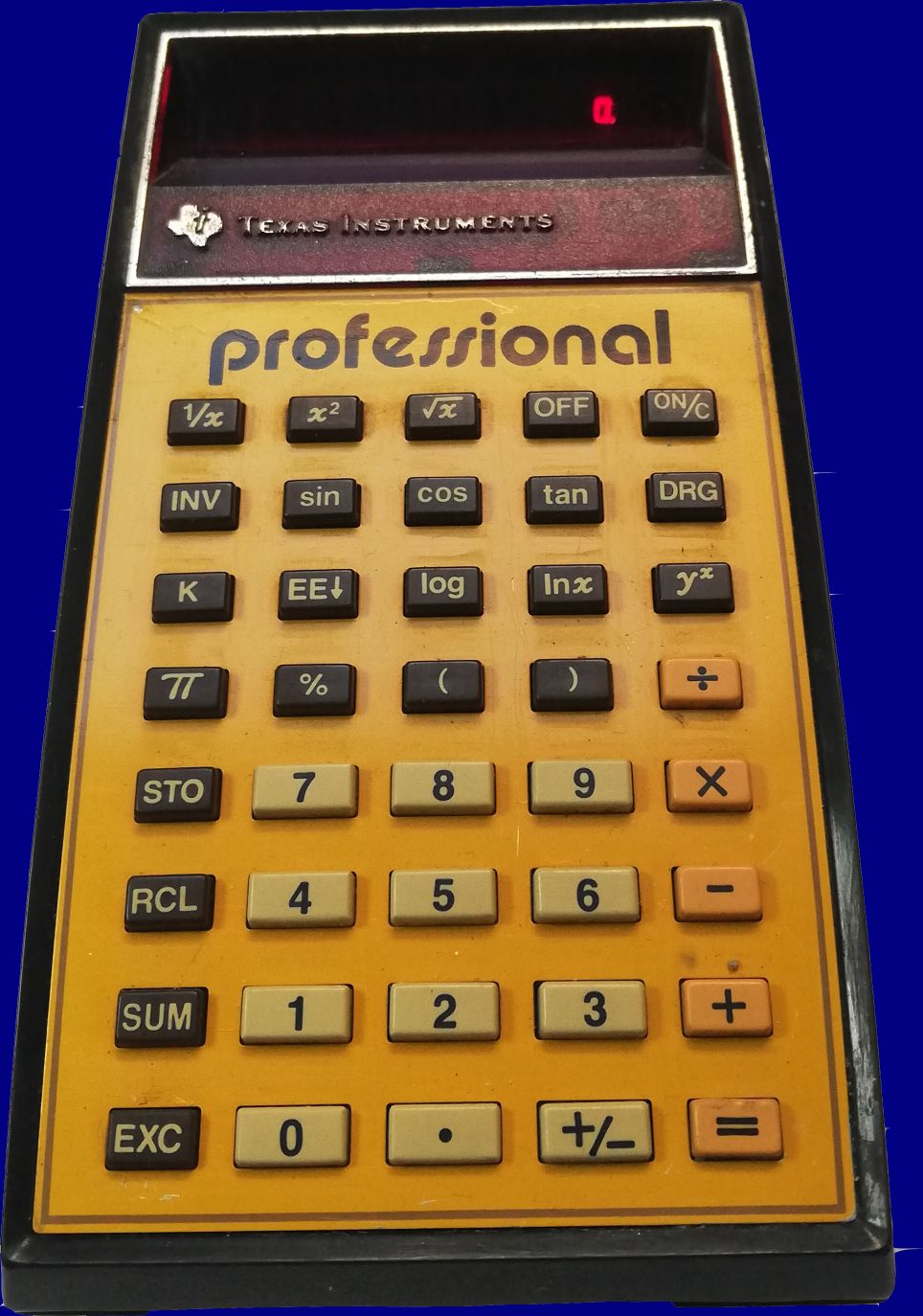 Model: TI Professional Koh-I-Noor
Battery: 9 volt or RK2
Adapter: AC9900/r
Year: 1978
Chip: TMS0981
Info: Made in Italy (RIETI) RCI
It is obvious that the model professional - manufactured for Koh-I-Noor Hardtmuth - is a hybrid of three different products:
| • The basic functionality is borrowed without any doubts from the TI-30 introduced in 1976 • The double-shot injection molded keys are known from the Business Analyst-I • The yellow-brown keyboard plate is... unique |
Dismantling this model professional manufactured in 1978 reveals a standard TI-30 printed circuit board (PCB) with the well-known TMS0981 single-chip calculator circuit.
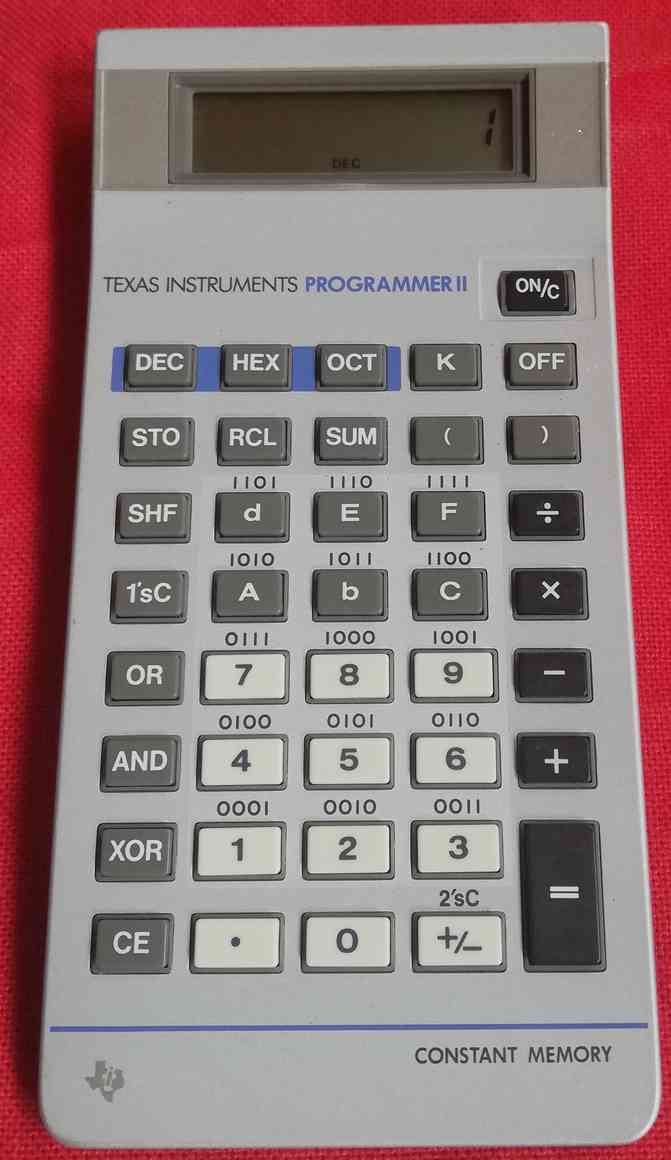 Model: TI programmer II lcd
Battery: 2 x LR44
Adapter:
Year: 1985
Chip: TPO456/CD4569
Info: If you take your time comparing this calculator with all other members of the second slanted series (BA-54, TI-57-II) you notice something very special. The keyboard position doesn't fit to the usual spacing. The ON/C-key is misplaced and one key is super-sized. You have to open the calculator to get the answer: This is not the usual construction of a slanted calculator! A very small printed-circuit-board, actual the form factor of a modern slimline calculator like the BA-II, is fitted into the housing.
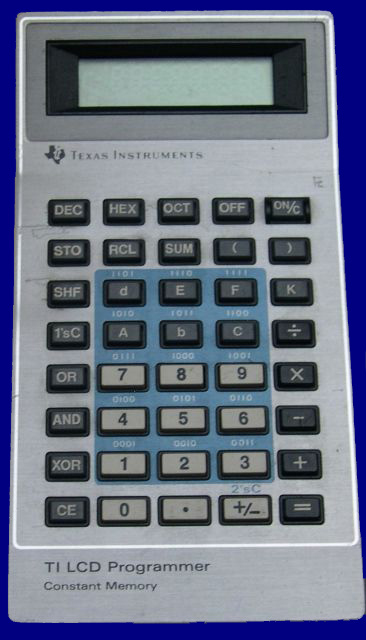 Model: TI programmer lcd
Battery: 2 x LR44
Adapter:
Year: 1983
Chip: CD4569
Info: slanted LCD generation
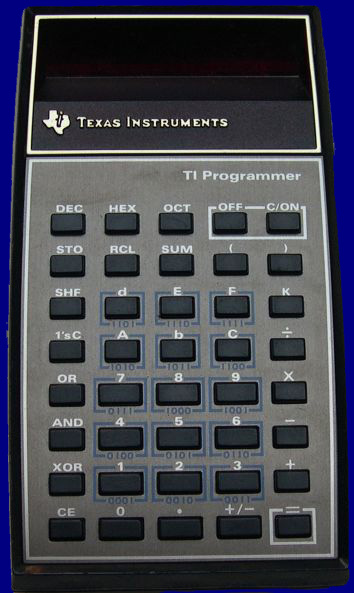 Model: TI programmer led
Battery: BP 8
Adapter: AC9132
Year: 1980
Chip: TMC0983
Info: MAJESTIC line
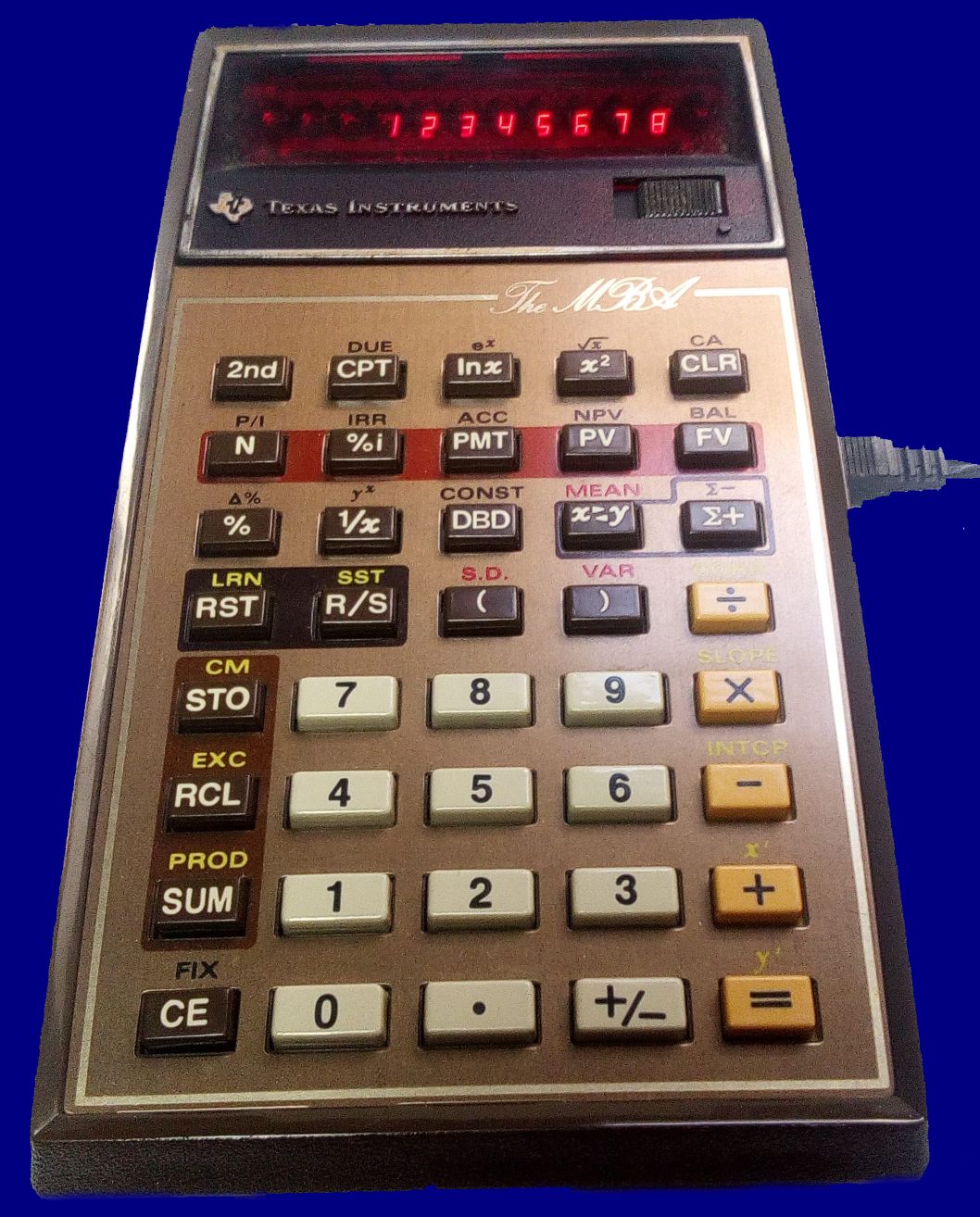 Model: TI the MBA
Battery: BP 7
Adapter: AC9132
Year: 1981
Chip: TMC1502
Info: MAJESTIC line Made in USA
Organizzazione di Volontariato " TI Watch Museum - ODV "
 Se avete l'opportunità di sostenere chi lavora gratuitamente, in questo museo no-profit, con l'obiettivo di aprire nella città di Rieti un museo dedicato a Texas Instruments. Puoi sostenerci donando il tuo 5x1000, inserendo nella dichiarazione dei redditi il CF: 90094080570 nella casella " Sostegno degli enti del Terzo Settore iscritti al RUNTS ", effettuando una donazione utilizzando il codice iban: IT38R0760114600001066057207, oppure premendo il pulsante PAYAPAL DONATE NOW sulla sinistra !
If you have the opportunity to support those who work for free, in this no-profit museum, and with the aim of opening a museum in the city of Rieti dedicated to Texas Instruments. You can support us by donating your 5x1000, entering the tax code 90094080570 in your tax return. Or by making a donation using the iban code: IT38R0760114600001066057207, or by pressing the PAYPAL DONATE NOW button on the left!
Volunteer Organization " TI Watch Museum - ODV "
This is a voluntary non-profit organization of an autonomous, free, apolitical and non-denominational nature which intends to operate mainly in the cultural, training, didactic and informational fields and aims to promote and manage cultural and aggregation and communication activities.
The main points of the association are:
a) Acquire, restore and preserve material and information relating to the history of Texas Instruments and beyond.
b) Carrying out dissemination activities also through meetings, conferences or any other form that serves to promote the activity.
c) Create and manage a "Texas Instruments Museum" in Rieti.
d) Support the proposed projects through conventions, grants, agreements.
e) Carry out any other activity, connected to the institutional purposes, which is deemed useful for the achievement of the association's purposes.
Who we are
Audio Guide
|
|
|
|
 Allow me to introduce myself. I'm Fabrizio, and together with other friends we take care of the museum dedicated to Texas Instruments. This voluntary organization was created to preserve, document and share the technology of all the objects that have made the history of Texas Instruments and beyond (for example Apple and HP ), the final goal is the birth of a museum in the city of Rieti (Italy), where in the 1970s he built one of the most important factories in Italy and Europe.
Much of the technology we enjoy today, such as personal computers, smartphones, tablets, gaming systems, and myriad other devices equipped with a microprocessor “brain,” has its genesis in technologies developed as a result of tenacious experimentation.
We have been passionate about all types of technology since we were children, we try to arouse everyone's curiosity but especially boys and girls from generations younger than ours, we are promoters of many initiatives, including cultural ones, such as conferences, but above all participation in exhibitions, fairs, meetings with students in schools and museums by making our Texas Instruments material available.
This museum is always looking for watches, calculators, games, computers of historical interest. If you own one of these items made primarily in the 20th century, the museum may be interested.
If you have something that seems to match these interests and are looking for a new home, please contact us with information about your item, which you would like to donate or sell.
5 x 1000 TI Watch Museum - ODV

 Organizzazione di volontariato no-profit, del Terzo Settore finalizzato a realizzare il Museo dedicato alla Texas Instruments nella città di Rieti. Destina il tuo #5 x 1000 scegliendo:
TI Watch museum - OdV scrivendo il codice fiscale 90094080570
nella casella "Sostegno degli enti del Terzo Settore iscritti al RUNTS ". Il #5permille, non richiede esborso di denaro, è uno strumento accessibile a tutti che può garantire la sopravvivenza economica dell' ODV.
- Cerca nel modulo della dichiarazione dei redditi (Modello Unico, 730, CU) oppure segnala al CAF lo spazio: "Scelta per la destinazione del cinque per mille dell'Irpef". - Inserisci la Tua Firma nel riquadro " Sostegno degli enti del Terzo Settore iscritti al RUNTS "
- Inserisci il codice fiscale dell'associazione: 90094080570 sotto la firma, nello spazio "Codice fiscale del beneficiario".
Oppure facendo una donazione utilizzando il codice iban: IT38R0760114600001066057207 .
Oppure premendo sul tasto PAYPAL DONATE NOW sulla sinistra !
Grazie Mille
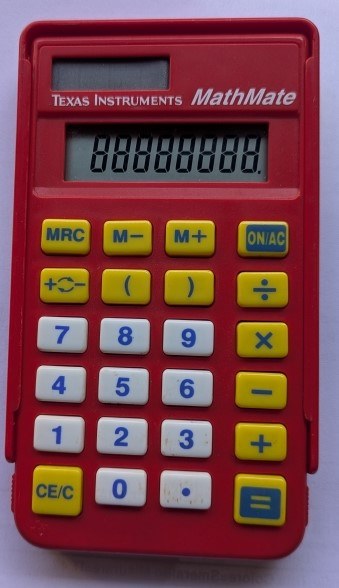 Model: TI-0007 MathMate
Battery: solar
Adapter:
Year: 1991
Chip:
Info:
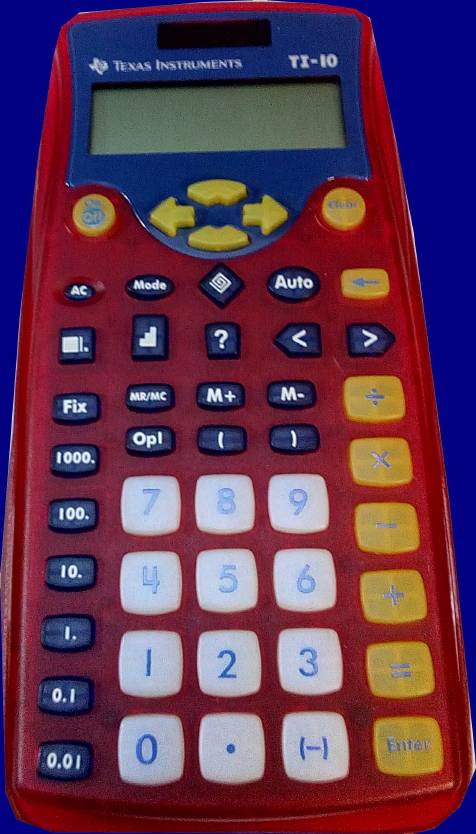 Model: TI-10
Battery: solar, CR2025
Adapter:
Year: 2002
Chip:
Info: modern LCD 2000 - 2017
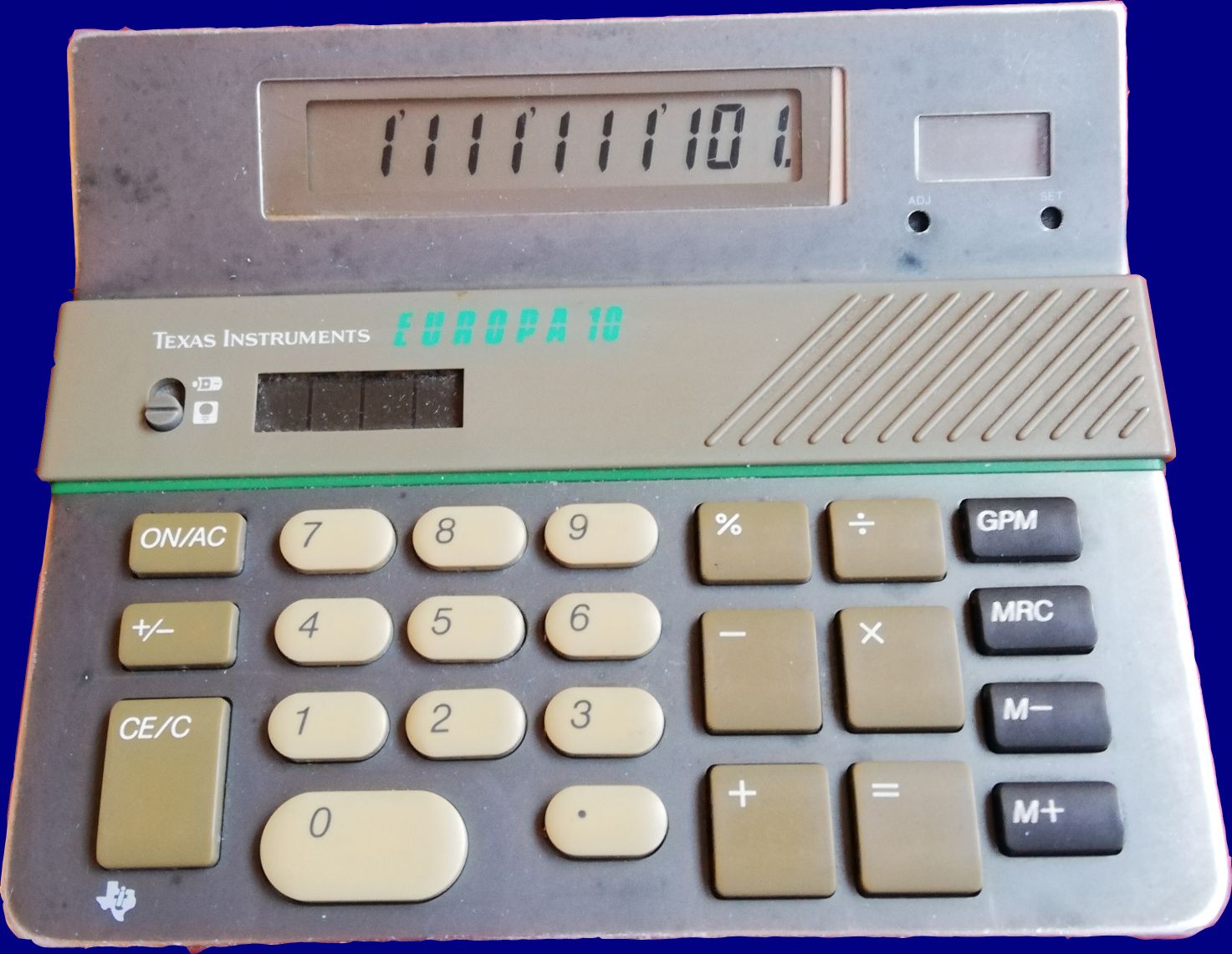 Model: TI-10 europa
Battery: solar
Adapter:
Year: 1995
Chip:
Info: modern DESKTOP
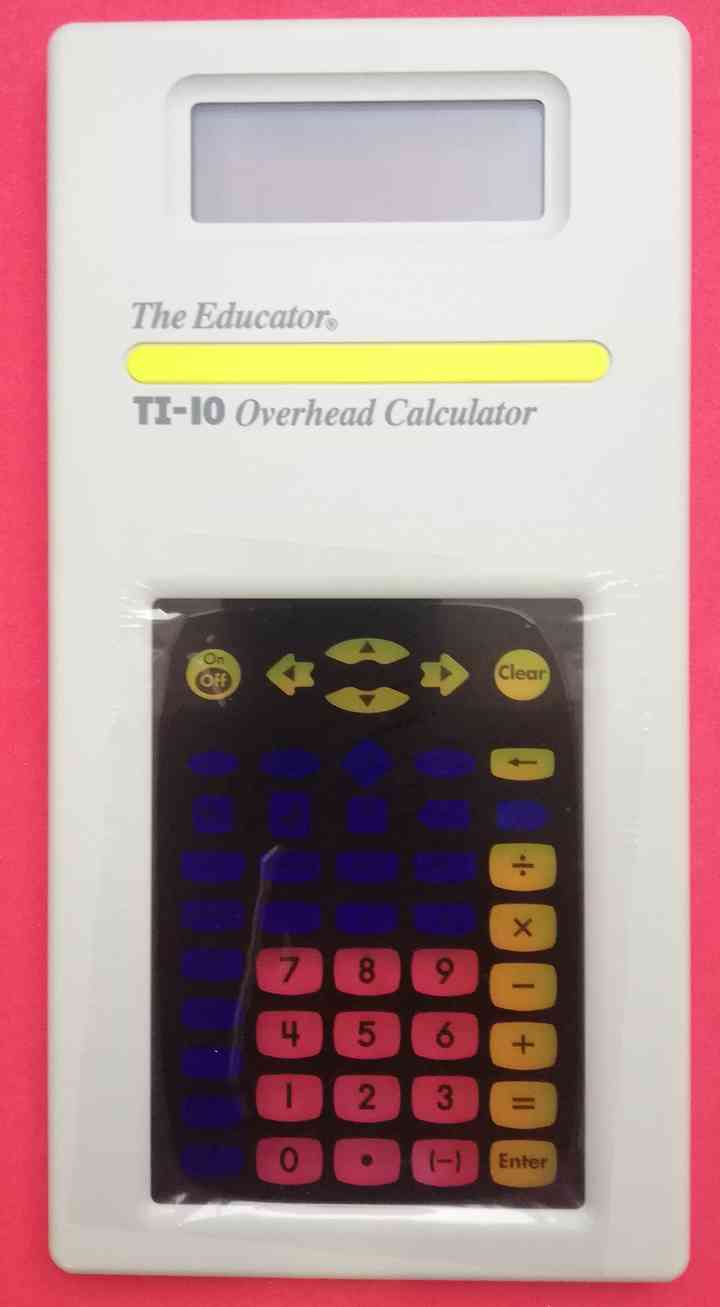 Model: TI-10 overhead
Battery:
Adapter:
Year: 2006
Chip: made in China
Info: The California based company Stokes Publishing Company, Inc. distributes under the label "The Educator®"
calculators optimized for teaching purposes. William T. Stokes filed already July 30, 1991 the US Patent Application U.S. Pat. No. 5,035,502
with the title "Transparent calculator for overhead projection".
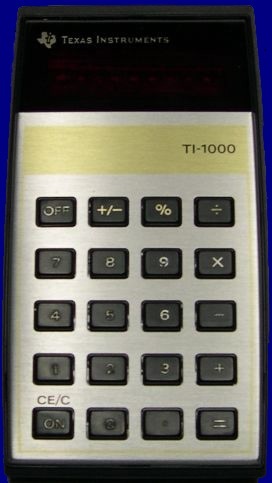 Model: TI-1000 gold
Battery: 3 x AAA ni-cd
Adapter: AC9180
Year: 1977
Chip: TMC1991 or TMC1992
Info:
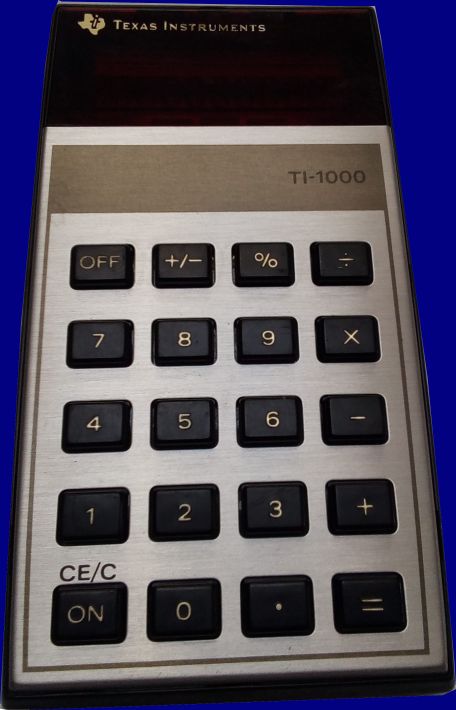 Model: TI-1000 silver
Battery: 3 x AAA ni-cd
Adapter: AC9180
Year: 1977
Chip: TMC1991 or TMC1992
Info:
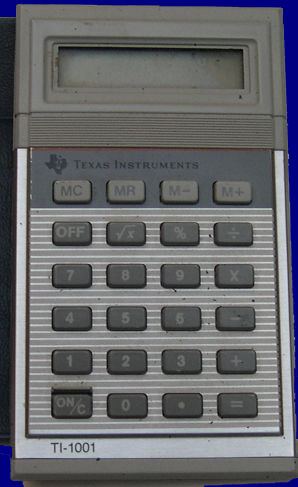 Model: TI-1001
Battery: 2 x LR43
Adapter:
Year: 1982
Chip: TP0311
Info: slimline LCD - first solar LCD
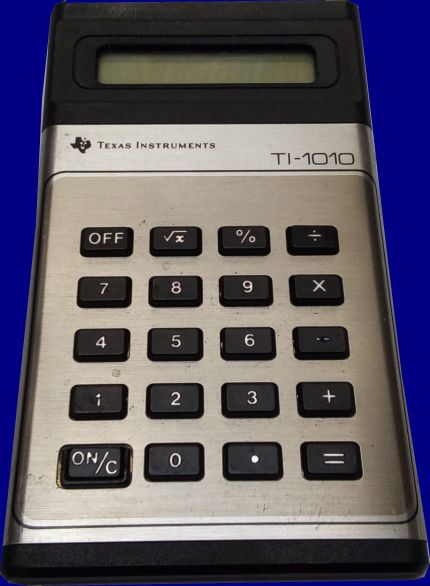 Model: TI-1002
Battery: 2 x LR1130
Adapter:
Year: 1983
Chip:
Info: made in Taiwan
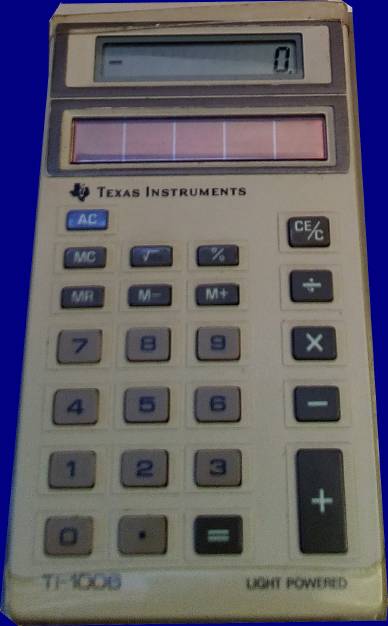 Model: TI-1006
Battery: solar
Adapter:
Year: 1983
Chip: T6789s Thoshiba
Info: LCD 1980 - 1984 Made in Japan
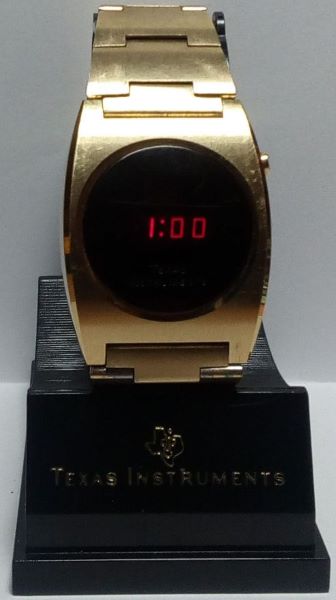 Model: TI-101 (GT101G01) Code: Ok
Battery: 2 x AG-12
WCase: gold tone metal WBand: matching bracelet Face: red
Manual: Yes (with permission www.datamath.org) Box: No Light: led
Year: 1975 Price: xxxx
Function: The watch has five functions- hours, minutes, seconds, month and date
Info: the same model in steel tone metal TI-101 steel
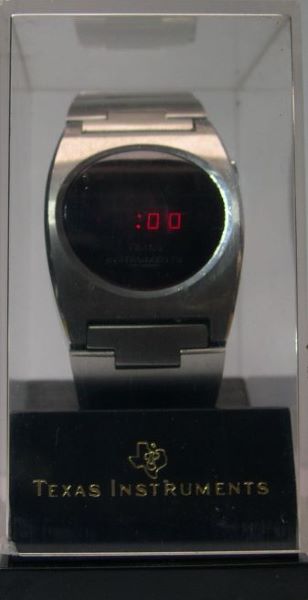 Model: TI-101 (SS101S01) Code: Ok
Battery: 2 x AG-12
WCase: steel tone metal WBand: matching bracelet Face: red
Manual: Yes (with permission www.datamath.org) Box: No Light:led
Year: 1975 Price: xxxx
Function: The watch has five functions- hours, minutes, seconds, month and date
Info:the same model in gold tone metal TI-101 gold
Model: TI-1010
Battery: 2 x LR43
Adapter:
Year: 1980
Chip: TP0311
Info: slimline LCD - first solar LCD
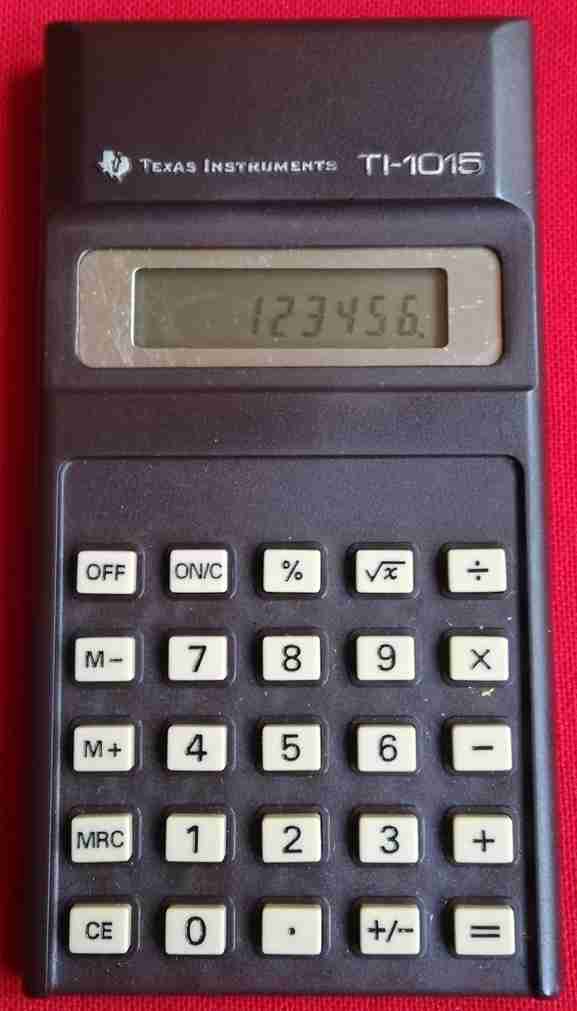 Model: TI-1015 brown
Battery: 2 x AA
Adapter:
Year: 1982
Chip: T3876Stoshiba
Info: Made in Japan Brown version
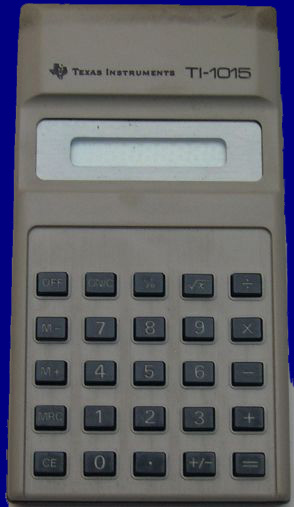 Model: TI-1015 cream
Battery: 2 x AA
Adapter:
Year: 1982
Chip: T3876Stoshiba
Info: Made in Japan
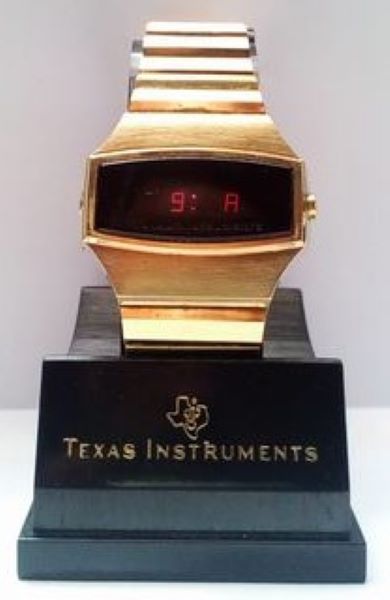 Model: TI-102 (GT102G03) Code: Ok
Battery: 2 x AG-12
WCase: gold tone metal WBand: matching bracelet Face: red
Manual: Yes (with permission www.datamath.org) Box: No Light:led
Year: 1975 Price: xxxx
Function: The watch has five functions- hours, minutes, seconds, month and date
Info: the same model in steel tone metal TI-102 steel
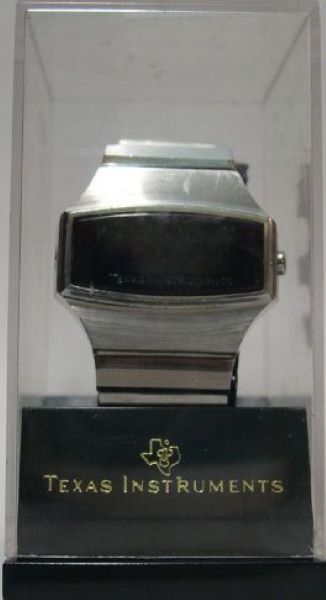 Model: TI-102 (SS102S03) Code: Ok
Battery: 2 x AG-12
WCase: steel tone metal WBand: matching bracelet Face: red
Manual: Yes (with permission www.datamath.org) Box: No Light: led
Year: 1975 Price: xxxx
Function: The watch has five functions- hours, minutes, seconds, month and date
Info:the same model in gold tone metal TI-102 gold
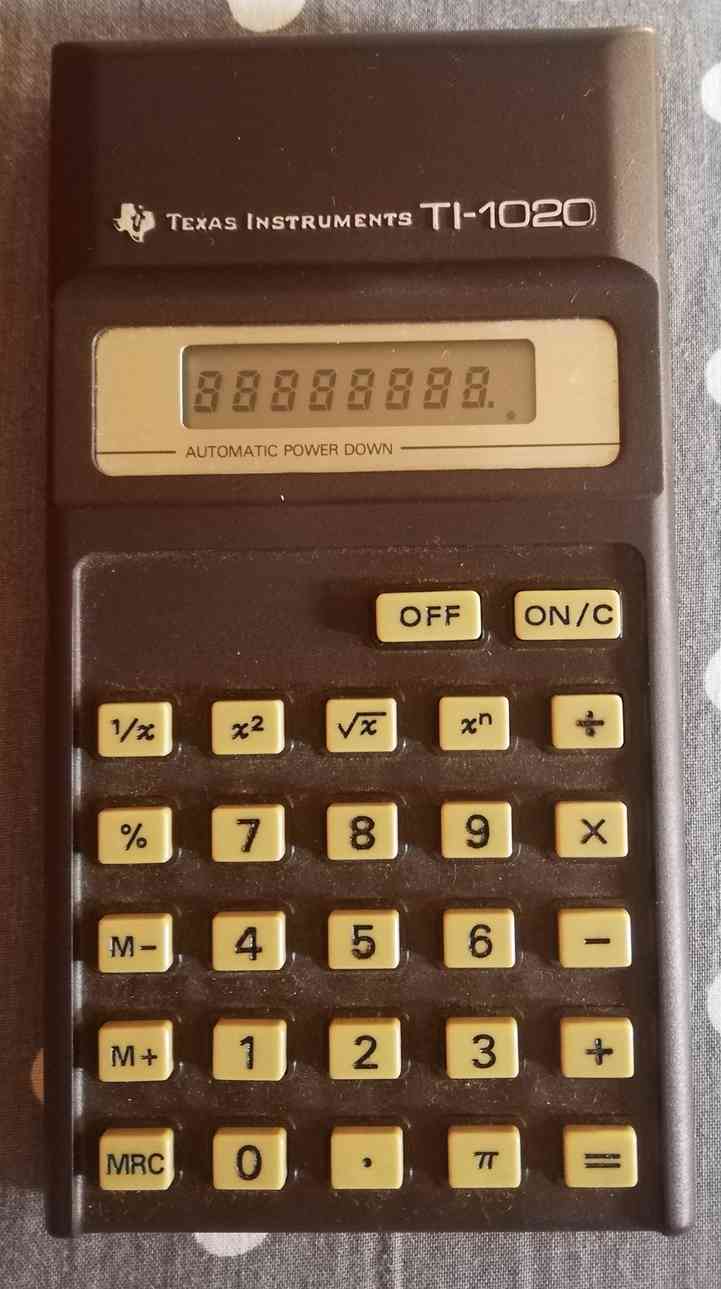 Model: TI-1020 brown
Battery: 2 x AA
Adapter:
Year: 1980
Chip: Sharp LI 3009
Info:We wrote the year 1980, when Texas Instruments discovered the lower labor costs of Taiwan, R.O.C. compared to US or Europe. Till the early 80s most calculators from Texas Instruments were produced either in US or Italy and some early LCD models like the TI-1768 even in Japan. Taiwan.
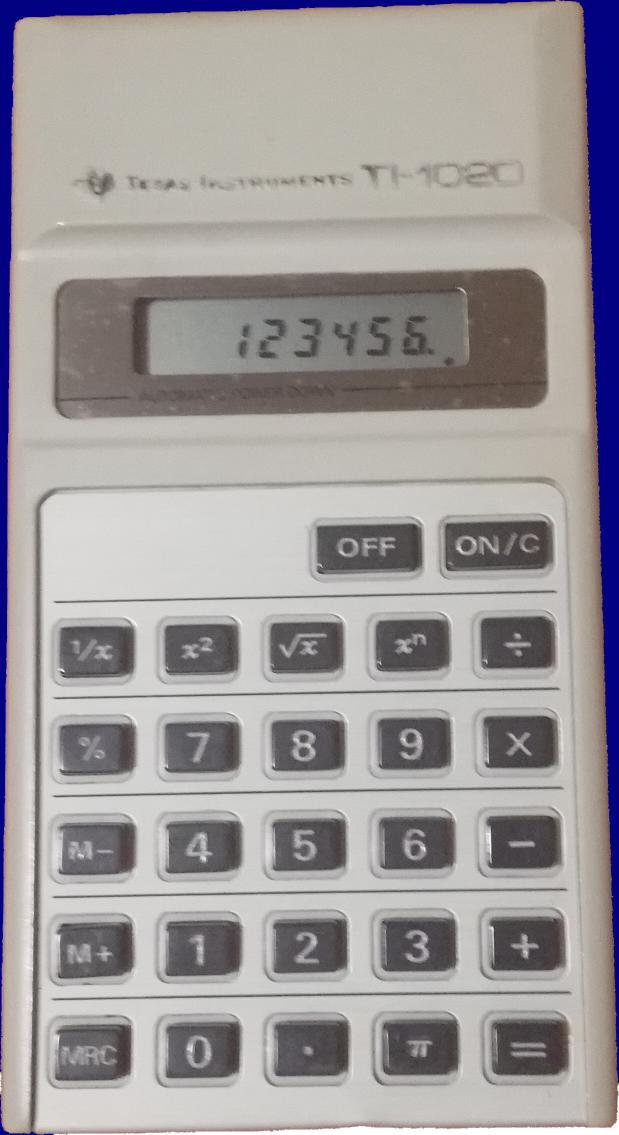 Model: TI-1020 cream
Battery: 2 x AA
Adapter:
Year: 1980
Chip: Sharp LI 3009
Info:We wrote the year 1980, when Texas Instruments discovered the lower labor costs of Taiwan, R.O.C. compared to US or Europe. Till the early 80s most calculators from Texas Instruments were produced either in US or Italy and some early LCD models like the TI-1768 even in Japan. Made in Taiwan
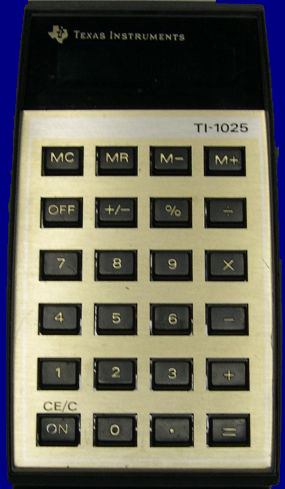 Model: TI-1025
Battery: 9 volt
Adapter:
Year: 1977
Chip: TMC0923
Info:
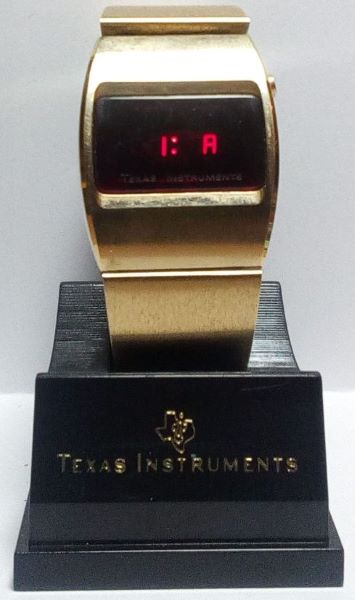 Model: TI-103 (GT103S05) Code: Ok
Battery: 2 x AG-12
WCase: gold tone metal WBand: matching bracelet Face: red
Manual: Yes Box: No Light: led
Year: 1975 Price: xxxx
Function: The watch has five functions- hours, minutes, seconds, month and date
Info: the same model in steel tone metal TI-103 steel
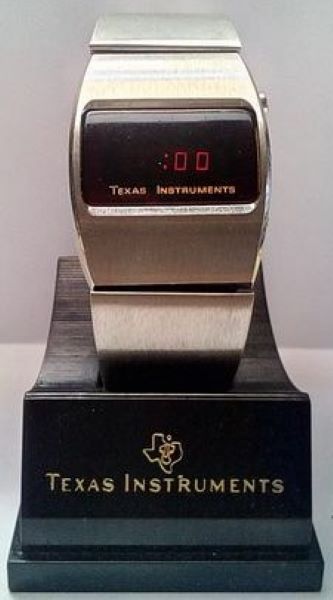 Model: TI-103 (SS103S05) Code: Ok
Battery: 2 x AG-12
WCase: steel tone metal WBand: matching bracelet Face: red
Manual: Yes Box: No Light: led
Year: 1975 Price: xxxx
Function: The watch has five functions- hours, minutes, seconds, month and date
Info:the same model in gold tone metal TI-103 gold
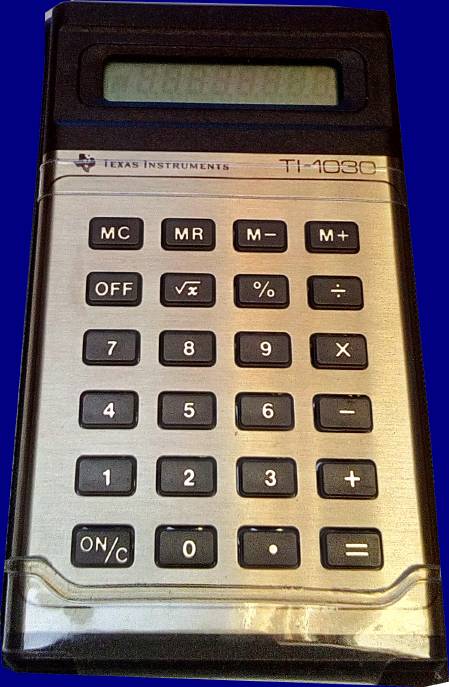 Model: TI-1030
Battery: 2 x LR43
Adapter:
Year: 1981
Chip: TP0311
Info: slimline LCD - first solar LCD
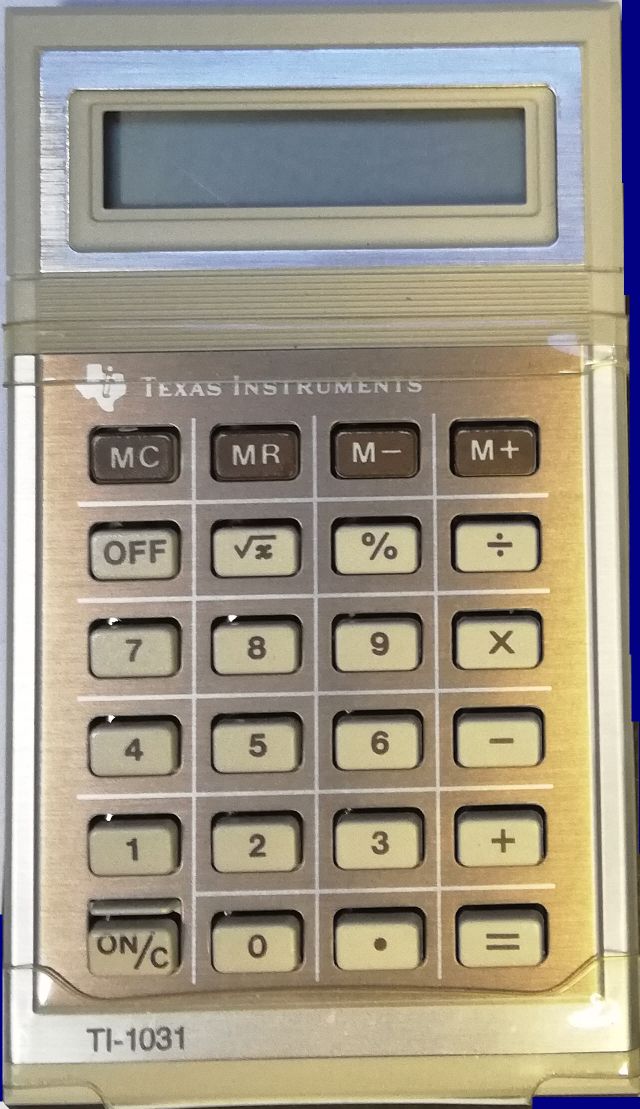 Model: TI-1031
Battery: 2 x LR43
Adapter:
Year: 1981
Chip: TP0311
Info: slimline LCD - first solar LCD
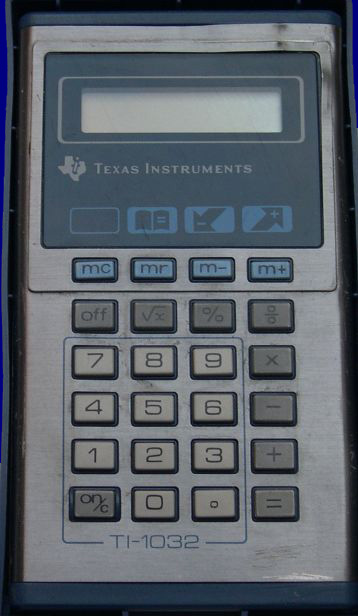 Model: TI-1032
Battery: 2 x AA
Adapter:
Year: 1982
Chip: TP0311
Info: slimline LCD - first solar LCD
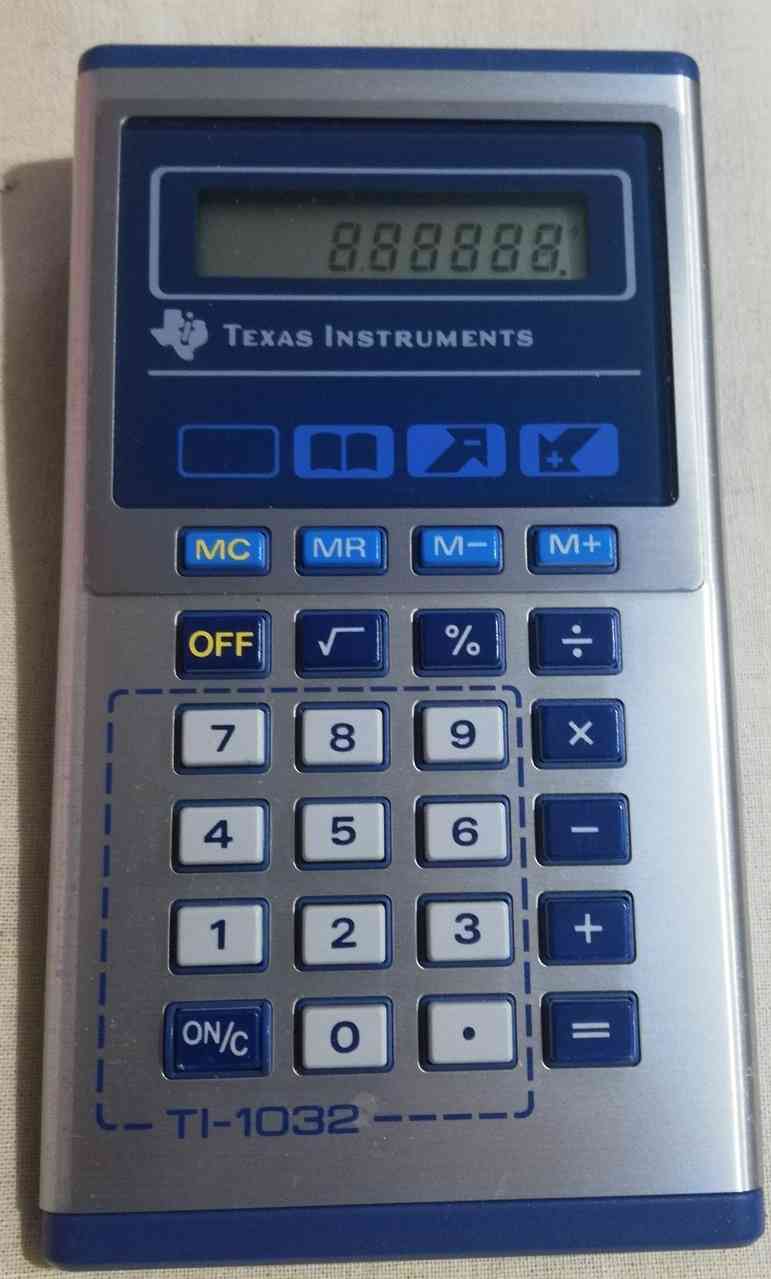 Model: TI-1032 BPR
Battery: 2 x AA
Adapter:
Year: 1982
Chip: TP0311
Info: This it was given to employees (Banca Popolare di Rieti) as a gift.
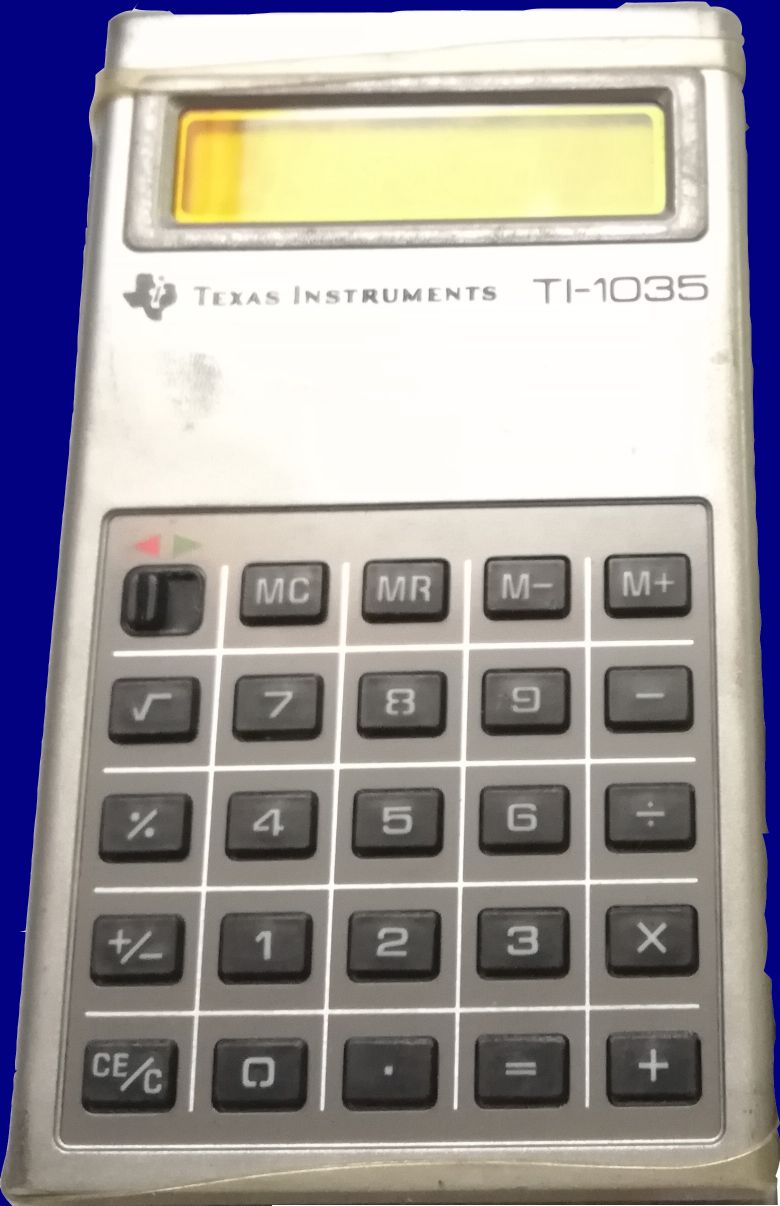 Model: TI-1035
Battery: 2 x LR44
Adapter:
Year: 1979
Chip: Toshiba T3703
Info:first TI-LCD - yellow LCD
 Model: TI-1036
Battery: 2 x LR1130
Adapter:
Year: 1986
Chip:
Info: LCD 1980 - 1984
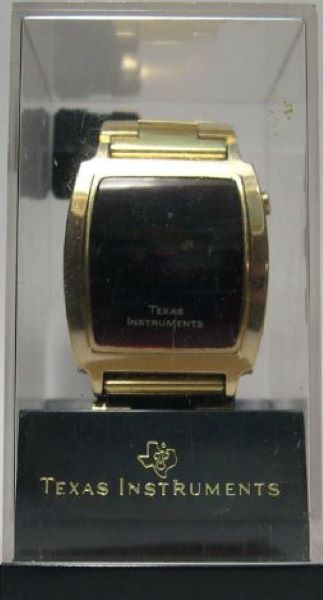 Model: TI-104 (SS104S06) Code: Ok
Battery: 2 x AG-12
WCase: gold tone metal WBand: matching bracelet Face: red
Manual: Yes (with permission www.datamath.org) Box: No Light: led
Year: 1975 Price: xxxx
Function: The watch has five functions- hours, minutes, seconds, month and date
Info: the same model in steel tone metal TI-104 steel
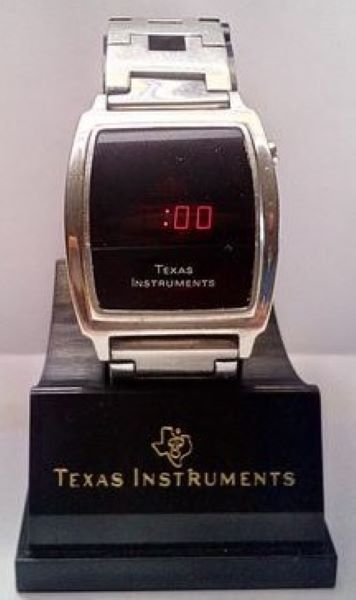 Model: TI-104 (GT104G06) Code: Ok
Battery: 2 x AG-12
WCase: steel tone metal WBand: matching bracelet Face: red
Manual: Yes (with permission www.datamath.org) Box: No Light: led
Year: 1975 Price: xxxx
Function: The watch has five functions- hours, minutes, seconds, month and date
Info:the same model in gold tone metal TI-104 gold
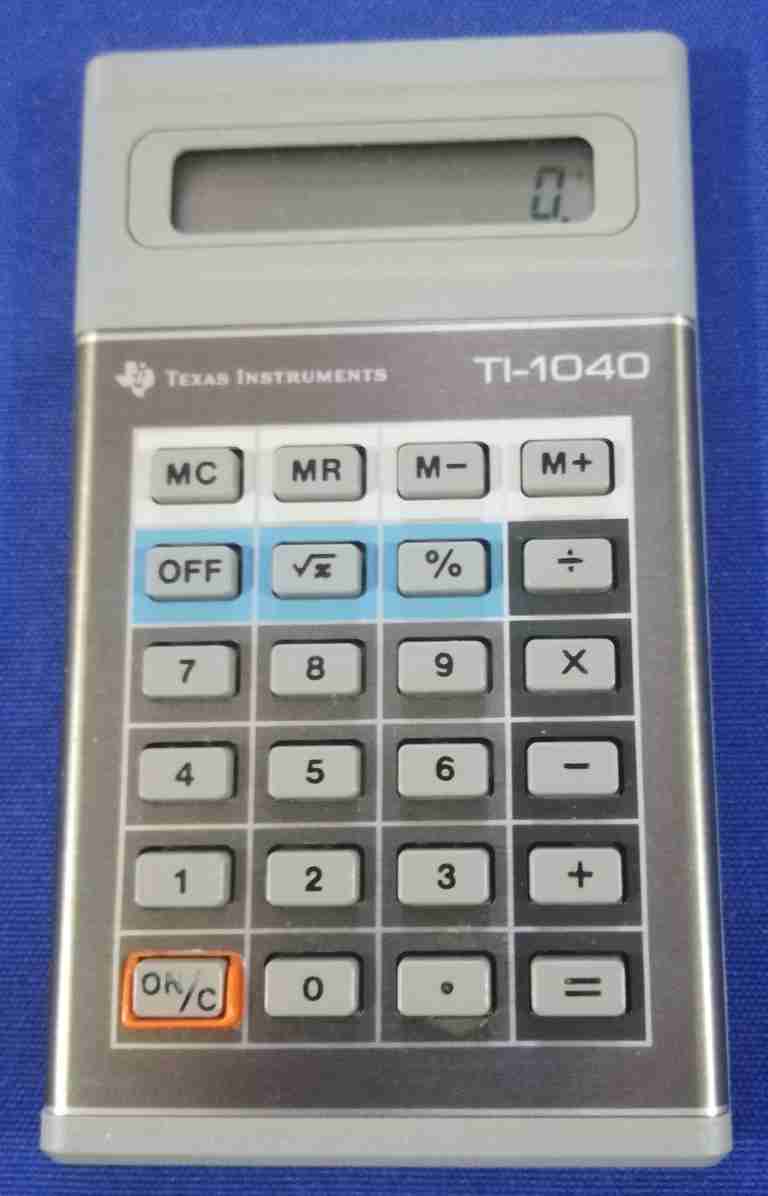 Model: TI-1040
Battery: 2 x LR43
Adapter:
Year: 1980
Chip: TPO311
Info:
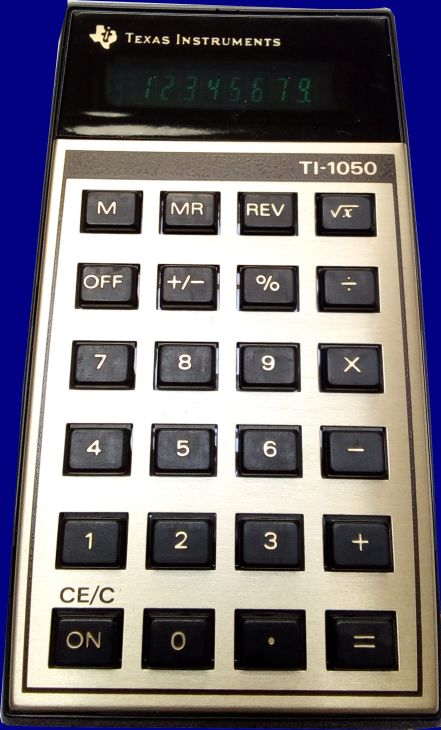 Model: TI-1050
Battery: 9 volt
Adapter:
Year: 1977
Chip: TMC0921
Info:
 Model: TI-1050 Koh-I-Noor
Battery: 9 volt
Adapter: AC9180
Year: 1977
Chip: TMC0921
Info:Made in Italy Rieti ( RCI ). Donated from Marie Collas (FR).
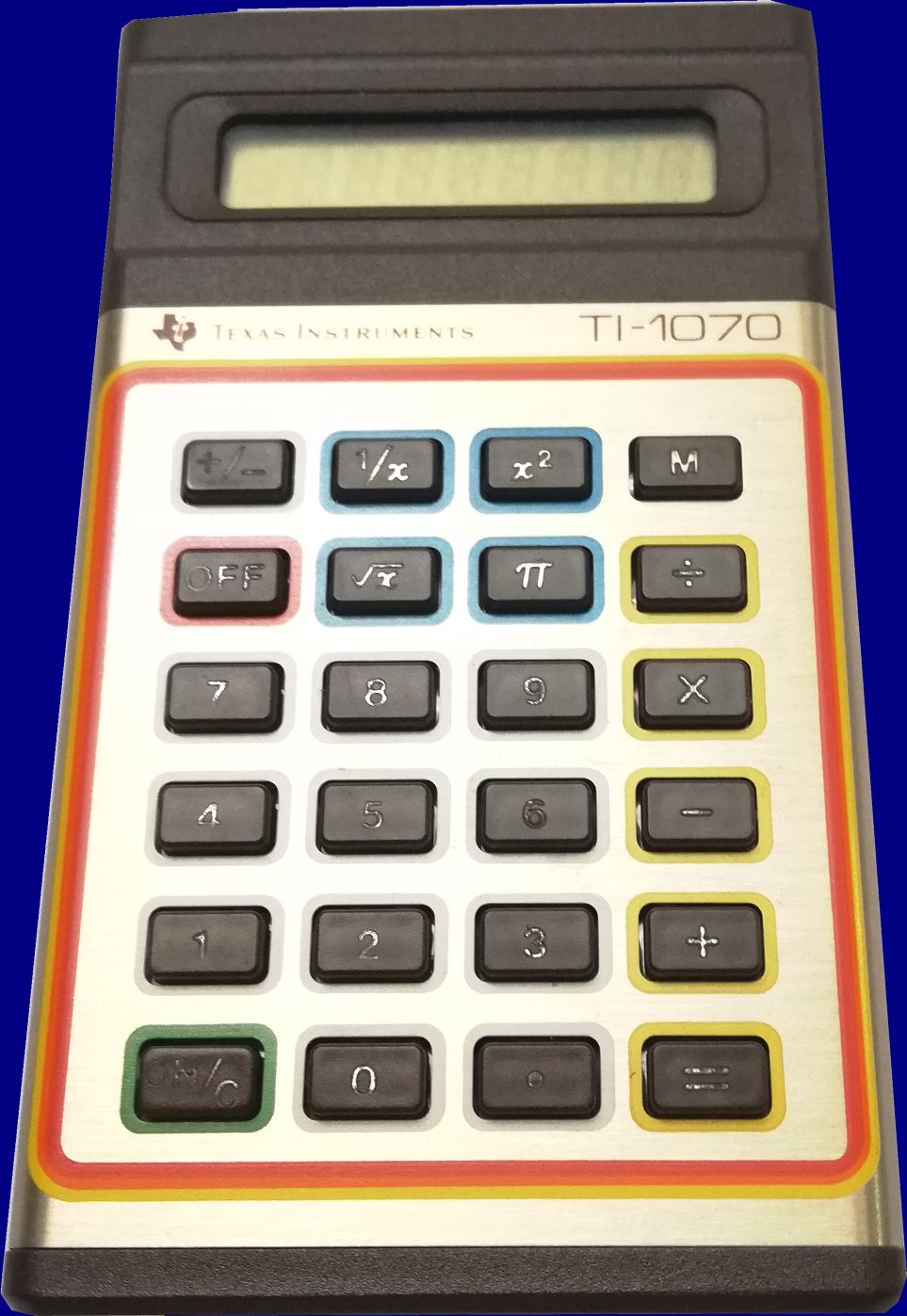 Model: TI-1070
Battery: 2 x LR43
Adapter:
Year: 1979
Chip: TP0314
Info: slimline LCD - first solar LCD Made in Italy
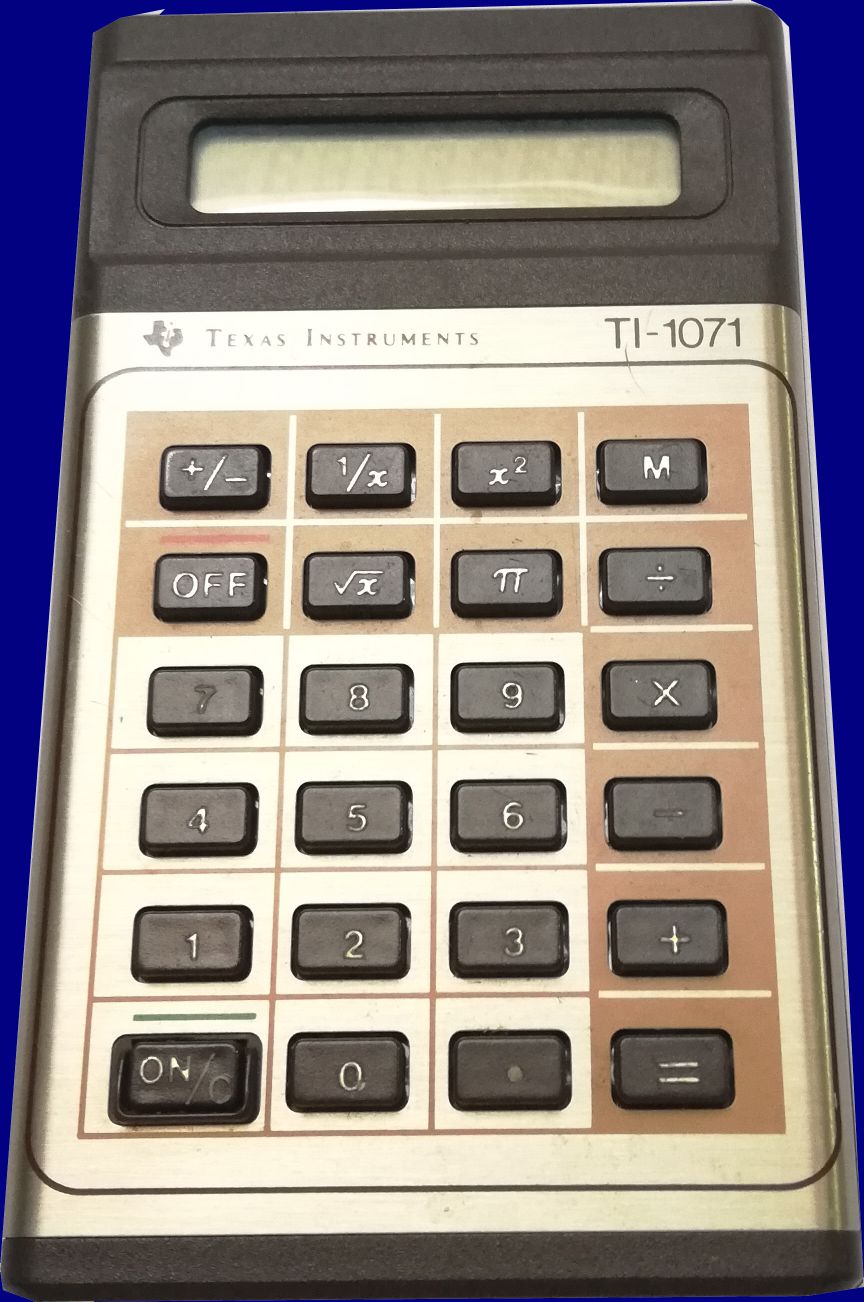 Model: TI-1071
Battery: 2 x LR43
Adapter:
Year: 1979
Chip: TP0314
Info: slimline LCD - first solar LCD Made in Spain
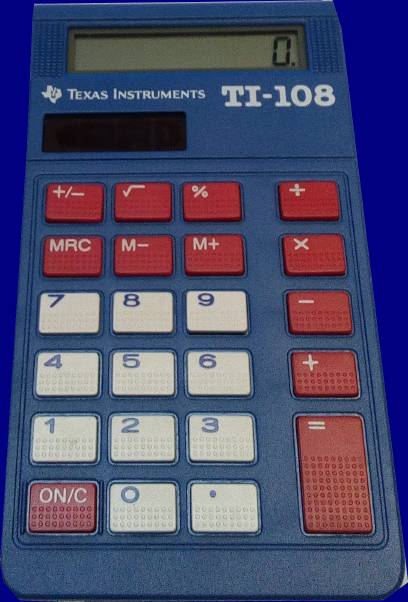 Model: TI-108
Battery: solar
Adapter:
Year: 1988
Chip:
Info: LCD 1985 - 1990 Made in Taiwan
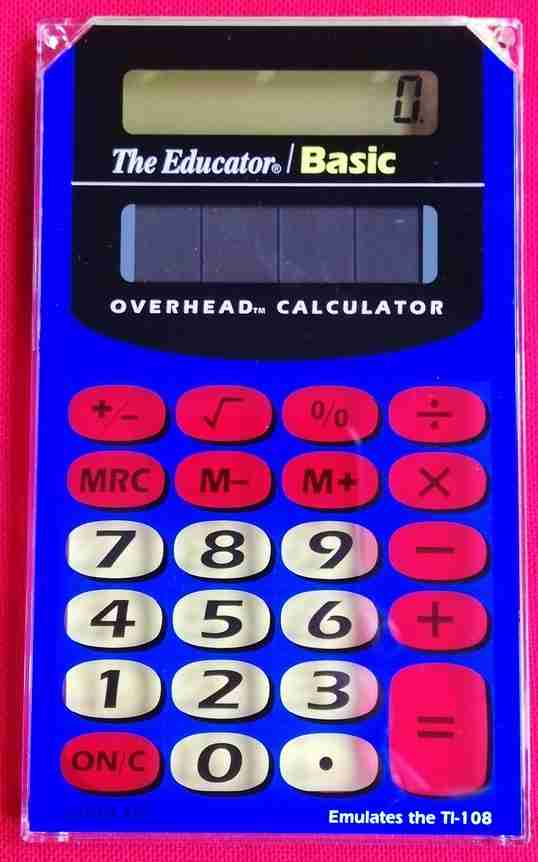 Model: TI-108 overhead
Battery:
Adapter:
Year:
Chip: made in China
Info: The California based company Stokes Publishing Company, Inc. distributes under the label "The Educator®"
calculators optimized for teaching purposes. William T. Stokes filed already July 30, 1991 the US Patent Application U.S. Pat. No. 5,035,502
with the title "Transparent calculator for overhead projection".
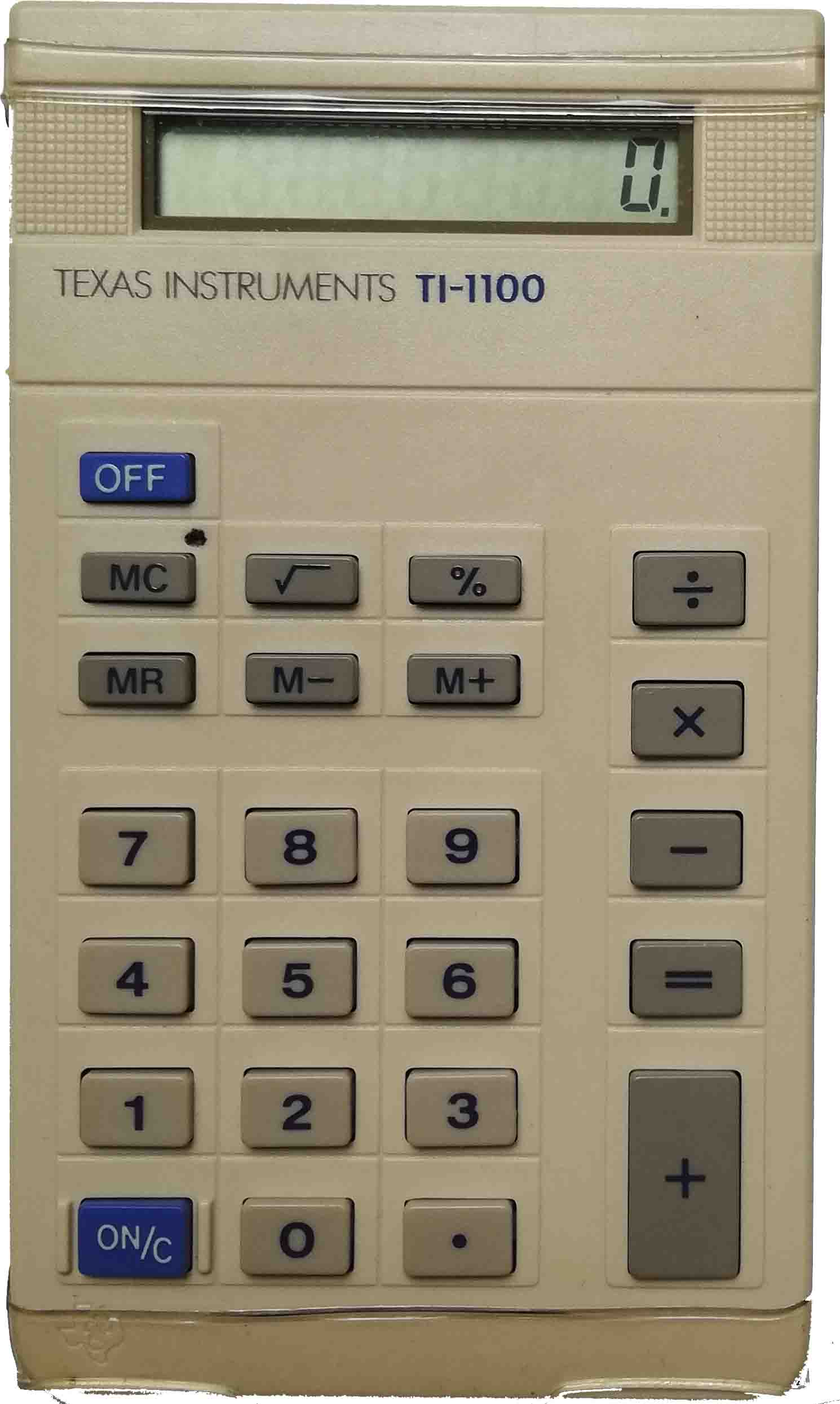 Model: TI-1100
Battery: LR43
Adapter:
Year: 1990
Chip: Toshiba
Info:
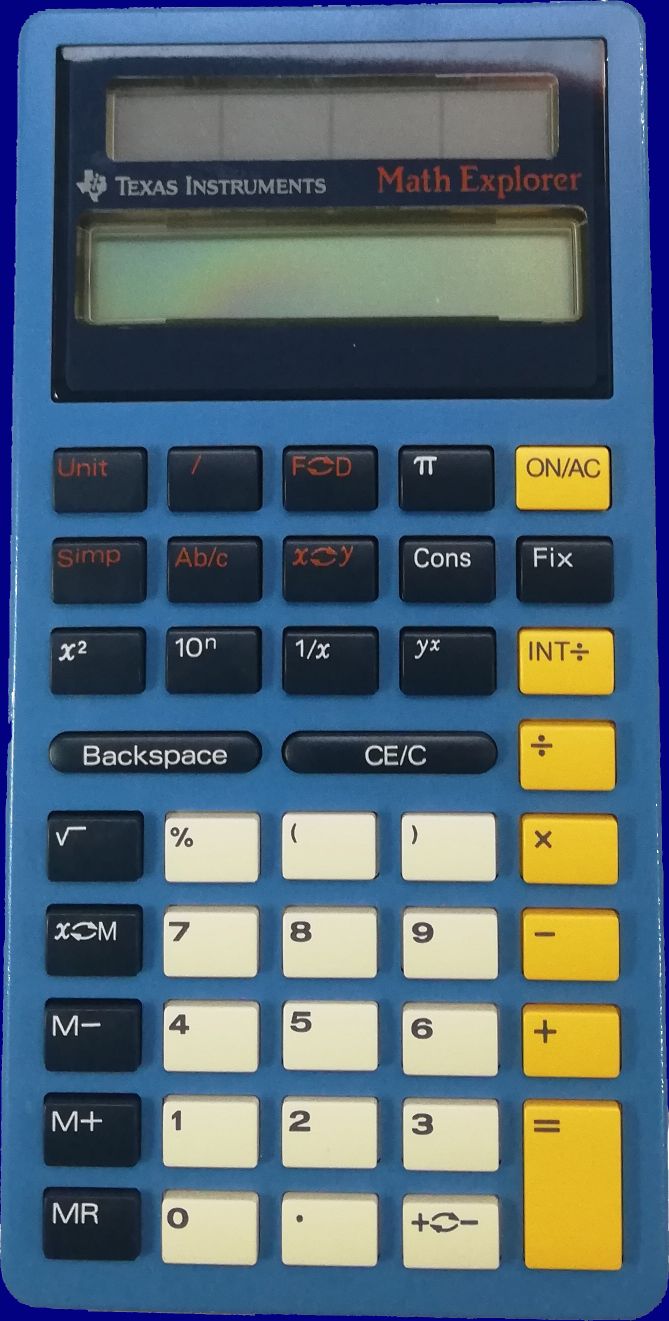 Model: TI-12 math explorer
Battery: solar
Adapter:
Year: 1988
Chip: T6m39s Toshiba
Info: modern LCD 1982 - 1987
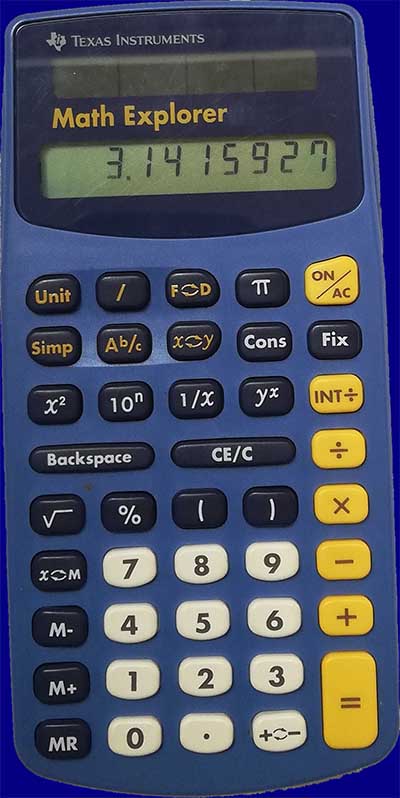 Model: TI-12 math explorer
Battery: solar
Adapter:
Year: 1998
Chip: T6m39s Toshiba
Info: China. The Math Explorer ( TI-12) is another calculator introduced by Texas Instruments to perform fractional arithmetic for elementary school.
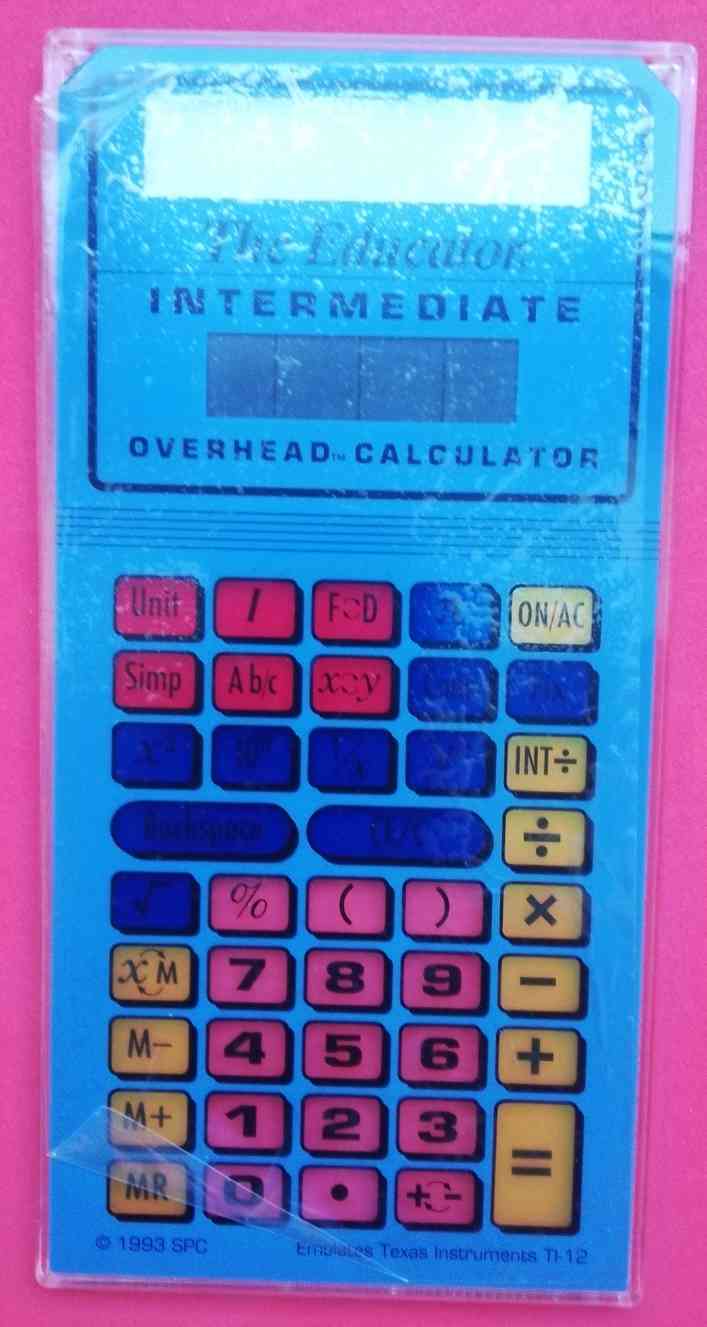 Model: TI-12 intermediate overhead
Battery:
Adapter:
Year:
Chip: made in China
Info: The California based company Stokes Publishing Company, Inc. distributes under the label "The Educator®"
calculators optimized for teaching purposes. William T. Stokes filed already July 30, 1991 the US Patent Application U.S. Pat. No. 5,035,502
with the title "Transparent calculator for overhead projection".
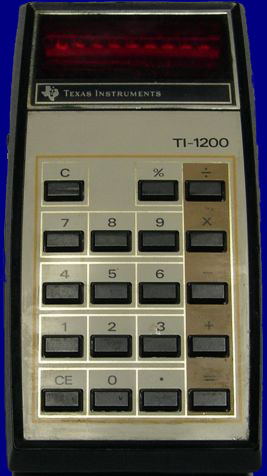 Model: TI-1200
Battery: 9 volt
Adapter:
Year: 1975
Chip: TMS0952
Info: Introduced in March 1975, the TI-1200 started together with the TI-1250 a great career with millions and millions units manufactured over the course of about 2 years. As a successor to both the stylish TI-1500 and the Exactra line, the TI-1200 demonstrated already the impressive design and technical engineering behind the TI-30.
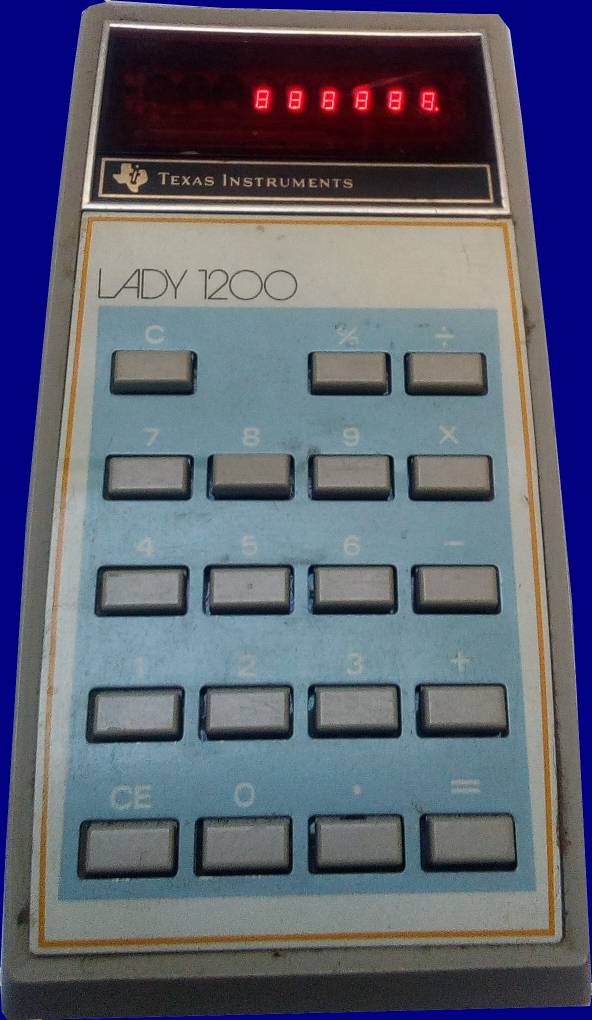 Model: TI-1200 lady
Battery: 9 volt
Adapter: AC9180
Year: 1976
Chip: TMS0972
Info:
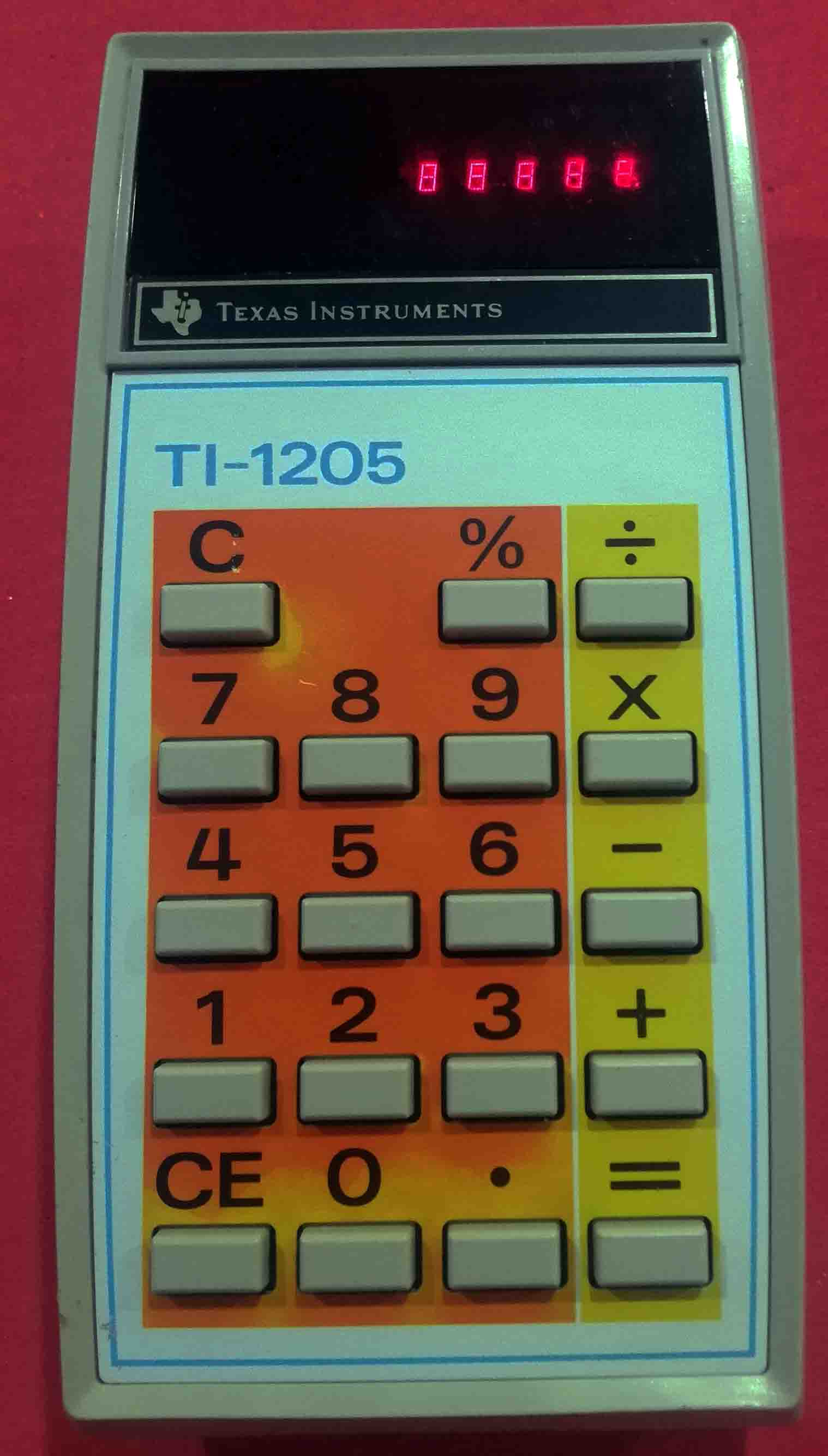 Model: TI-1205
Battery: 2 x AA ni-cd
Adapter: AC9130
Year: 1977
Chip: TMS0972
Info:Texas Instruments took in 1976 in conjunction with mathematics educators at two major universities an initiative to introduce a group of 6 calculators for educational use. Including the Little Professor, the limited function ABLE calculator, the colorful TI-1205 and TI-1255, the TI-30 and the sophisticated SR-51-II, these calculators helped students understand and use math concepts from kindergarten through college and career.The TI-1205 is based on the TI-1200 but includes rechargeable NiCd-batteries instead the standard 9V block battery. To enhance the readability of the keyboard both the size of the numerals and the color-scheme was improved.Disassembling the TI-1205 with Date code 1977 LTA and manufactured in May 1977 in Lubbock, Texas reveals an internal construction identical with the TI-1255. Instead of the 9V battery found in the original TI-1200/TI-1250 design, the TI-1205 makes use of 2 rechargeable, AA-sized NiCd (Nickel Cadmium) batteries. The printed circuit board (PCB) of the TI-1205 adds both the charging circuit for the batteries and a step-up converter to generate the 9V supply of the TMS0972 single-chip calculating circuit to the design known from the TI-1250.
Donated from Marie Collas (FR)
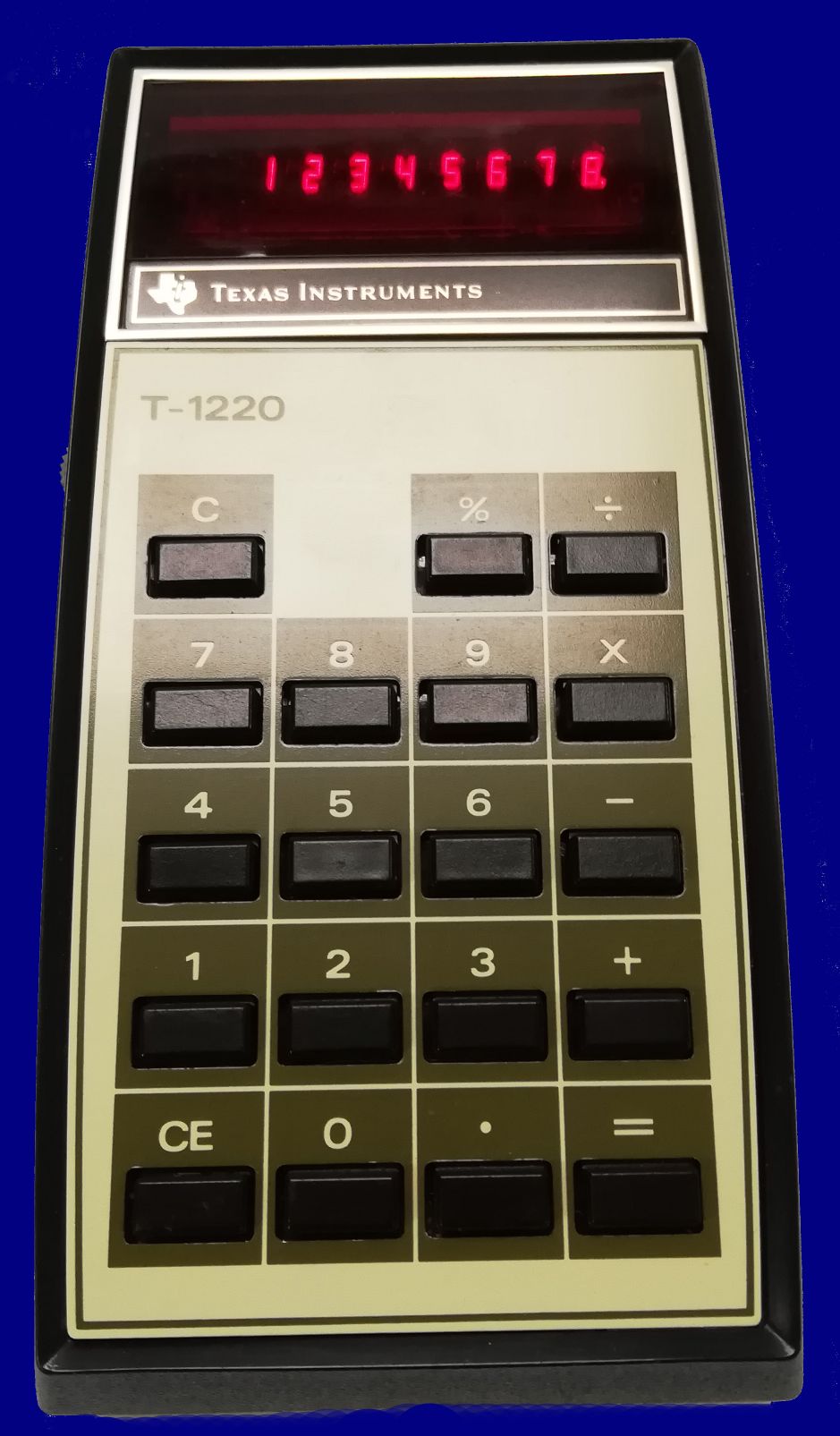 Model: TI-1220
Battery: 9 volt
Adapter: AC9180
Year: 1976
Chip: TMS0972
Info: custom model manufactured for True Value Harware Store
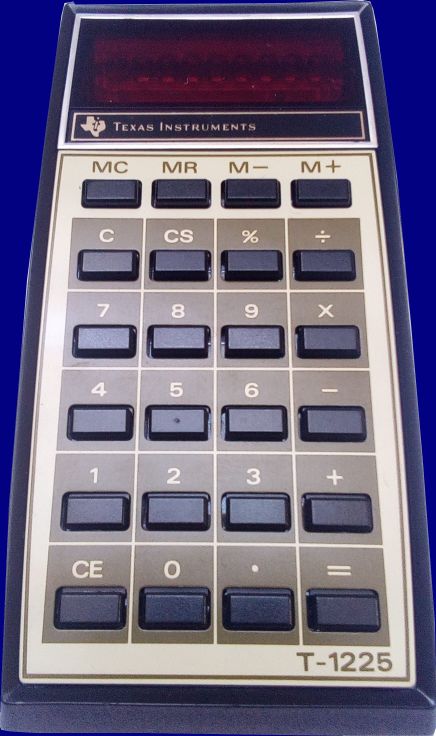 Model: TI-1225
Battery: 9 volt
Adapter: AC9180
Year: 1976
Chip: TMS0972
Info: custom model manufactured for True Value Harware Store
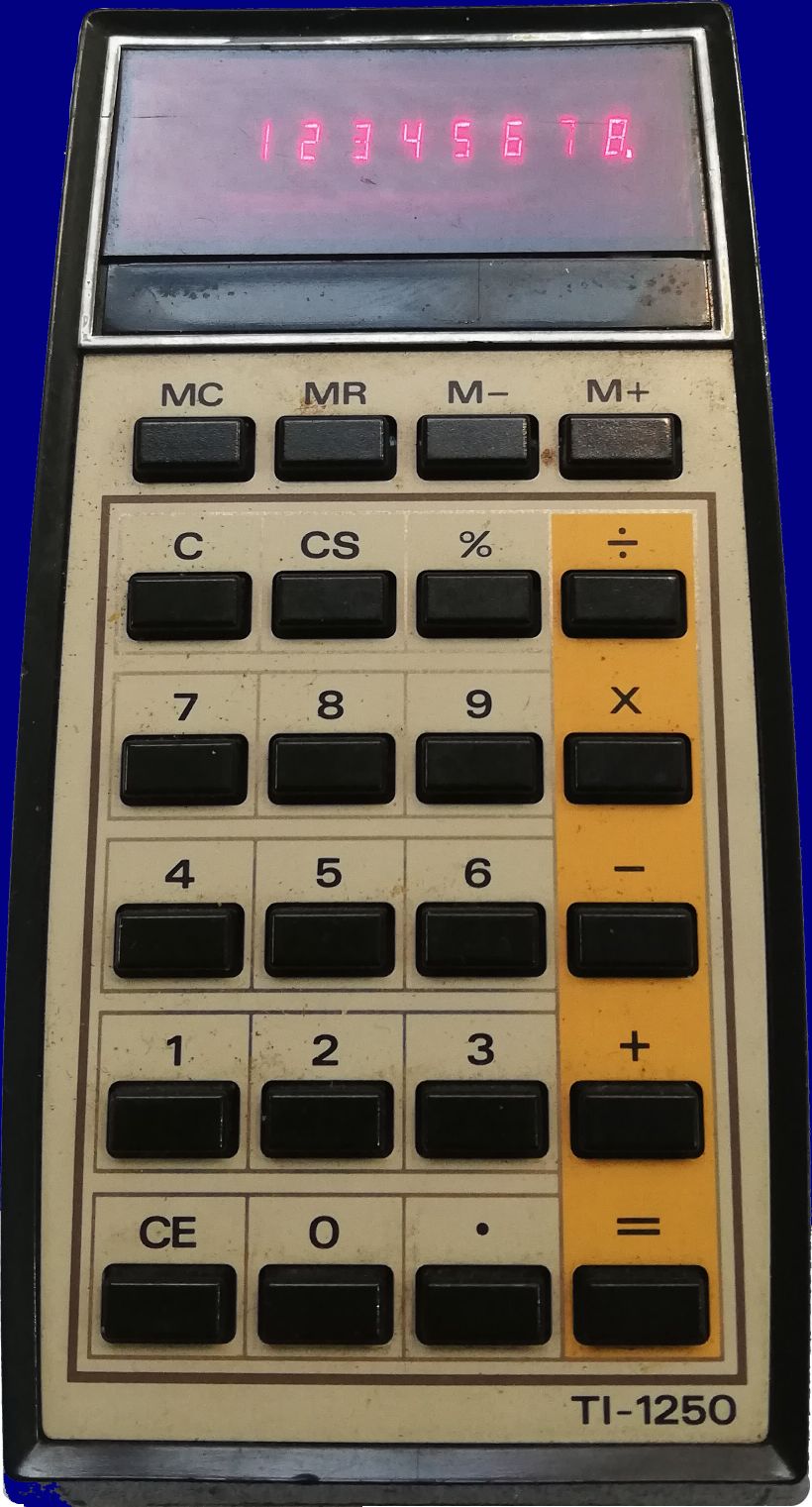 Model: TI-1250
Battery: 9 volt
Adapter: AC9180
Year: 1976
Chip: TMC0952
Info:
 Model: TI-1255
Battery: 9 volt
Adapter: AC9130
Year: 1977
Chip: TMC0972
Info: property Marie Collas
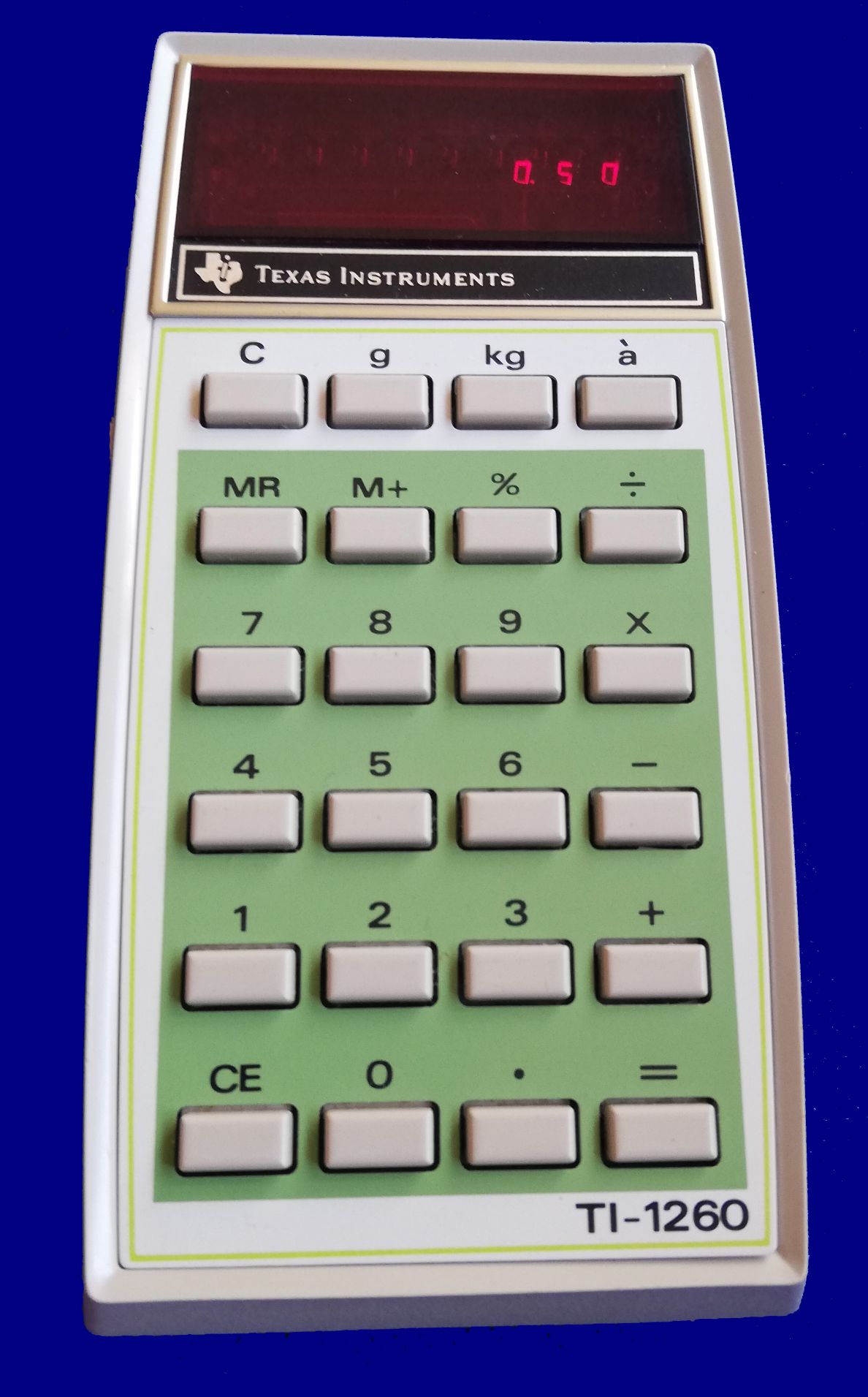 Model: TI-1260
Battery: 9 volt
Adapter: AC9180
Year: 1976
Chip: TMC0954
Info:
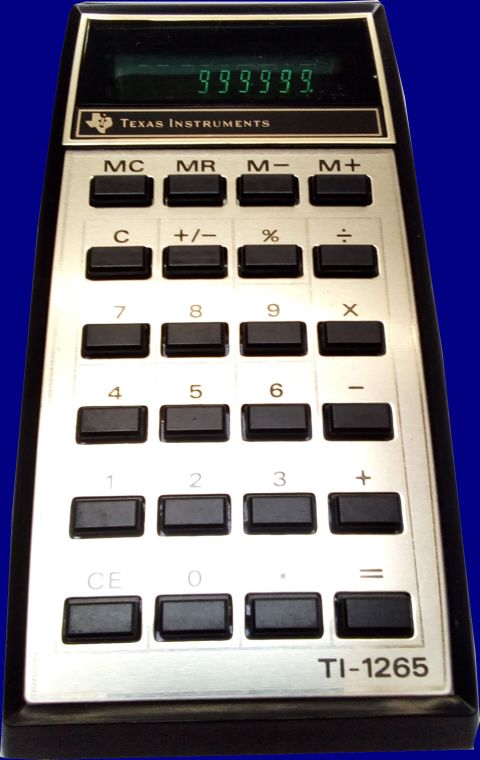 Model: TI-1265
Battery: 9 volt
Adapter: AC9180
Year: 1977
Chip: TMS1043
Info:
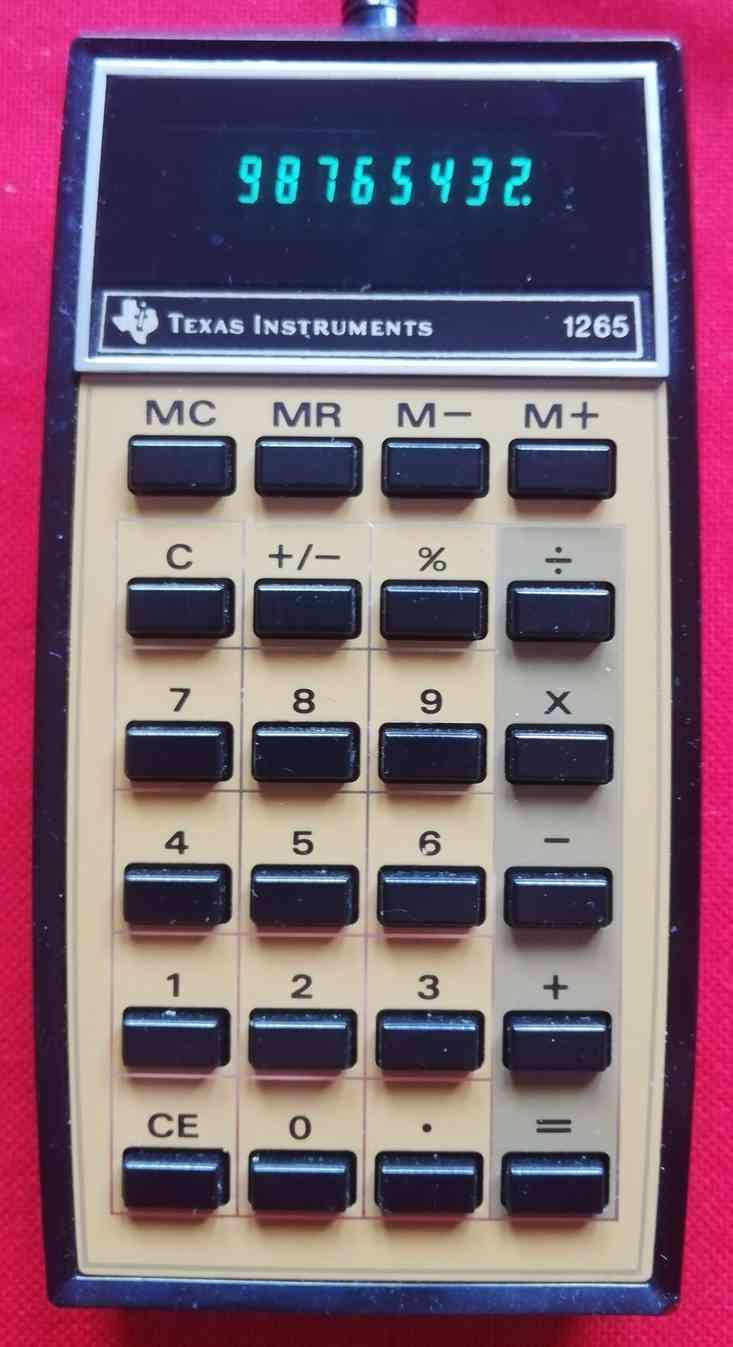 Model: TI-1265 Koh-I-Noor
Battery: 9 volt
Adapter: AC9180
Year: 1977
Chip: TMS1043
Info: Made in Italy Rieti ( RCI ).
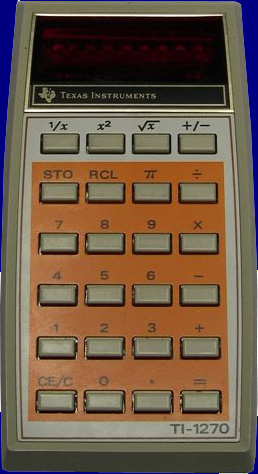 Model: TI-1270
Battery: 9 volt
Adapter:
Year: 1976
Chip: TMC0974
Info:
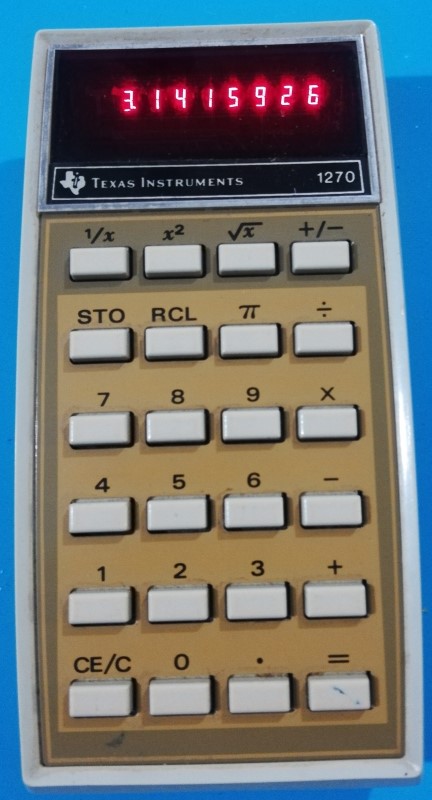 Model: TI-1270 V0
Battery: 9 volt
Adapter: AC9180
Year: 1977
Chip: TMS0974 (7701) Year 77 Week 01 / ZA0355
Info: Discovery of a very early version of TI-1270 built in Rieti (RCI2177 Week 21 Year 1977), you can see the writing 1270 printed on the metal mask under the display.
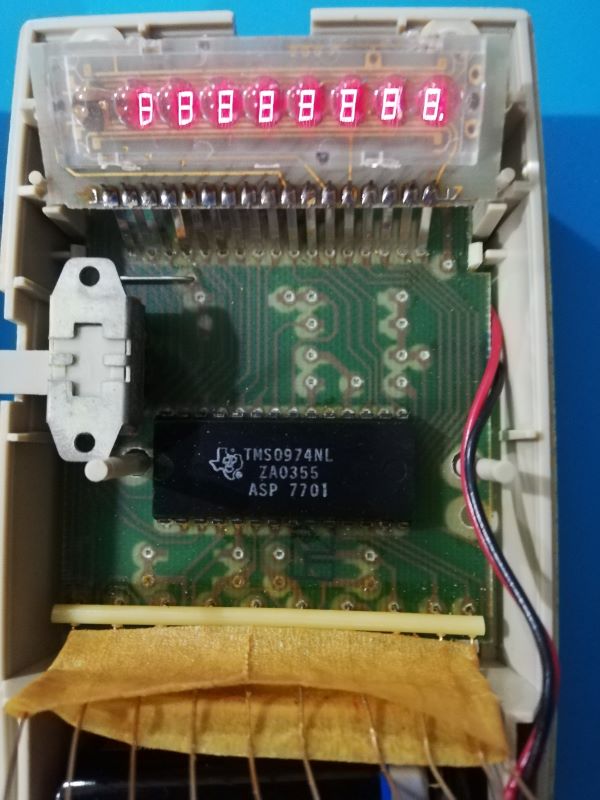
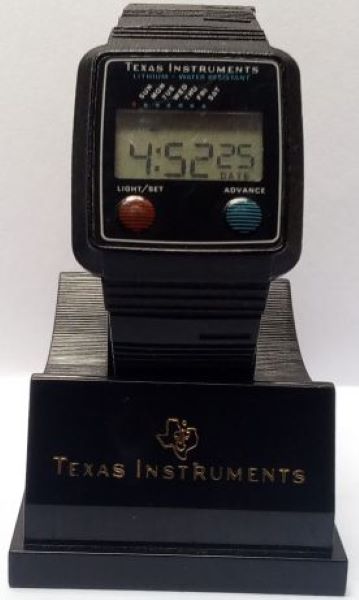 Model: TI-131-11 Code: ok
Battery: CR2025
WCase: black plastic WBand: black rubber Face: black frame
Manual: Yes Box: No Light: no
Year: 1981 Price: $ 28.00
Function: For swimmers, snorkelers,sports enthusiasts and everyone who gets his watch wet. Tested water resistant to a submerged depth of 81 feet, 3 ATM. Features: hours, minutes, seconds or date, day-of-week and incandescent backlight.he watch has five functions- hours, minutes, seconds, month and date
Info:
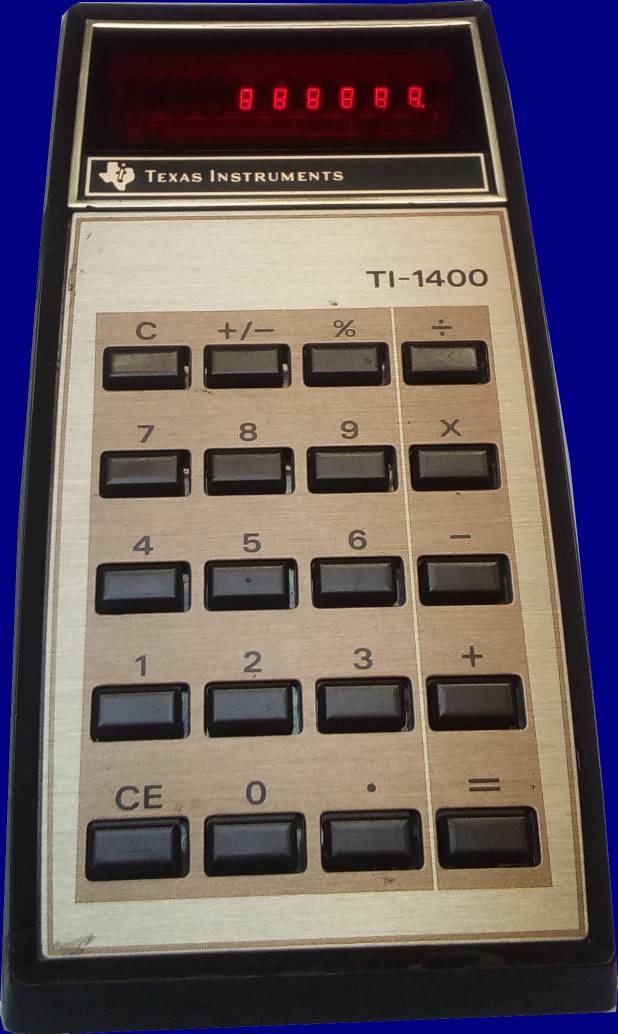 Model: TI-1400
Battery: 9 volt
Adapter: AC9180
Year: 1976
Chip: TMS0972
Info:
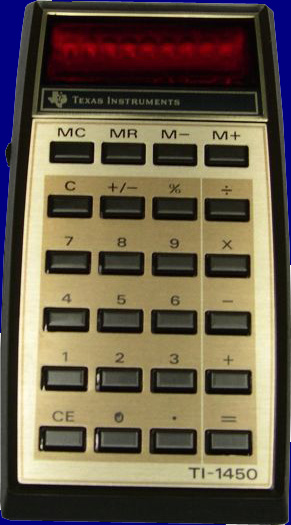 Model: TI-1450
Battery: 9 volt
Adapter: AC9180
Year: 1976
Chip: TMS0972
Info:
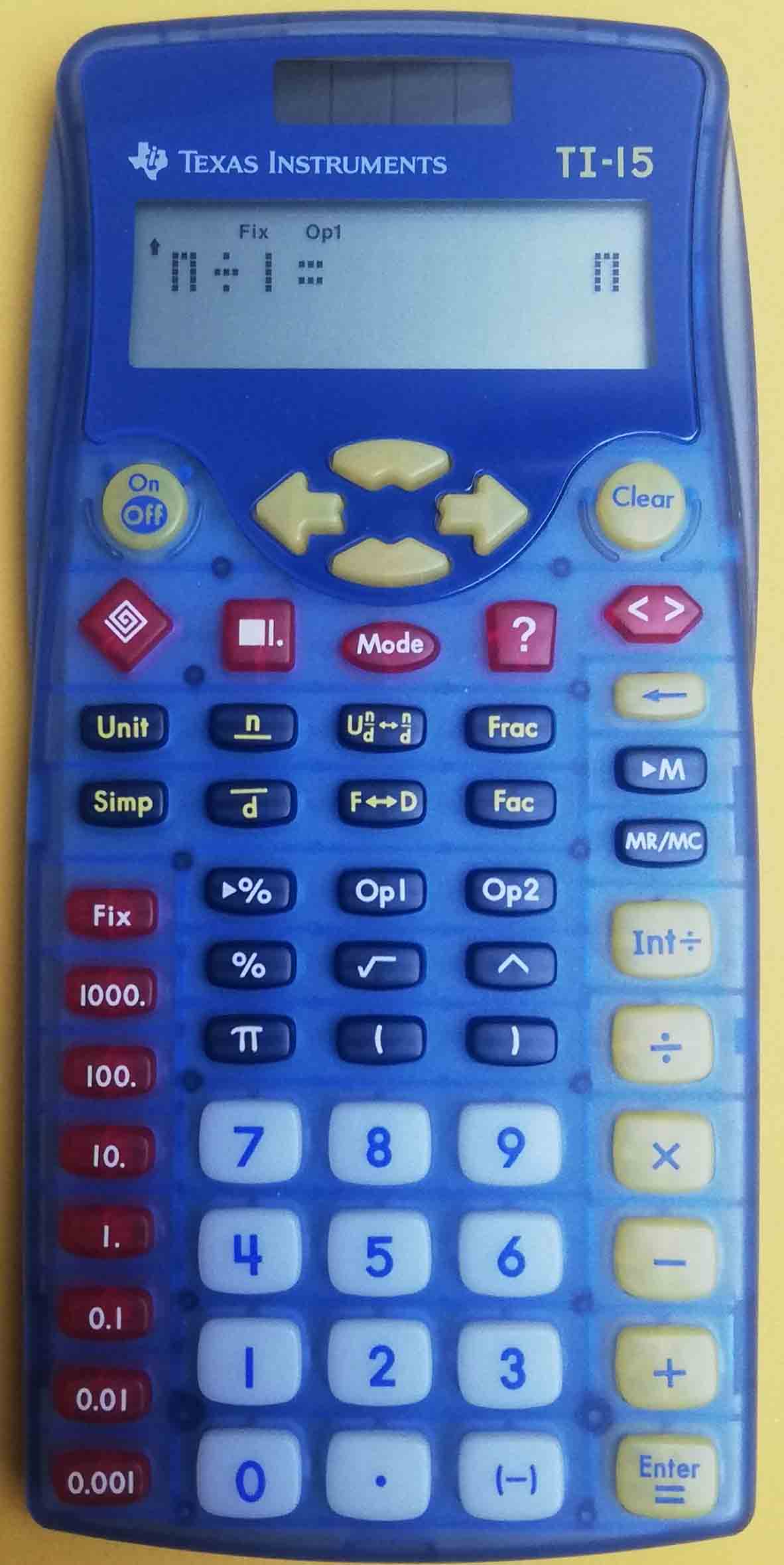 Model: TI-15 explorer lcd
Battery: CR2025
Adapter:
Year: 2007
Chip: China
Info:
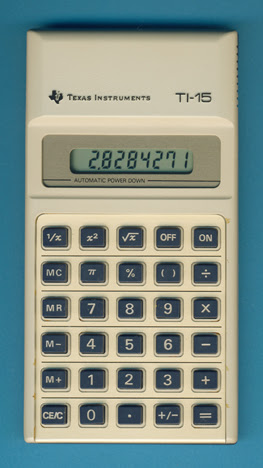 Model: TI-15 lcd
Battery: 2 x AA alkaline
Adapter:
Year: 1982
Chip: Taiwan
Info
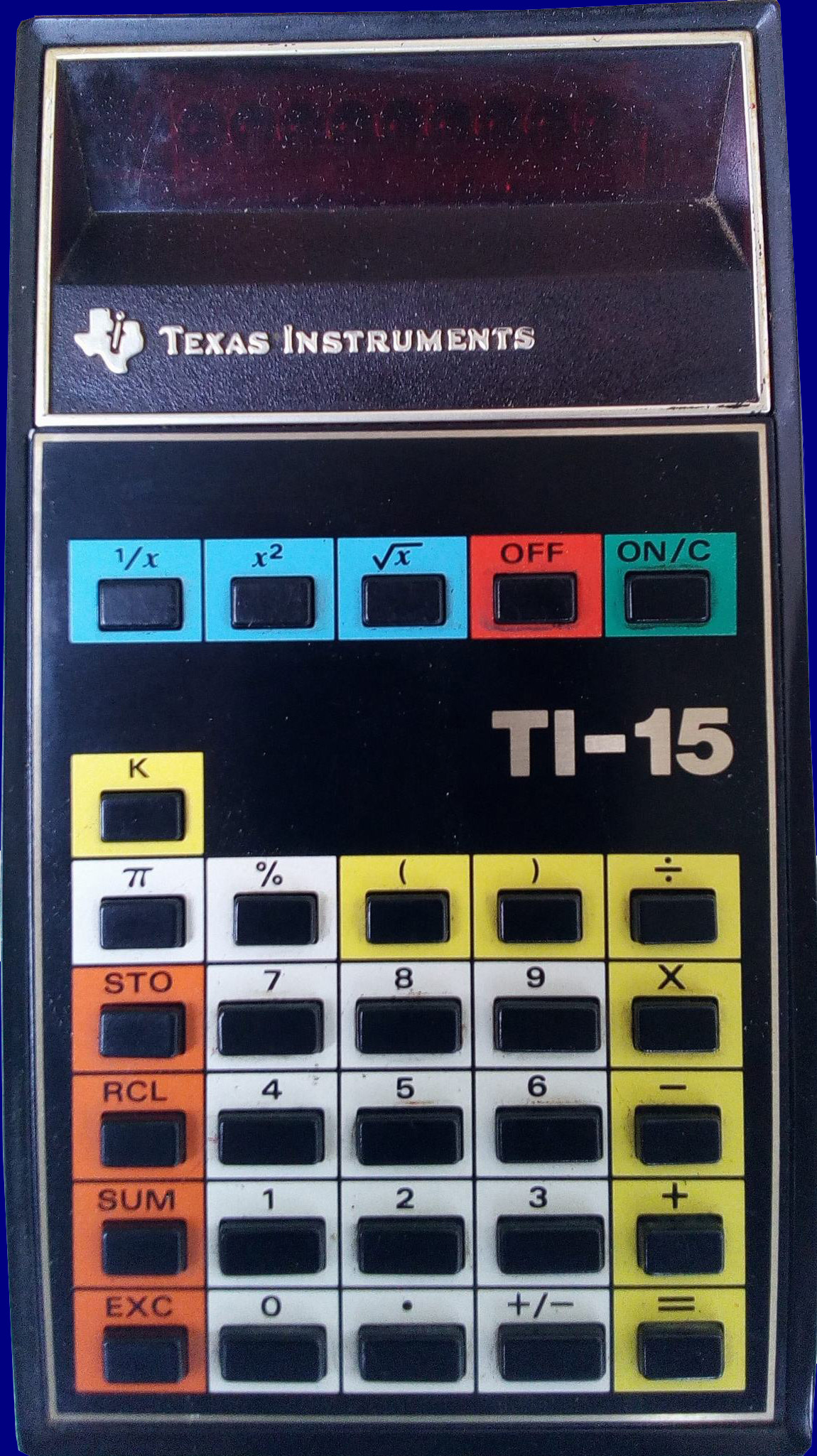 Model: TI-15
Battery: 9 volt
Adapter:
Year: 1981
Chip: TMC0981
Info: EURO line
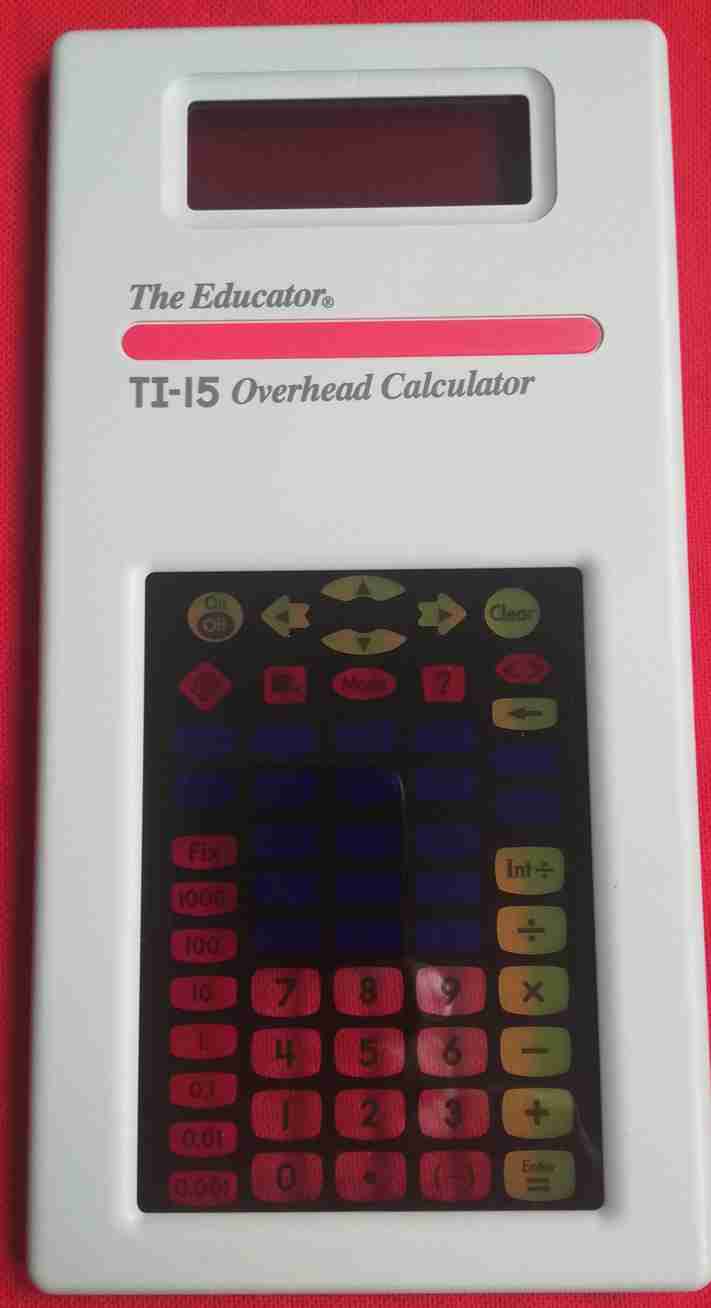 Model: TI-15 overhead
Battery:
Adapter:
Year:
Chip: made in China
Info: The California based company Stokes Publishing Company, Inc. distributes under the label "The Educator®"
calculators optimized for teaching purposes. William T. Stokes filed already July 30, 1991 the US Patent Application U.S. Pat. No. 5,035,502
with the title "Transparent calculator for overhead projection".
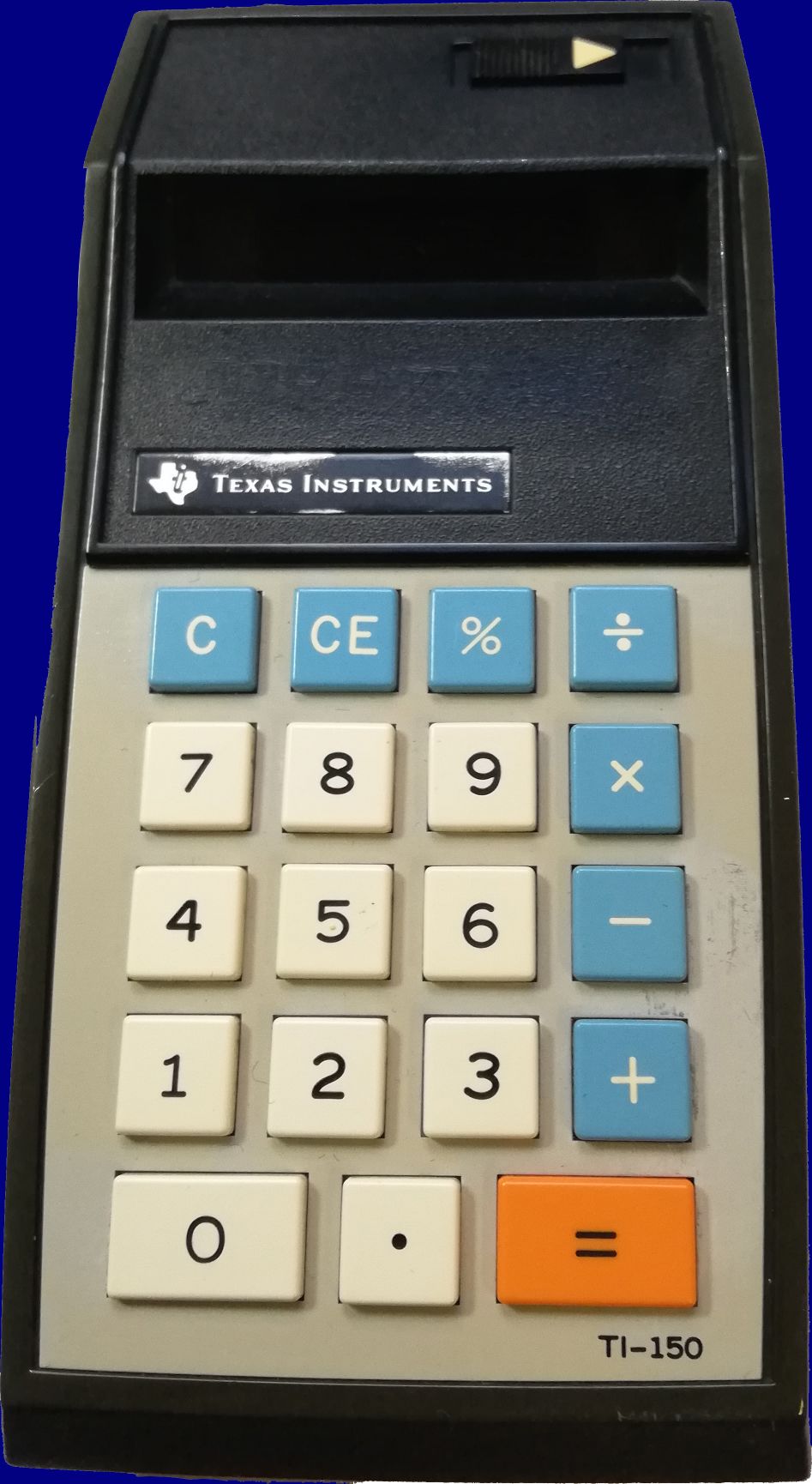 Model: TI-150
Battery: 4 x AA ni-cd internal
Adapter: AC9150
Year: 1975
Chip: TMS0852
Info: This calculator tastes different, it was a dear friend Joerg of datamath.org who gave it to me.
Very Rare
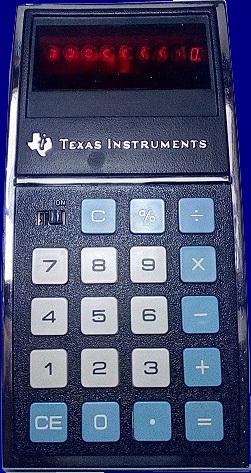 Model: TI-1500
Battery: 2 x AA ni-cd
Adapter: AC9140, AC9900/C
Year: 1974
Chip: TMS0803
Info:
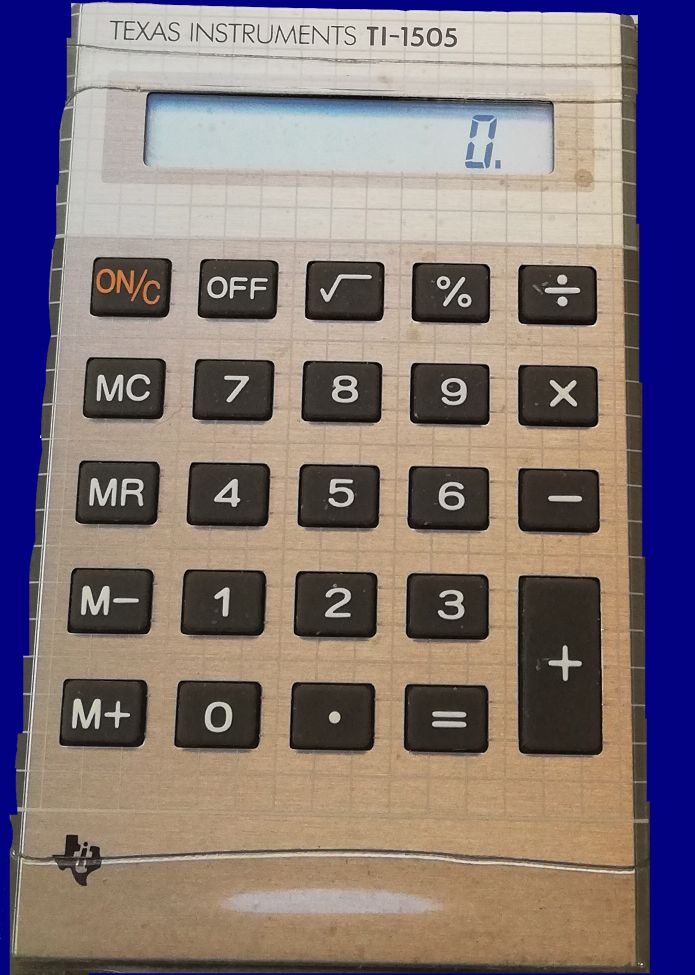 Model: TI-1505
Battery: LR1130
Adapter:
Year: 1985
Chip:
Info: LCD 1985 - 1990 Made in Taiwan
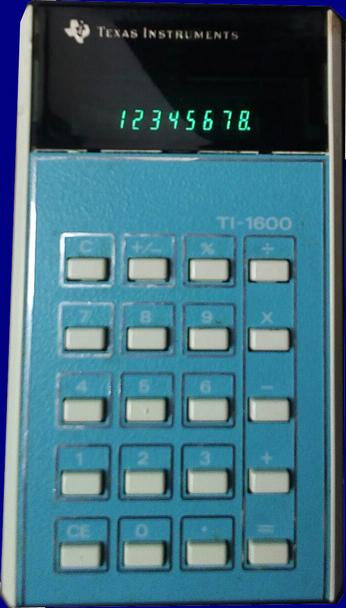 Model: TI-1600
Battery: special 1,2 ni-cd
Adapter: AC9131
Year: 1977
Chip: TMS1043
Info:
 Model: TI-1606
Battery: solar
Adapter:
Year: 1985
Chip:
Info:
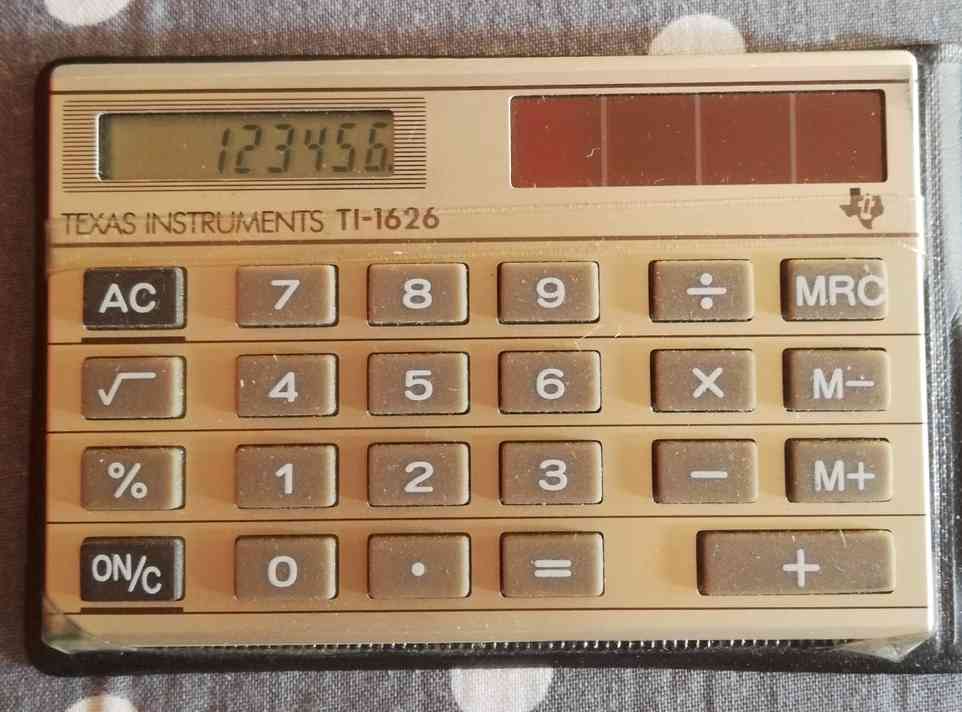 Model: TI-1626
Battery: 2 x AA
Adapter:
Year: 1985
Chip:
Info: The TI-1626 could be called one of the smallest, thinnest and lightest calculators manufactured by Texas Instruments.
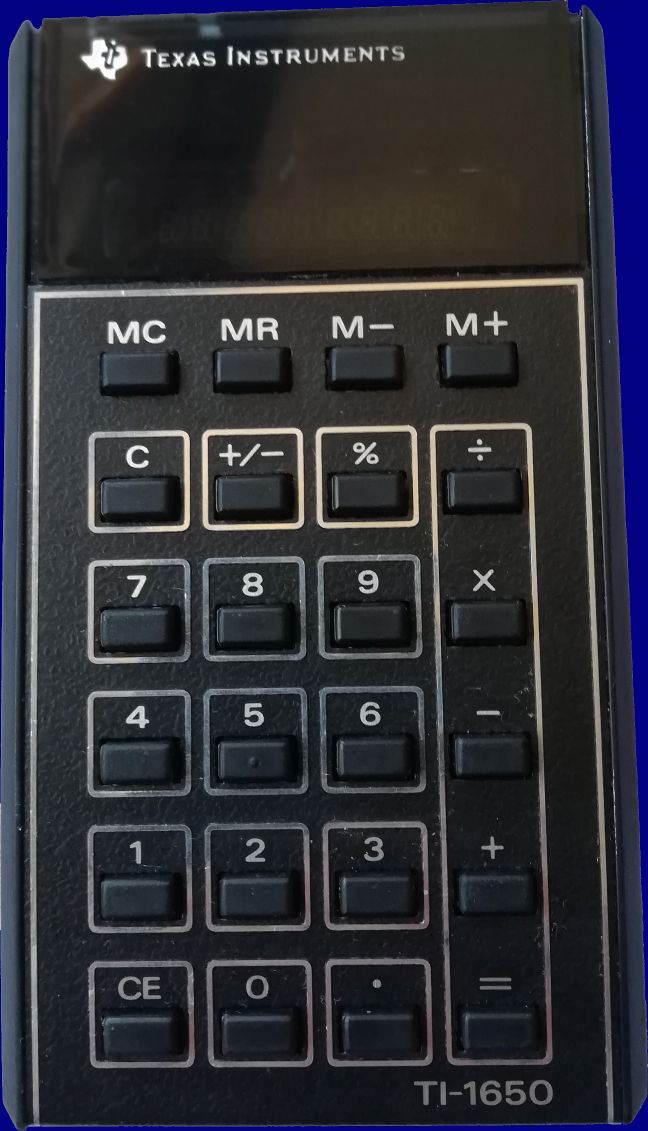 Model: TI-1650
Battery: special 1,2 ni-cd
Adapter: AC9131
Year: 1976
Chip: TMS1043
Info:
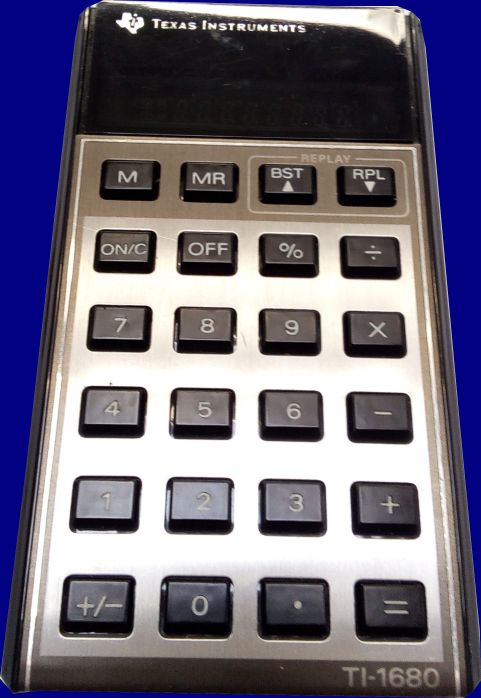 Model: TI-1680
Battery: special 1,2 ni-cd
Adapter: AC9131,AC9132
Year: 1978
Chip: TMC1981,TMC0999
Info:
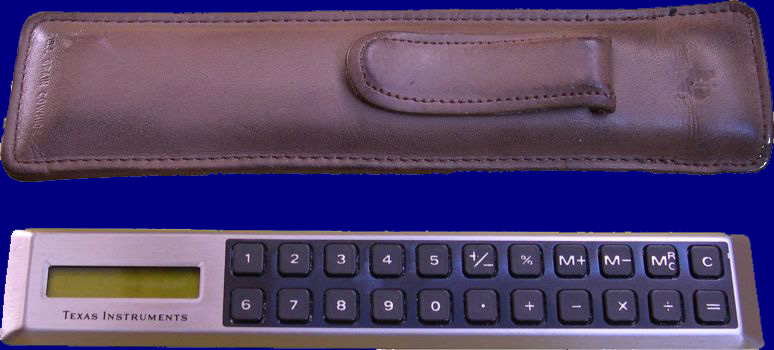 Model: TI-1700
Battery: 3 x LR54
Adapter:
Year: 1978
Chip: T3551 or T3708toshiba
Info: first TI-LCD - yellow LCD
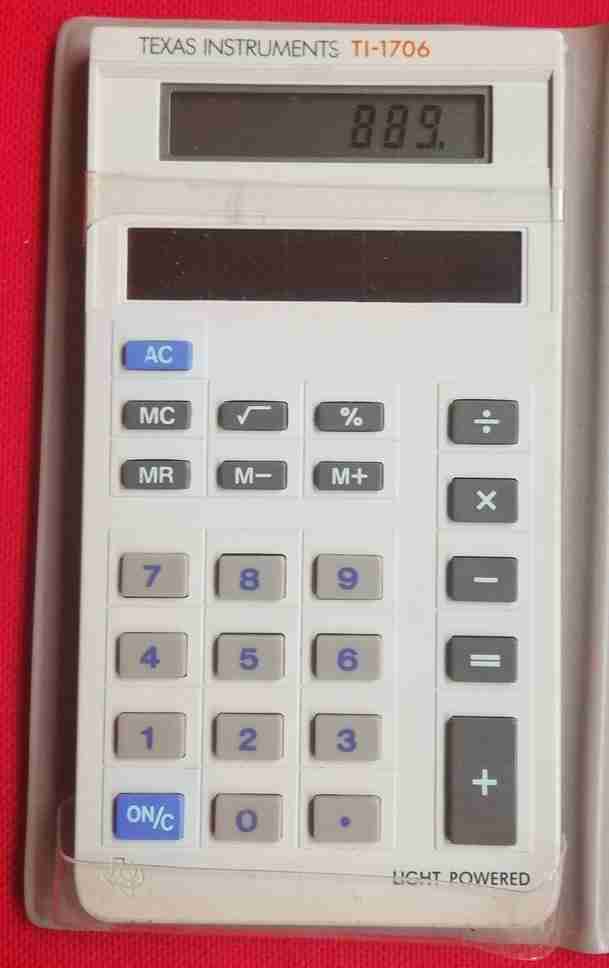 Model: TI-1706
Battery: solar
Adapter: solar
Year: 1983
Chip: Sharp LI3129
Info:
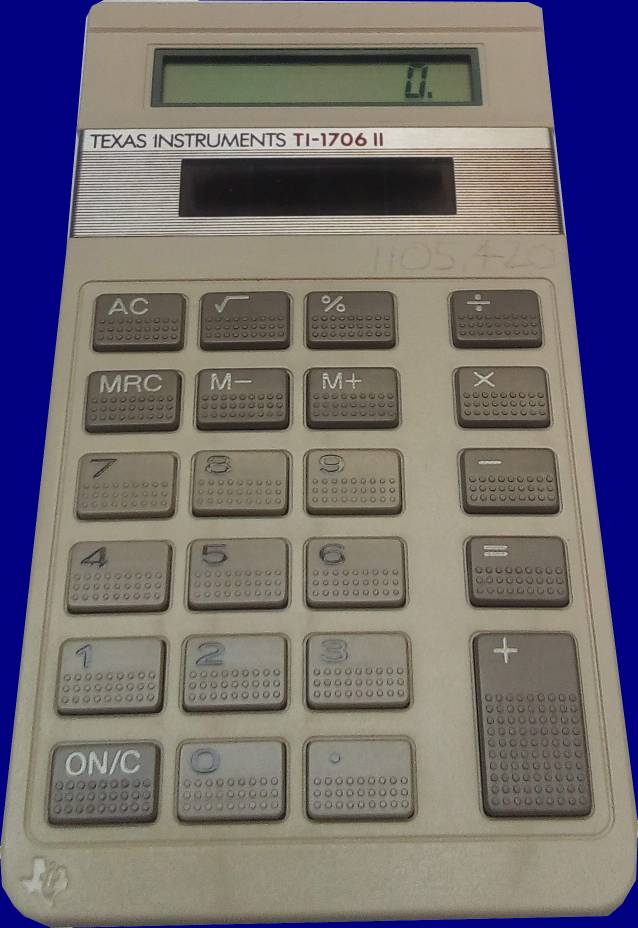 Model: TI-1706 II
Battery: 2 x solar
Adapter:
Year: 1985
Chip:
Info: LCD 1980 - 1984
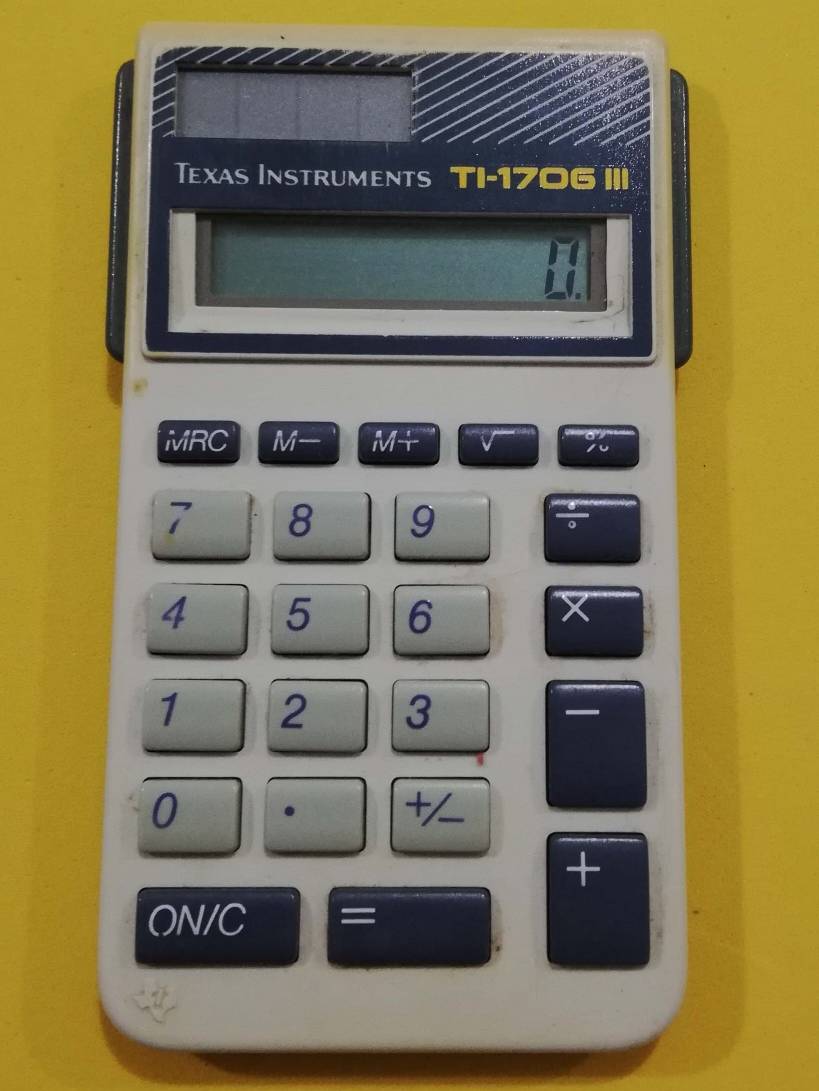 Model: TI-1706 III
Battery: solar
Adapter: solar
Year: 1990
Chip: Sharp LI3135MS
Info:
 Model: TI-1706 SV
Battery: LR54
Adapter:
Year: 1999
Chip: sharp LI3154
Info: LCD 1991 - 1999
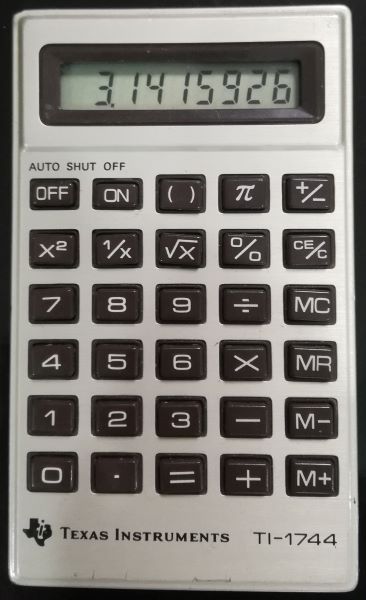 Model: TI-1744
Battery: 2 x LR43
Adapter:
Year: 1982
Chip: NEC uPD1831G
Info: Made in Taiwan
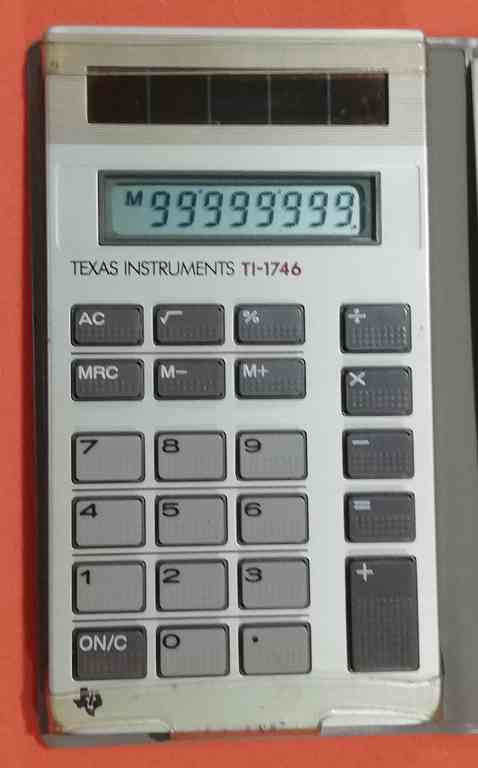 Model: TI-1746
Battery: solar
Adapter:
Year: 1985
Chip:
Info: Made in Taiwan
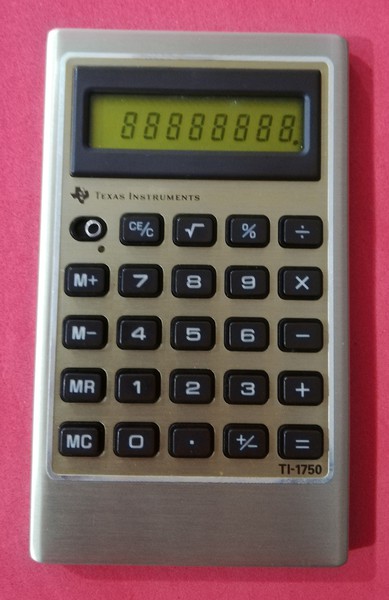 Model: TI-1750
Battery: 3 x LR44
Adapter:
Year: 1977
Chip: Toshiba T3532
Info: first TI-LCD - yellow LCD
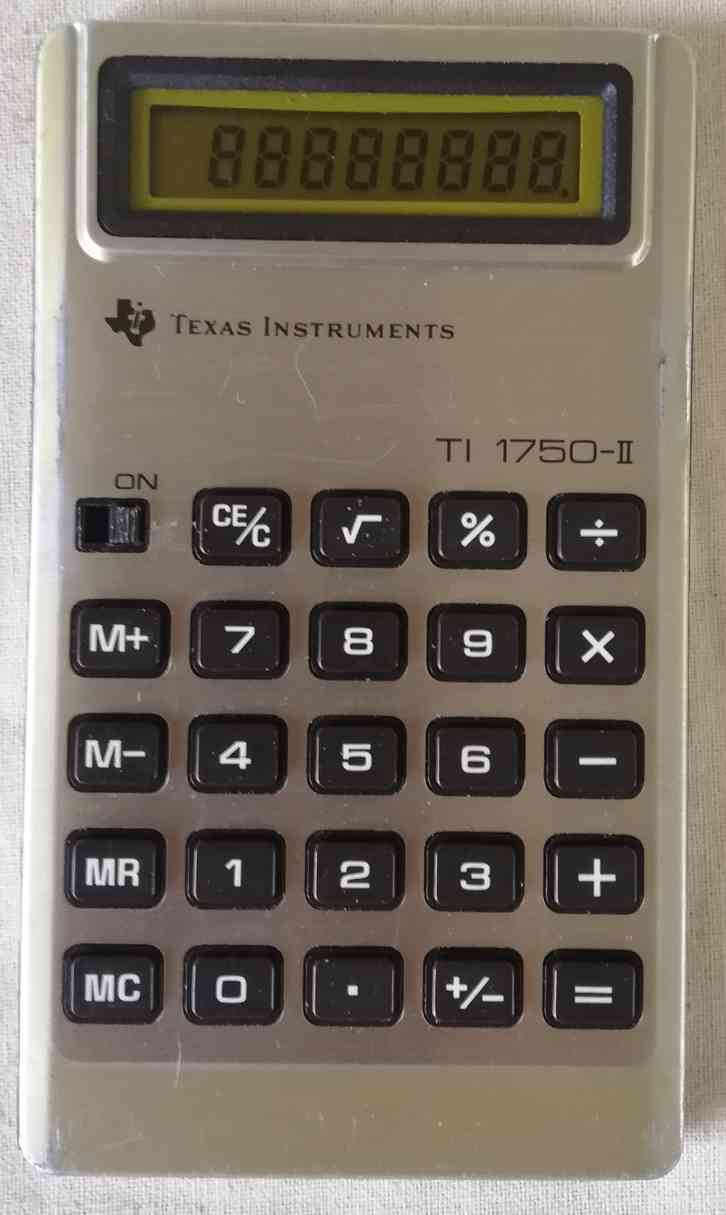 Model: TI-1750-II
Battery: 2 x LR54
Adapter:
Year: 1980
Chip: Toshiba T3709
Info:
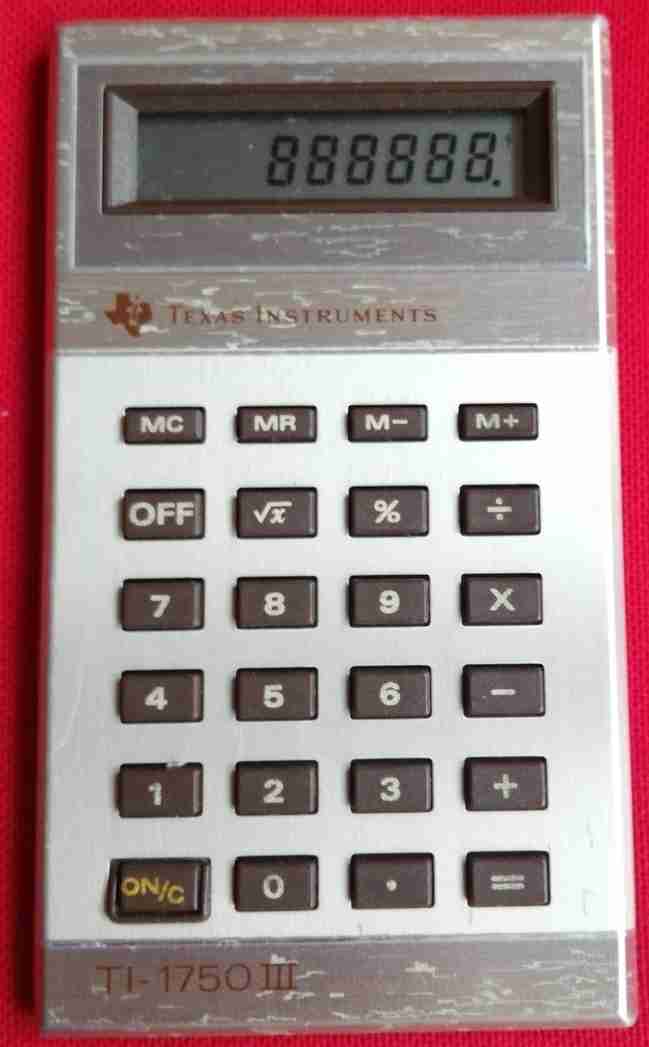 Model: TI-1750 III
Battery: 2 x LR43
Adapter:
Year: 1982
Chip: TPO311
Info:
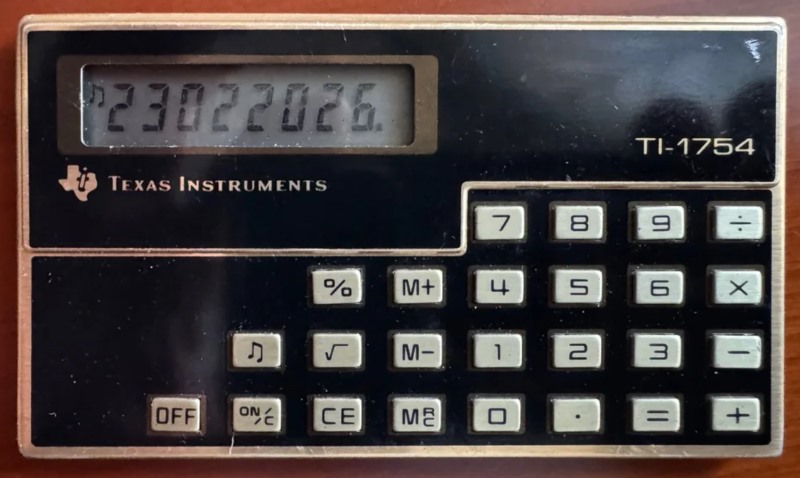 Model: TI-1754
Battery: 2 x LR54
Adapter:
Year: 1981
Chip: Sharp LI3033MT
Info:In 1981/1982 Texas Instruments introduced not only cheap looking calculators manufactured in Taiwan like the TI-1015 or TI-1006 but some very stylish and thin calculators. The line covers the TI-1754 (credit card sized), TI-1755 (golden trim), TI-1756 (silver edition of the TI-1755) and TI-1757 (Music Card). All four models got an audible instead of a tactile feedback of the entries.
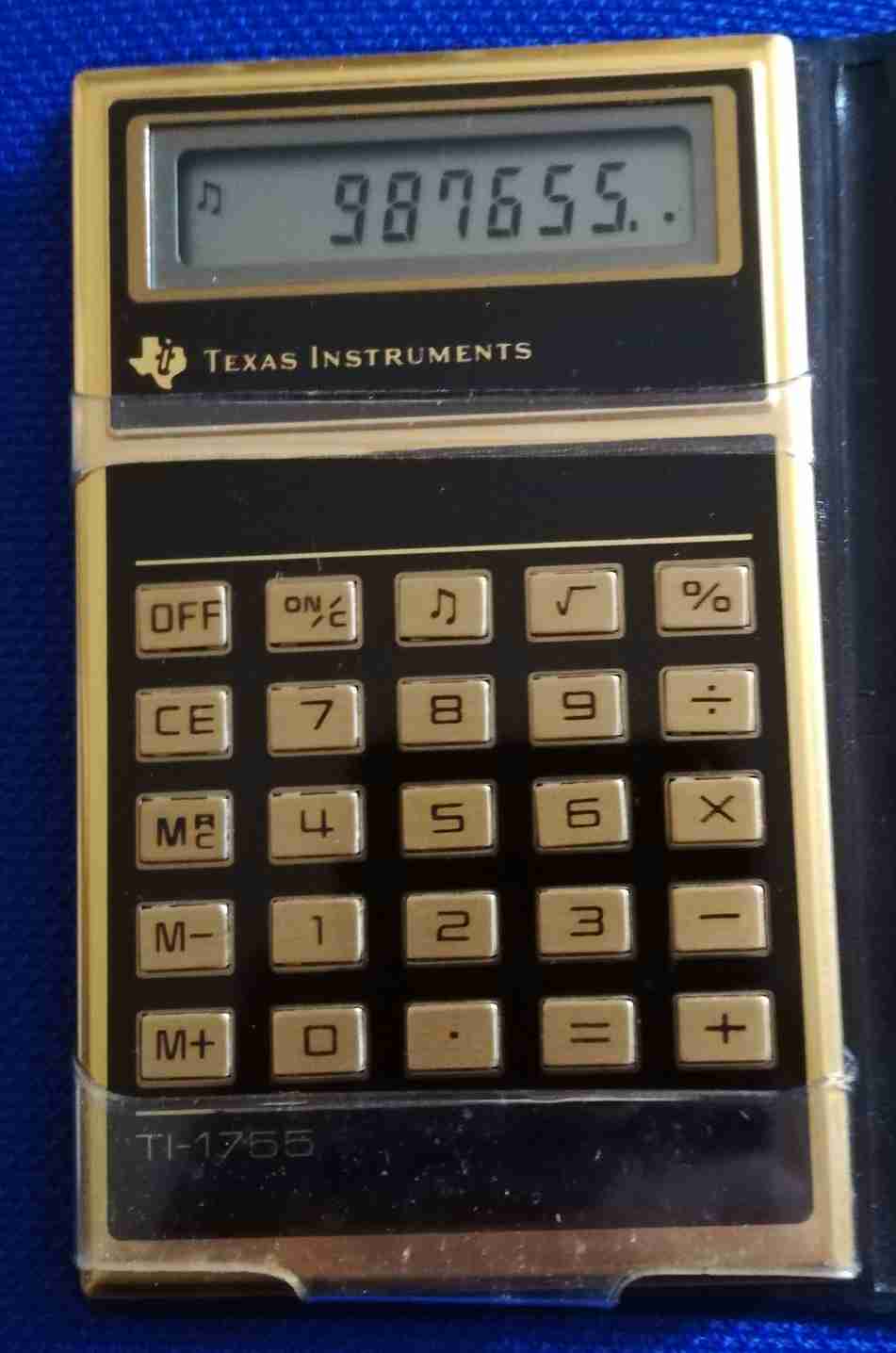 Model: TI-1755
Battery:
Adapter:
Year: 1982
Chip: Sharp LI3033MT
Info: In the year 1982 Texas Instruments introduced not only cheap looking calculators manufactured in Taiwan like the TI-1015 or TI-1006 but some very stylish and thin calculators.
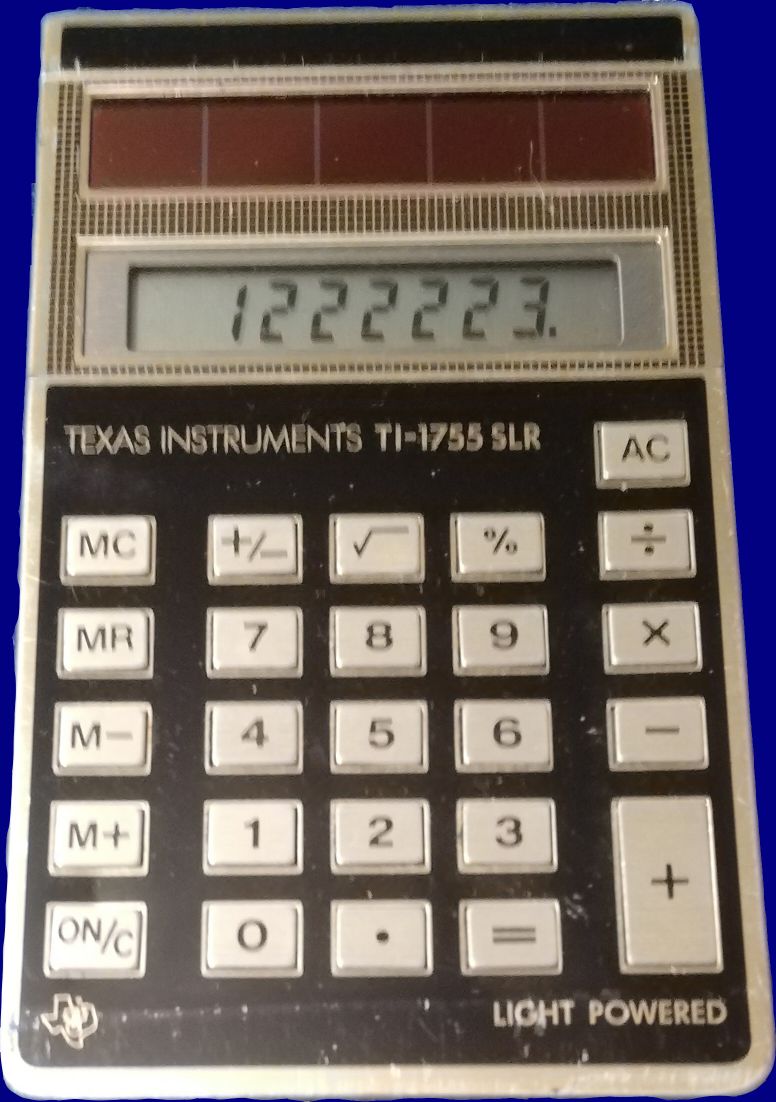 Model: TI-1755 solar
Battery:
Adapter:
Year: 1983
Chip:
Info: LCD 1980 - 1984 Made in Taiwan
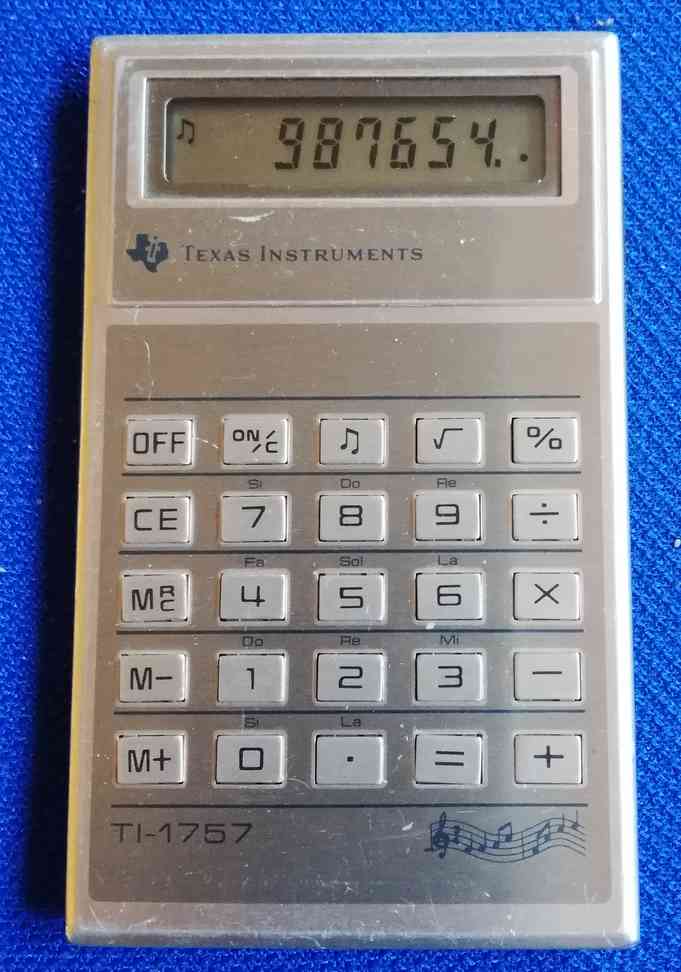 Model: TI-1757
Battery: 2 x LR54
Adapter:
Year: 1981
Chip: Sharp LI3033MT
Info:The TI-1757 added the ability to reproduce musical notes to the TI-1755, pressing all keys from zero to nine reproduces the musical scale.
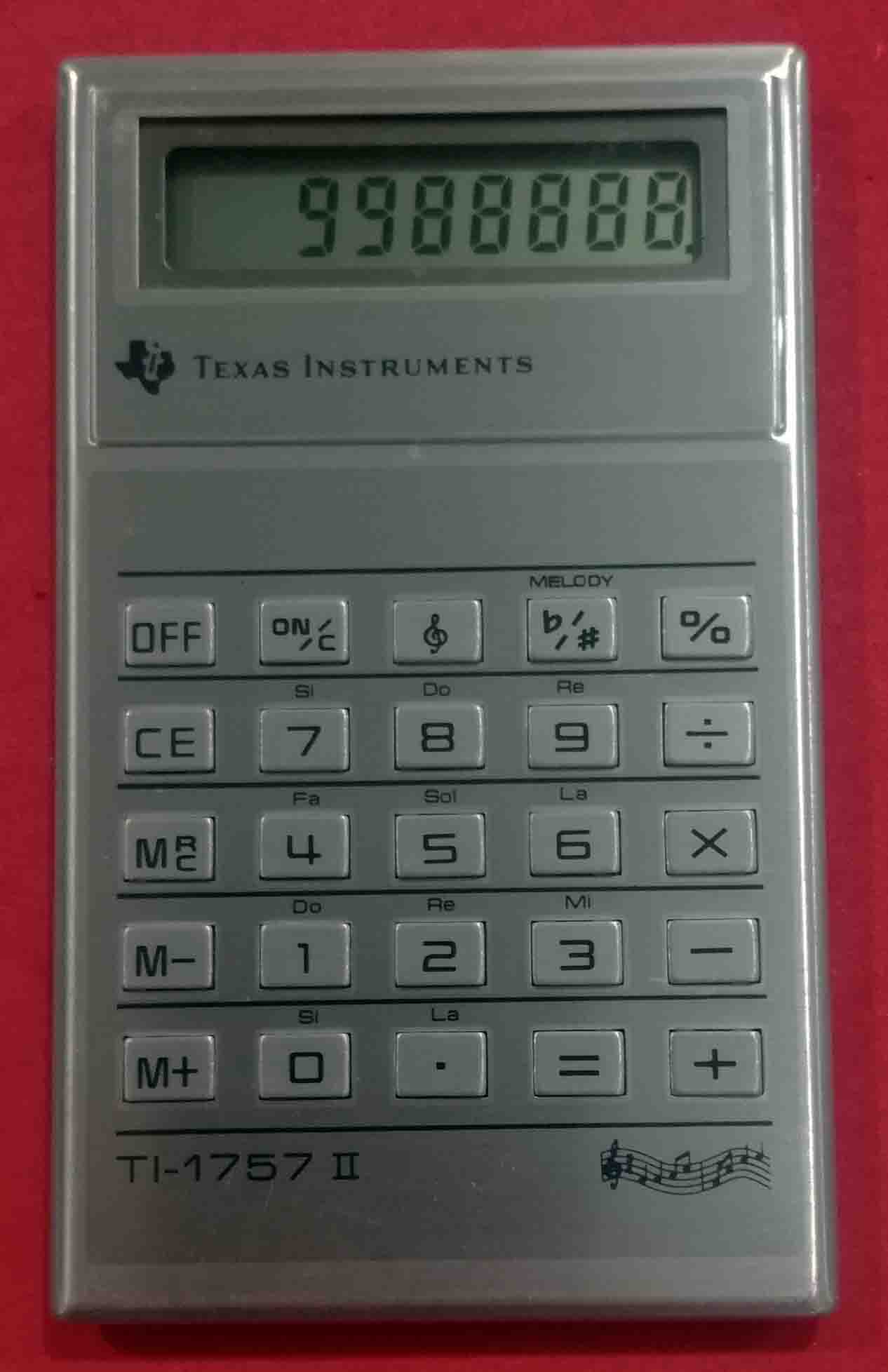 Model: TI-1757 II
Battery: 2 x LR54
Adapter:
Year: 1983
Chip: Sharp LI3033MT
Info:The TI-1757 II "Melody Calculator" added to the similar TI-1755 the capabilities to play own melodies or the "Happy Birthday..." rhyme. The music function gives 10 notes of a scale. With 2 notes below the octave and one above you can play simple tunes. Another key allows you to play either flat (b) or sharp (#). This transforms the basic key of C to F and G by flattening the B to Bb in the first case and sharpening the F to F# in the second case. Thus most tunes can be played with a little practice.
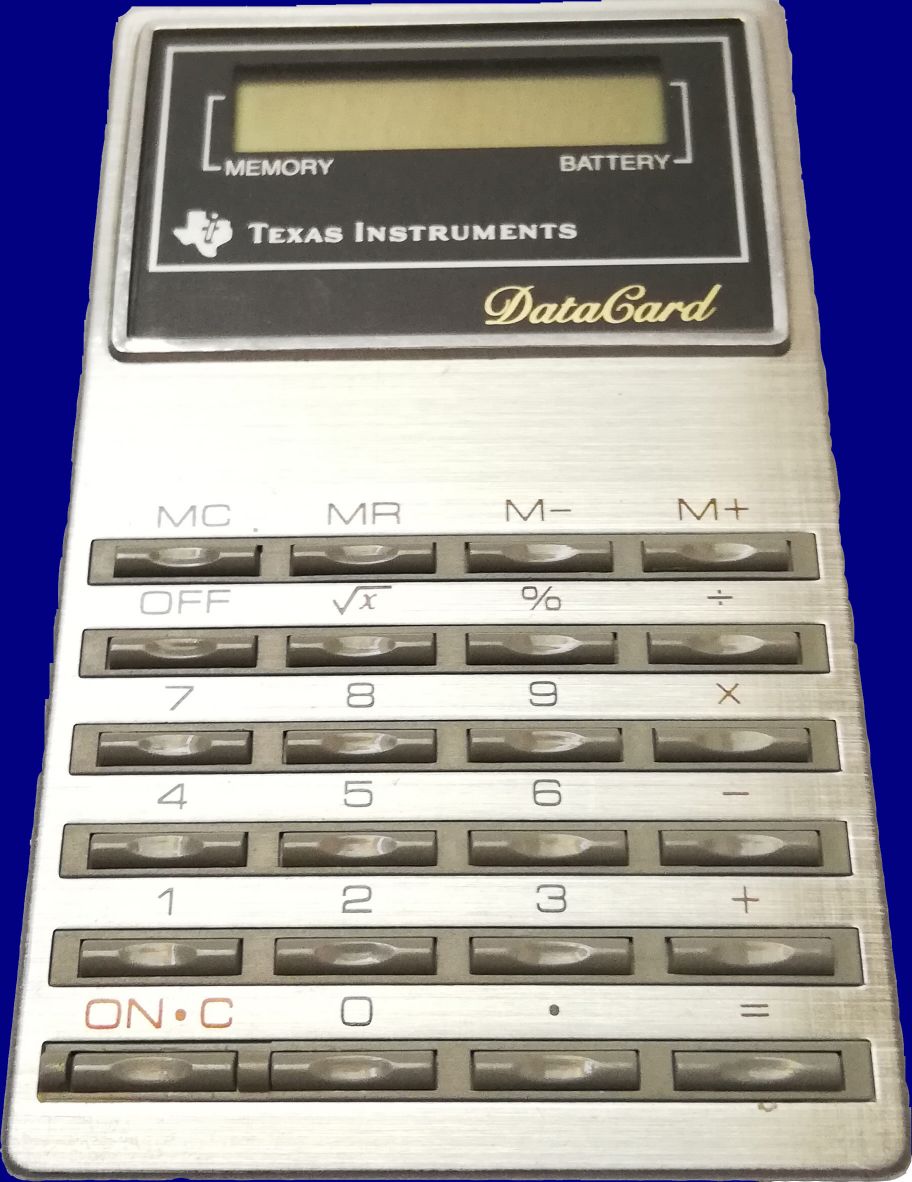 Model: TI-1760 datacard
Battery: 2 x LR54
Adapter:
Year: 1979
Chip:
Info: first TI-LCD - yellow LCD
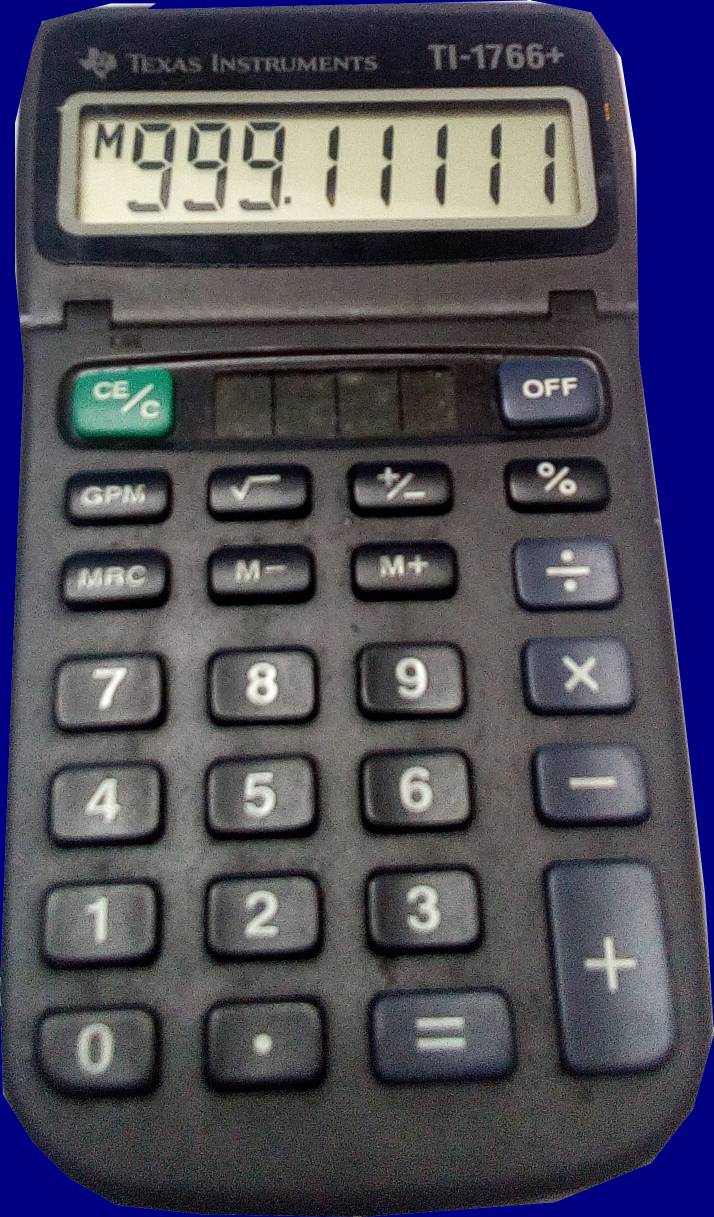 Model: TI-1766 +
Battery: LR54
Adapter:
Year: 1999
Chip:
Info: LCD 1991 - 1999
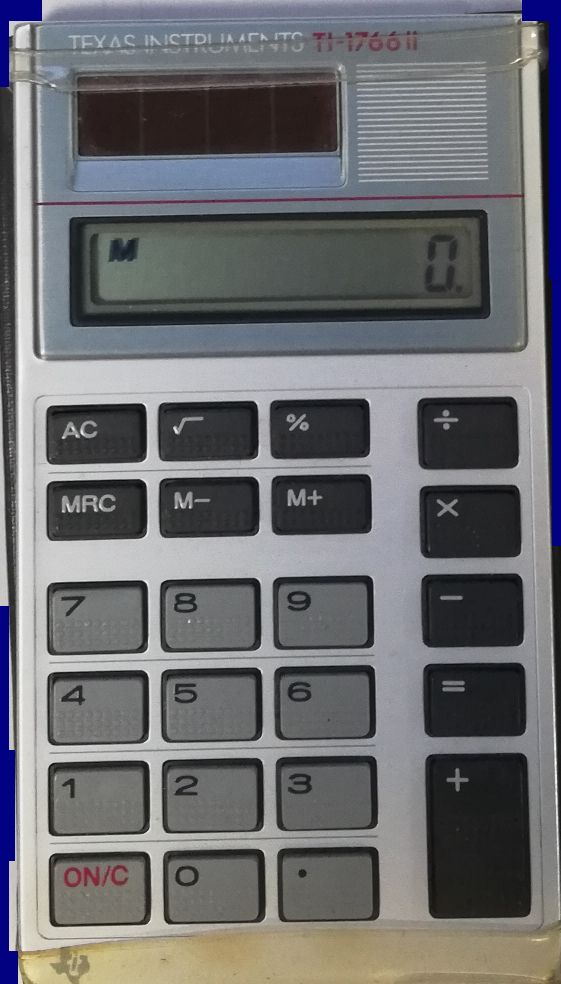 Model: TI-1766 II
Battery: solar
Adapter:
Year: 1986
Chip:
Info: LCD 1985 - 1990 Made in Taiwan
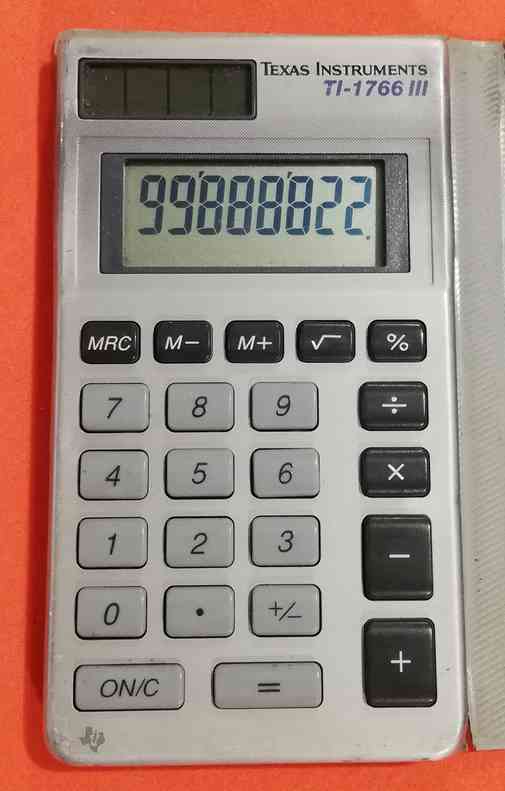 Model: TI-1766 III
Battery: solar
Adapter:
Year: 1992
Chip:
Info: Made in Malaysia
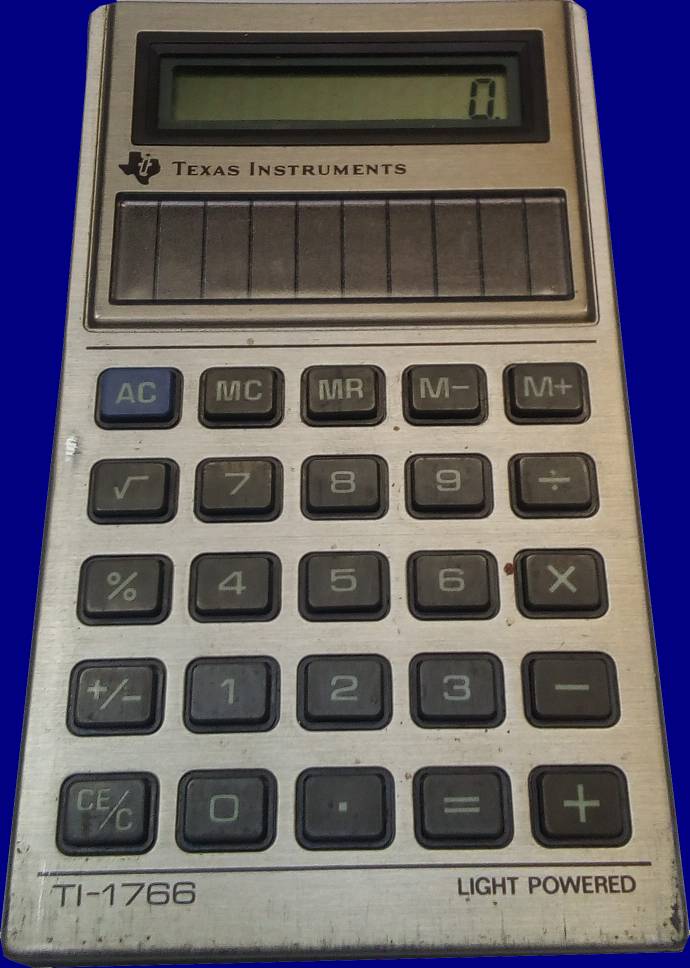 Model: TI-1766
Battery: solar
Adapter:
Year: 1983
Chip: T6758 Toshiba
Info: LCD 1980 - 1984
 Model: TI-1767
Battery: solar
Adapter:
Year: 1984
Chip:
Info: The TI-1767 was introduced together with the TI-1706. It combines design elements of the wonderful TI-1766 with the cheaper housing of the TI-1706. Main difference to both other calculators is the 10-digit display capability.
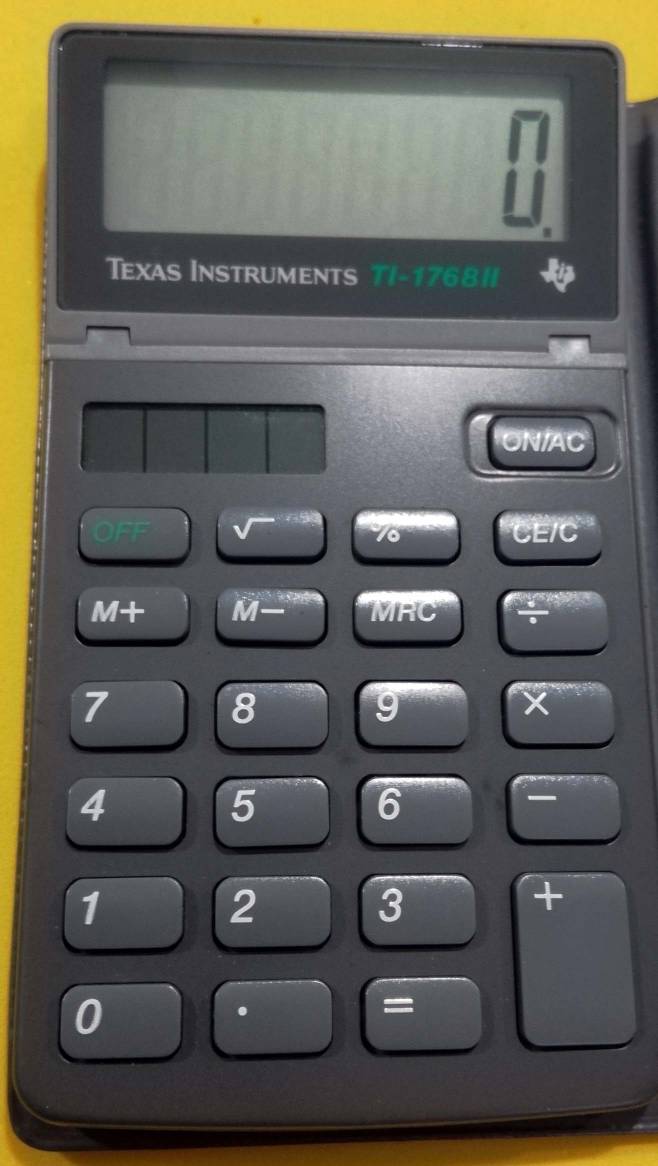 Model: TI-1768 II
Battery: solar
Adapter:
Year: 1991
Chip: Sharp LI3135 or LI3154
Info:
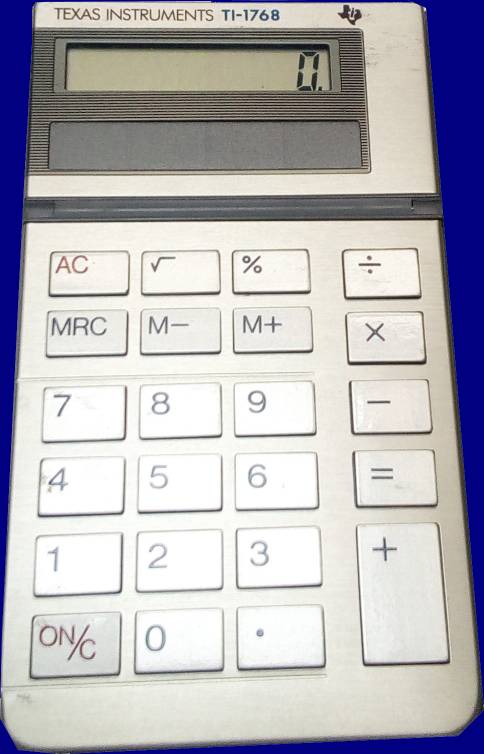 Model: TI-1768
Battery: solar
Adapter:
Year: 1987
Chip: LI3135 sharp
Info: LCD 1985 - 1990
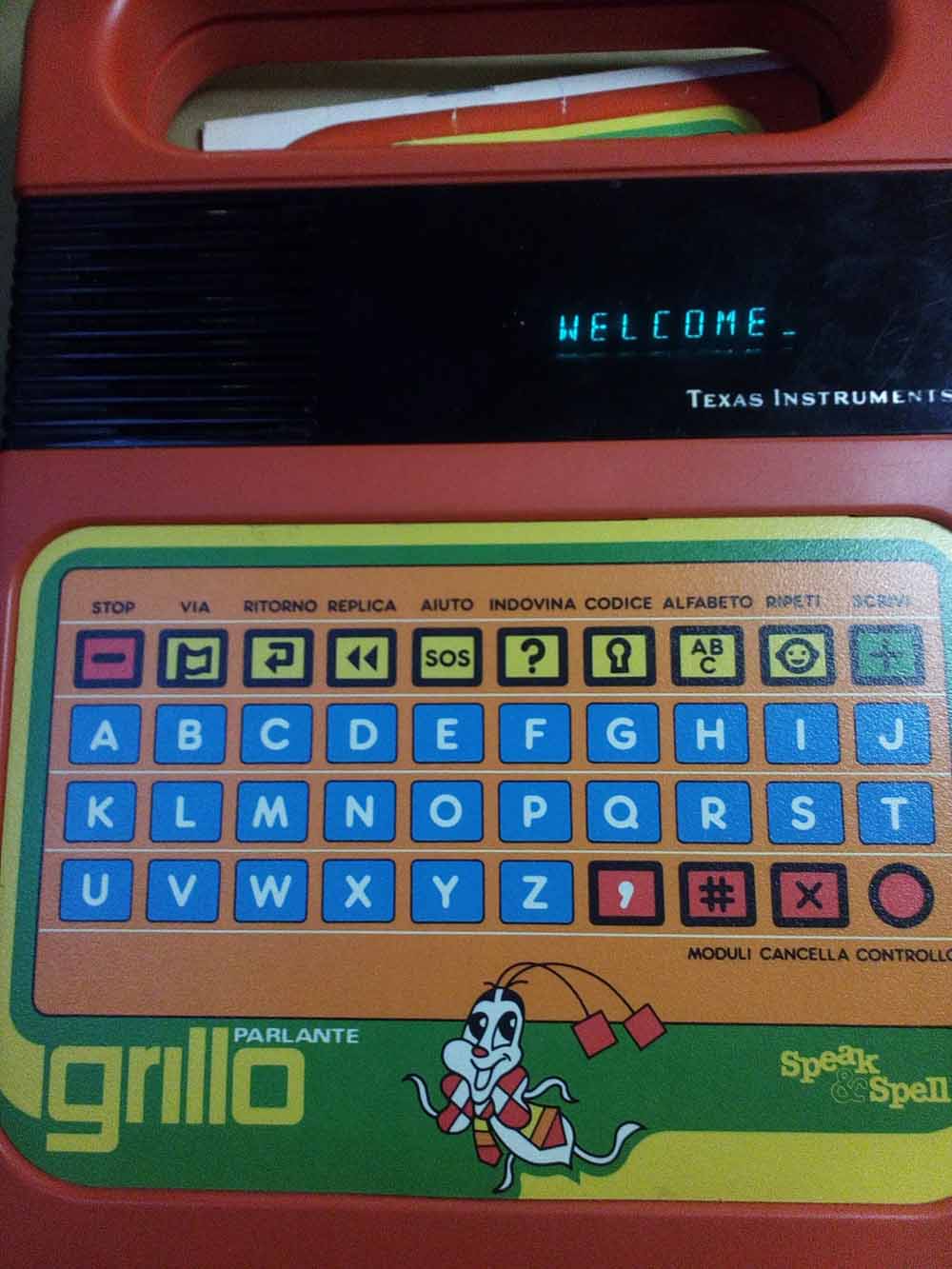
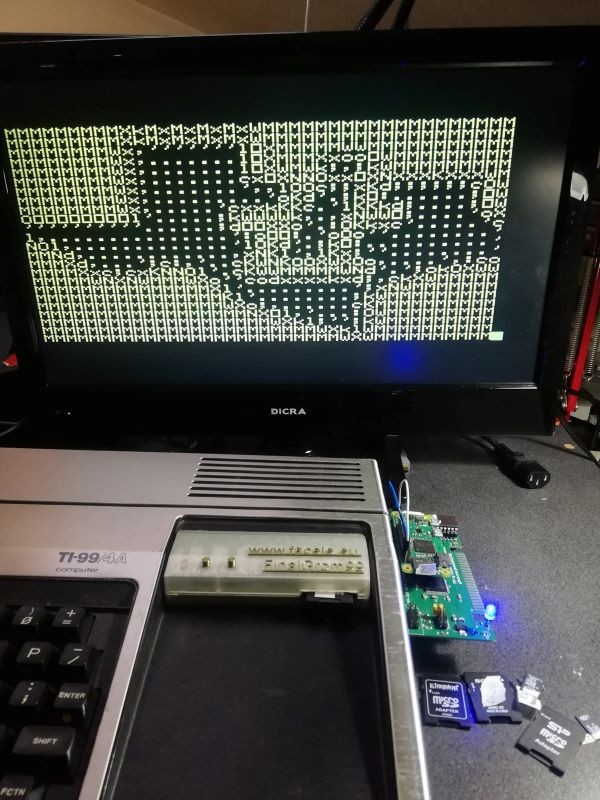
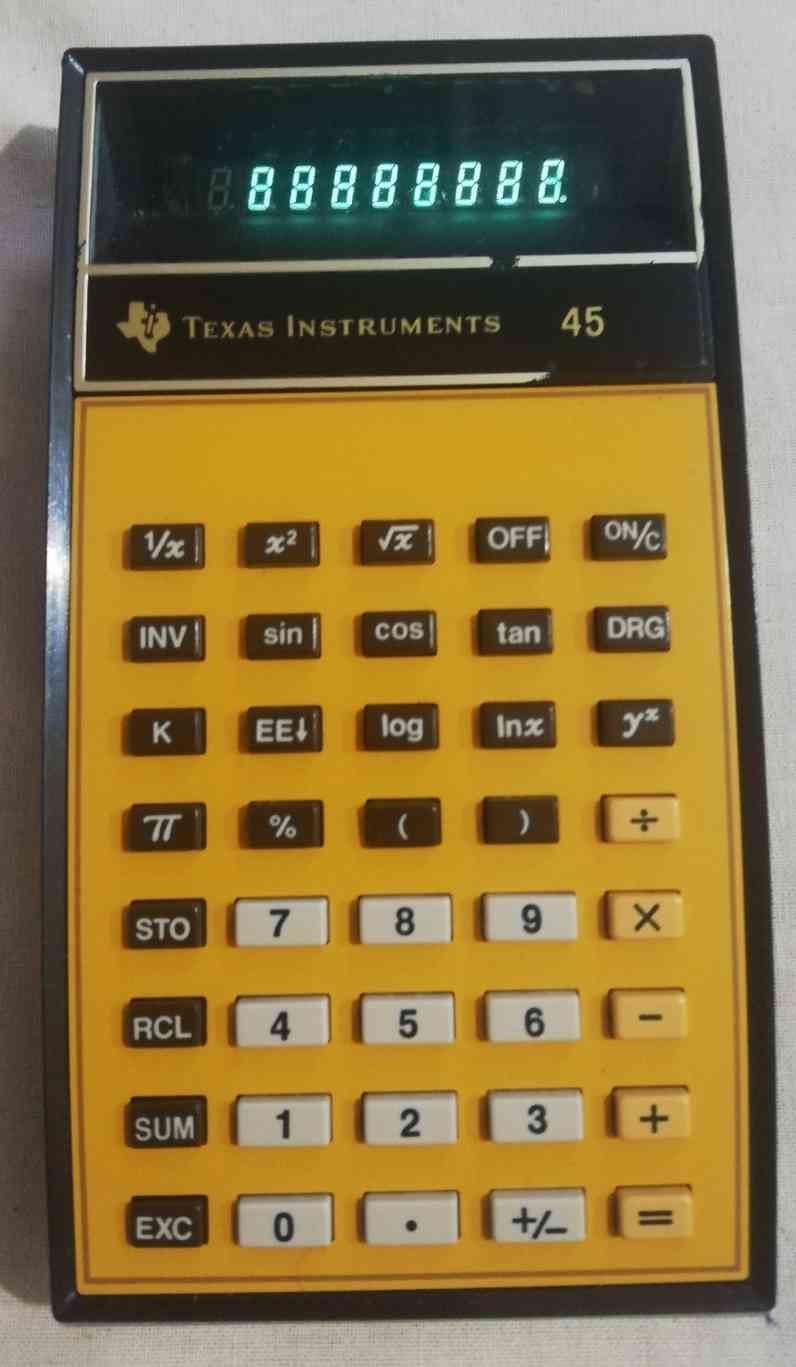
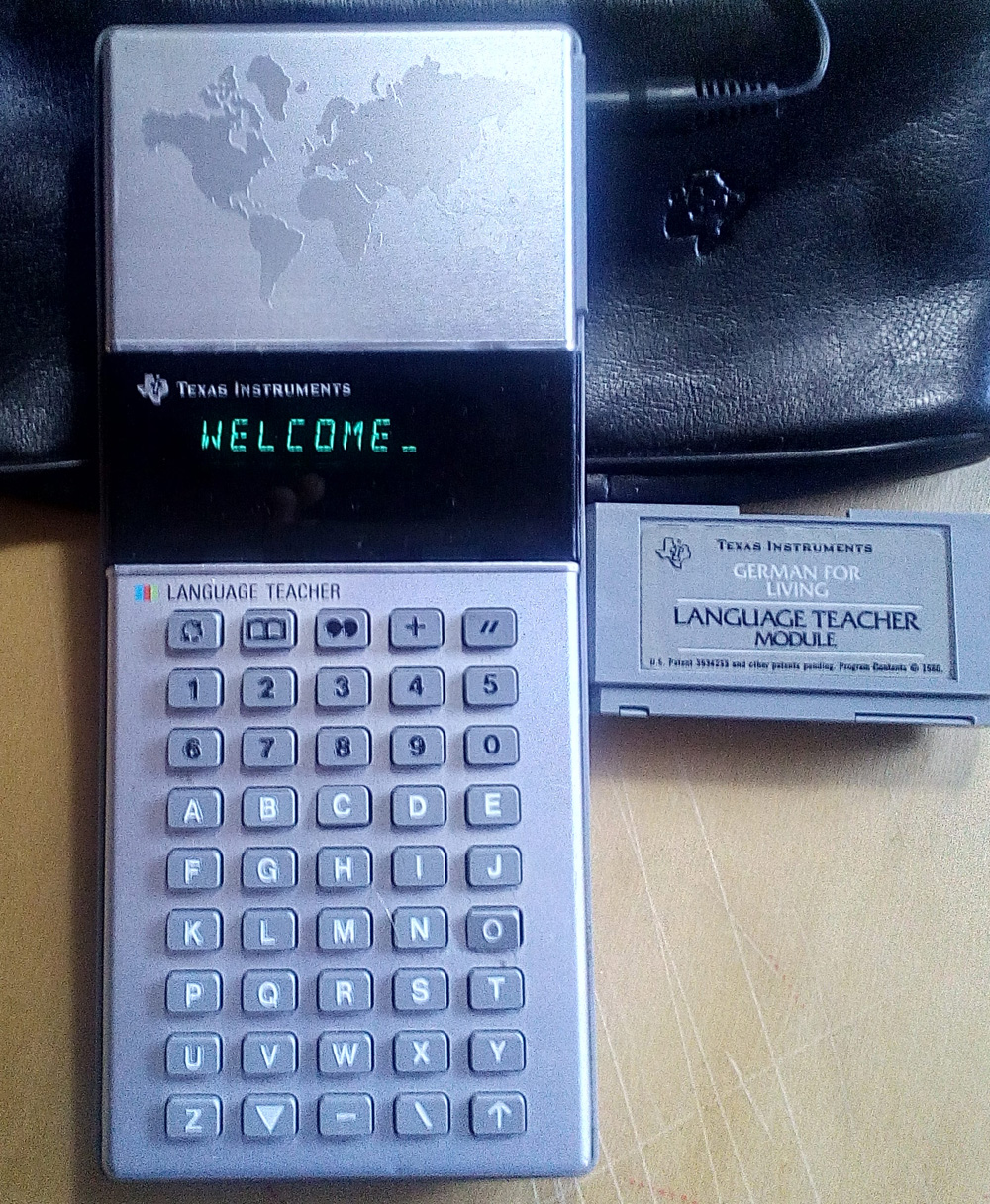
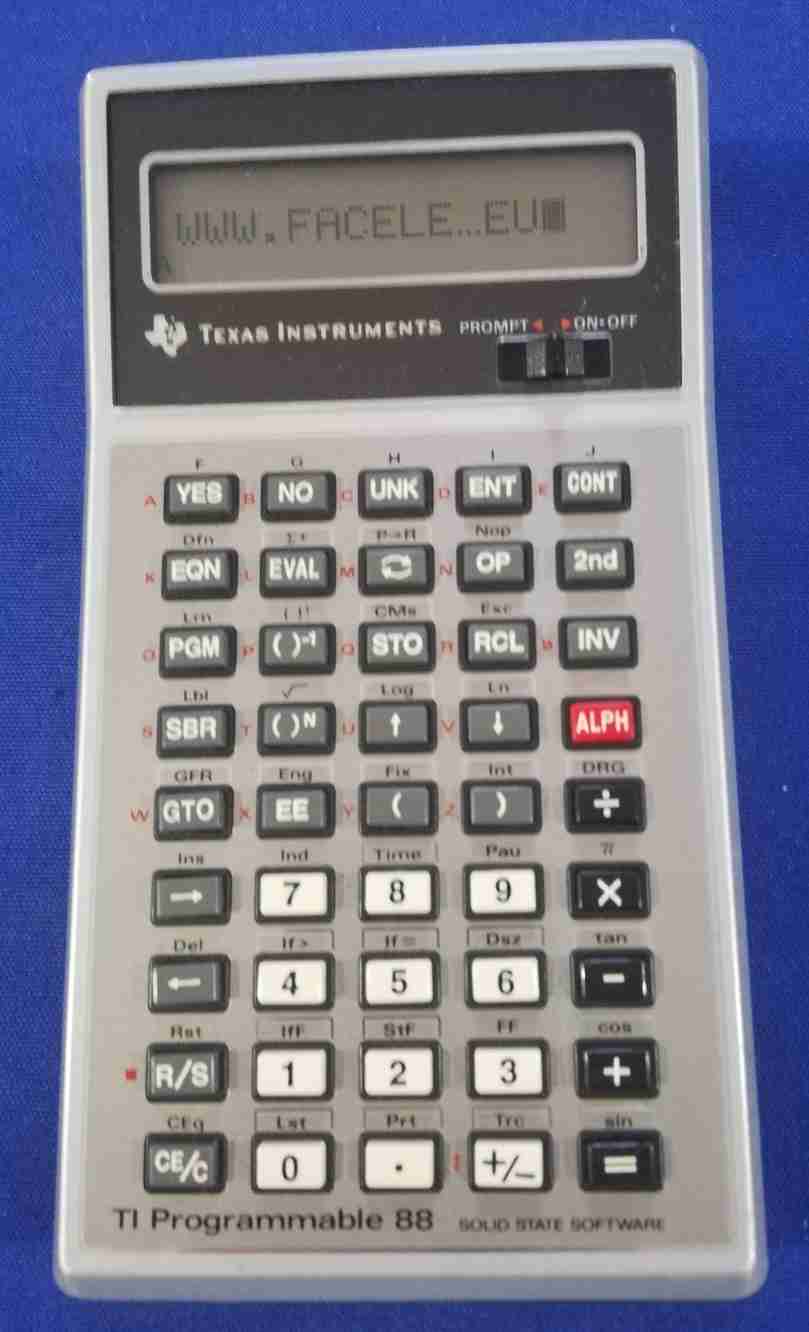
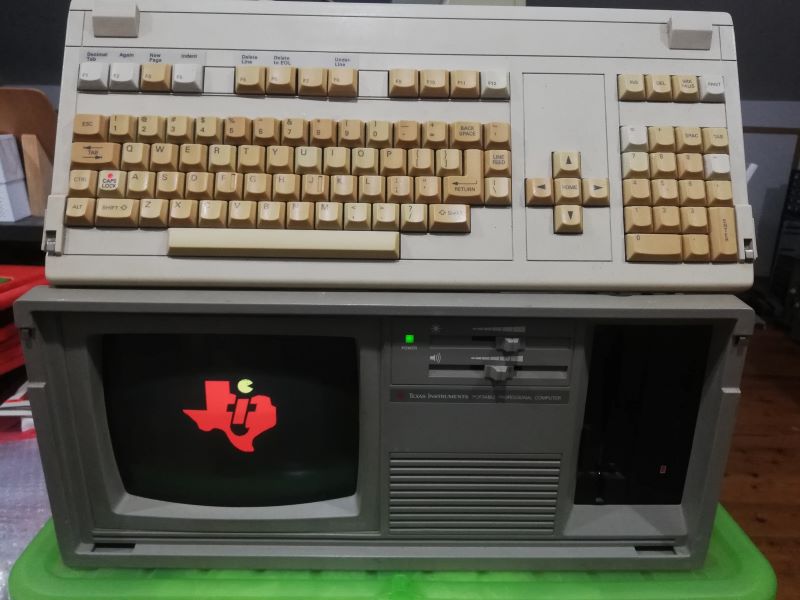
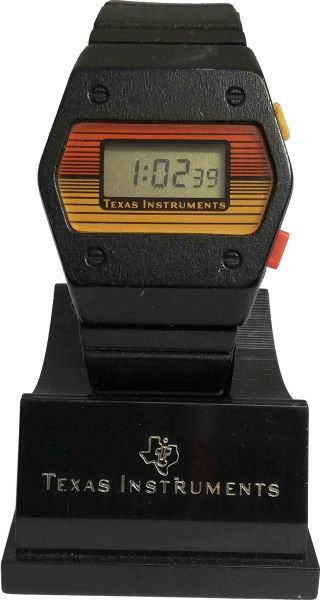
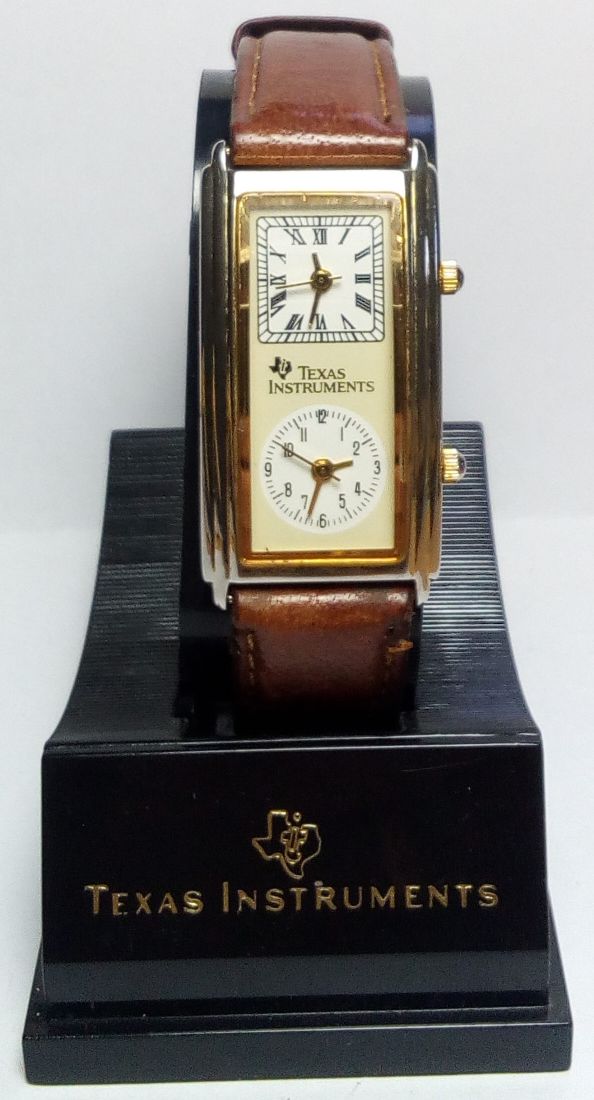
.jpg "Core Module Watch")

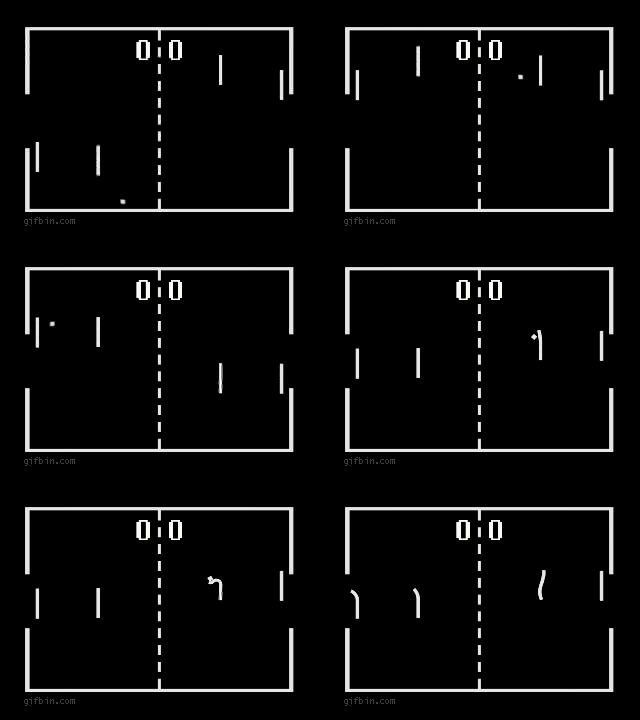
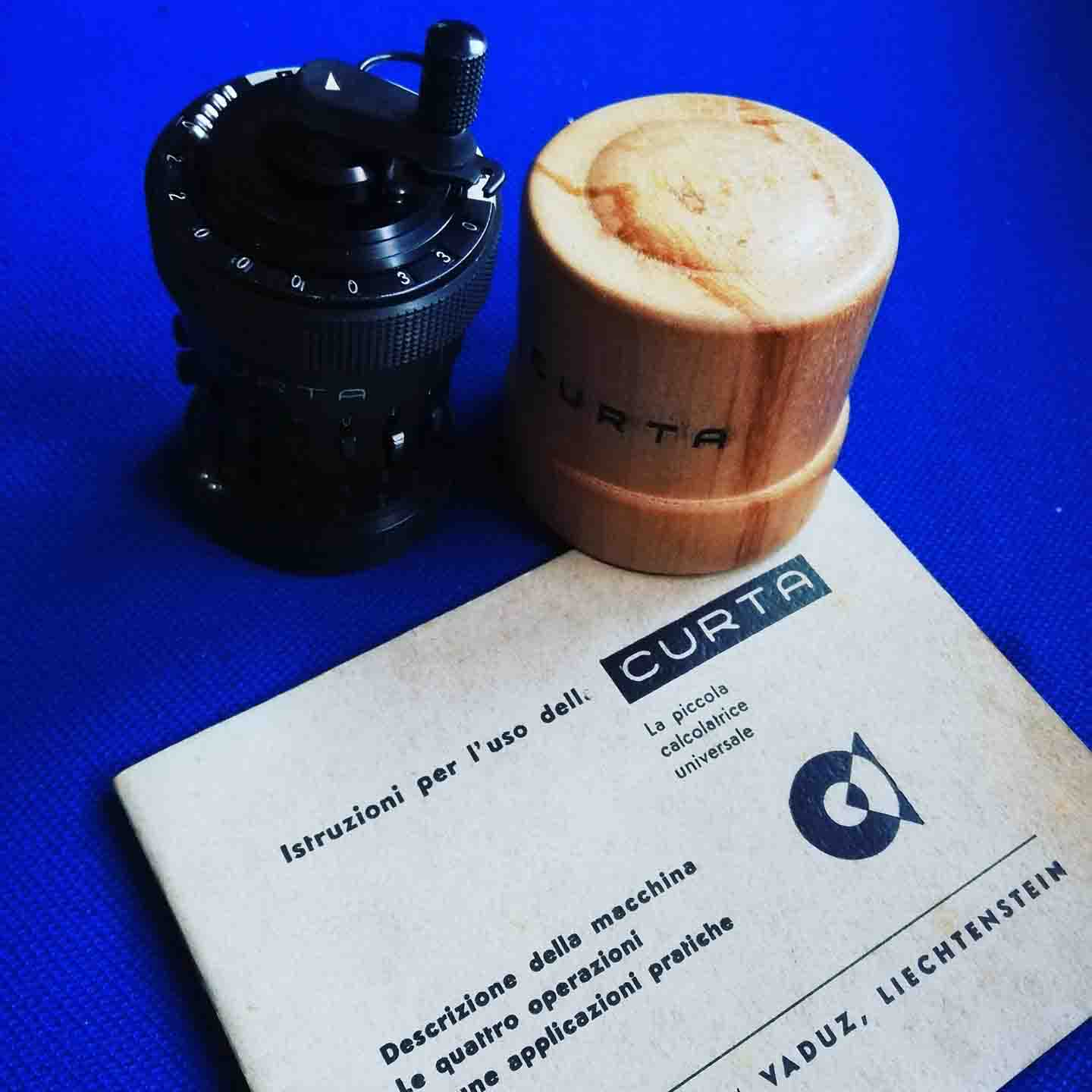
.jpg "Calculator Fuller")

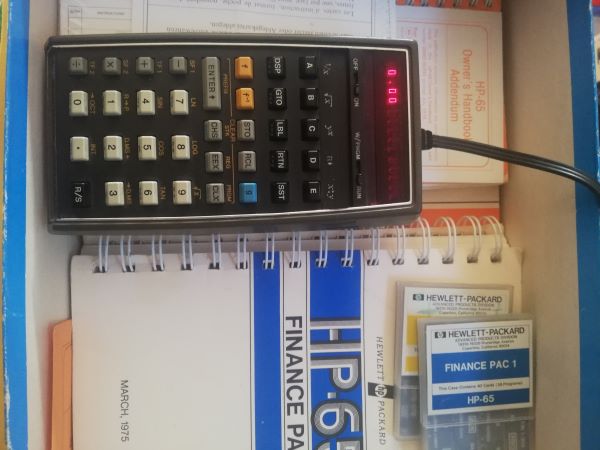
.jpg "Olivetti Valentine")
.jpg "Console / Games")
.jpg "Battle Star Galactica")
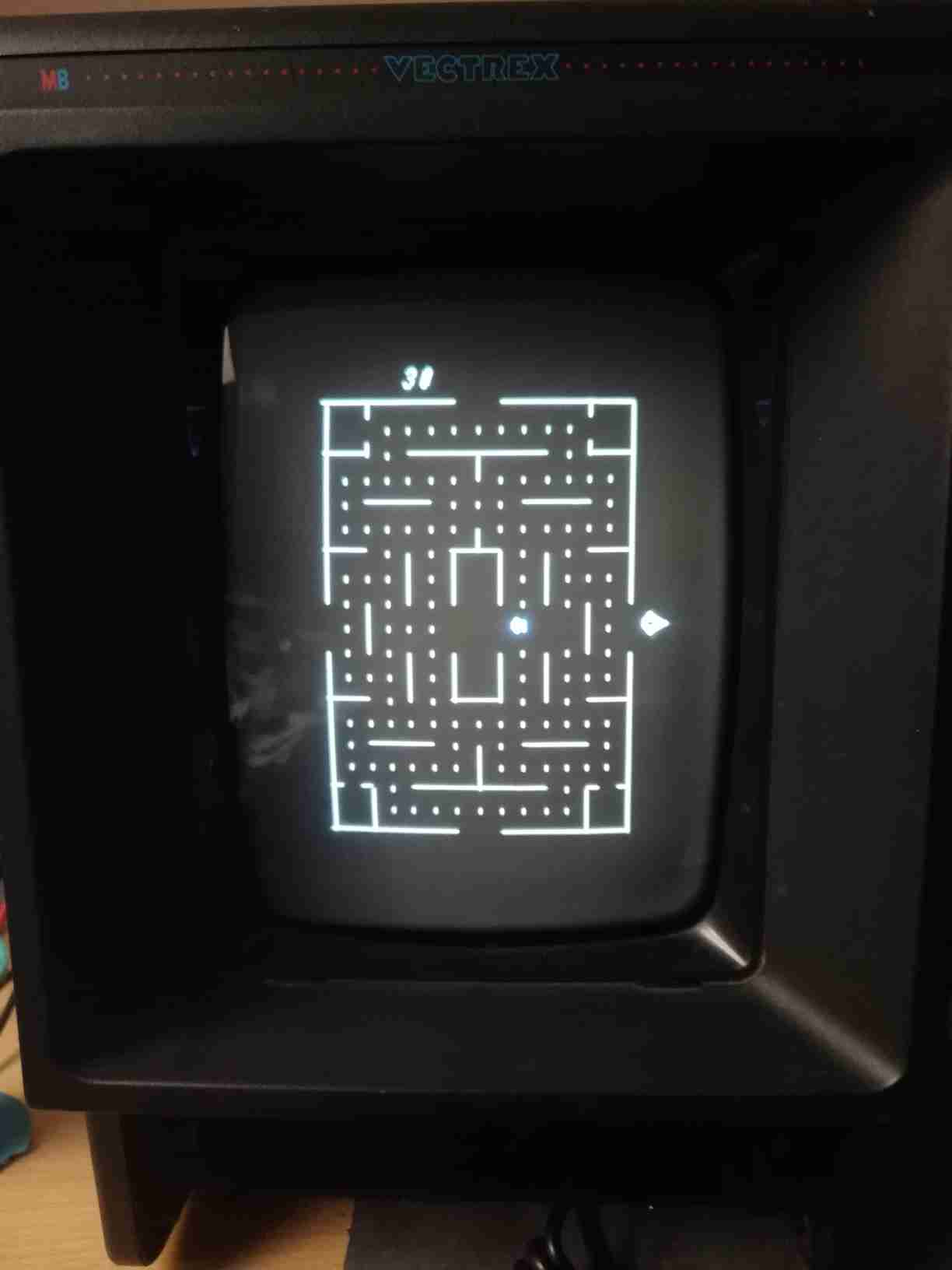
.jpg "APPLE")


.png)